The Construction Bottleneck: Australia Bets on Robots to Build More Solar
Australia is backing solar-construction robots with up to A$32.3 million. Field trials show where the machines could speed up construction, and where the work still gets stuck.
Published October 18, 2026Analysis / Energy / Next-Gen Renewables
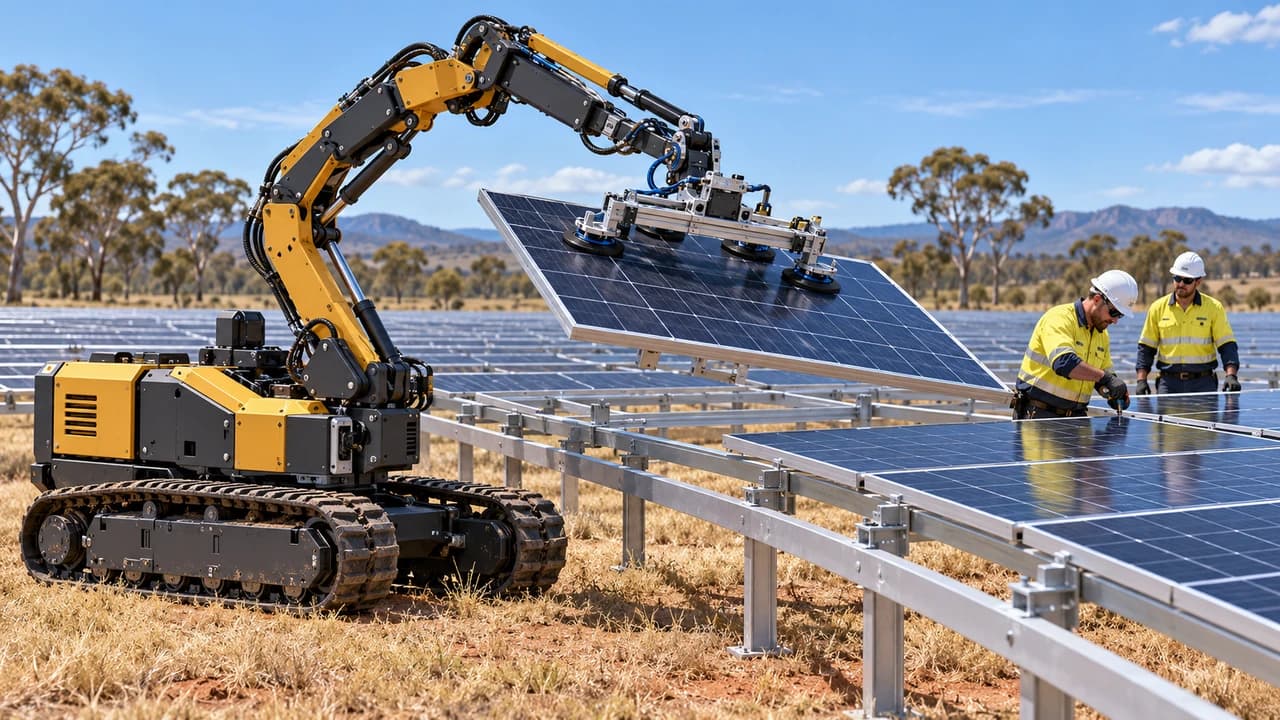
A solar farm takes shape one foundation and one panel at a time. Across a large project, those repetitive jobs become a formidable construction challenge. The next advance in solar economics could come from changing how that work gets done.
On October 13, the Australian Renewable Energy Agency announced up to A$32.3 million for two manufacturing projects: Luminous Robotics’ panel-installation machines in Melbourne and Built Robotics’ autonomous piling equipment in Brisbane. The planned output includes around 100 LUMI robots manufactured and deployed by 2029, plus 12 robotic piling systems. These are funded scale-up plans; the new fleets have yet to be delivered. ARENA announcement
The case for paying attention is unusually tangible. Both technologies have already worked on Australian construction sites. Their earlier trial reports also expose the less glamorous engineering that will determine whether larger fleets deliver meaningful savings. The performance figures come from project participants, with limits to the comparisons they establish.
Two jobs, two kinds of robot
LUMI lifts solar modules and places them onto their supporting structures. Workers complete the securing process. Automating that repeated lift could change how much a crew can install while reducing the burden of handling panels throughout a shift. That division of work was explicit in ARENA’s original description of the technology. LUMI’s initial deployment announcement
For the 2025 pilot, major kits were assembled by Luminous in the United States and shipped to Australia. The first two Australian pilot robots were then assembled, tested and fine-tuned at Röhlig’s Melbourne warehouse. Luminous pilot report, page 5 · Röhlig’s account, September 23, 2025
Plans for the Melbourne factory include progressively increasing Australian manufacturing and supply-chain participation while supporting deployment of the LUMI fleet. LUMI manufacturing project
Built Robotics addresses an earlier construction stage: installing the steel foundations. Its Australian project will assemble autonomy kits that turn standard excavators into robotic piling machines. ARENA estimates a typical single-axis-tracker solar farm needs around 300 piles per megawatt. At that scale, modest improvements repeated across a site can matter. Built Robotics project description
The technologies therefore act on different parts of the same construction chain. The practical question is how well they fit the crews, material deliveries and ground conditions surrounding them.
What the field evidence actually shows
Fortescue tested Built’s equipment at its Cloudbreak Solar Farm in Western Australia from August to October 2025. Its report, published February 27, 2026, found approximately 67% lower staffing requirements per piling rig compared with conventional methods. It attributed the productivity gains chiefly to simplified logistics and reduced labor. Fortescue trial report, pages 9–11
The limitations are equally important. Hard ground prevented direct driving, so every pile hole needed pre-drilling and cement-stabilized fill. Problems with fill hardening and cracking caused rework. Continuous operation above 40°C remained unproven, and the small trial could not establish a direct cost comparison. Those findings define the conditions under which its encouraging results should be read. Trial conditions and conclusions, pages 8–11
Luminous’ earlier Goorambat East pilot offers a complementary lesson. Its report, marked November 6, 2025, lists a nominal installation rate of 133 modules an hour and an actual rate of 73 in its shift breakdown. The nominal figure excludes interruptions. During the later weeks, robots sometimes stopped placing panels an hour early so workers could finish bolting, torquing and marking them. Luminous pilot report, pages 6–9
Those numbers make the central challenge visible: the robot’s peak movement rate and the crew’s finished output are different measurements. Improving one does not automatically improve the other by the same amount.
The construction process becomes part of the machine
The Luminous pilot also changed how panels reached the robot. Having a skid-steer loader bring pallets alongside the machine reduced travel, but required additional equipment and operators. Placement speed depended on the surrounding workflow. The company documented both the benefit and the added complexity. Luminous pilot report, pages 21–22
That suggests a useful way to judge construction robotics: follow the complete job from materials arriving to an inspected installation. Count supporting labor, stoppages and rework alongside the automated motion. The economic prize is more finished work for the resources consumed.
The new piling project addresses some of these practical limits directly. It includes development and piloting of autonomous pre-drilling, plus work toward night operation. Its forecast of up to 50% lower foundation costs over five years remains a target. Foundation savings would also apply to only part of a solar farm’s total cost. Built Robotics project scope and targets
On October 15, ARENA also announced up to A$250 million for a new Solar Sunshot funding round, open to Australian and international companies establishing or expanding solar manufacturing in Australia. It includes robotics, trackers, racking and prefabrication, with applications scheduled to open November 2. Solar Sunshot Round 3
What to watch next
The decisive evidence will be delivered machines, repeated full-shift performance and comparable installed costs. Reports should show how much support each robot requires, which conditions stop work, and whether task-level gains bring forward a project’s completion.
Australia’s investment gives construction robotics a concrete path toward wider use. The earlier trials give it something just as valuable: a clear account of where the work still gets stuck. Solving those problems could make robot-assisted construction an increasingly ordinary part of building the energy system.
Sources · 11
- https://arena.gov.au/news/australian-made-solar-robots-move-towards-commercial-scale-with-32-3-million-in-arena-funding/
- https://arena.gov.au/assets/2025/07/ARENA-Media-Release_Luminous_02072025_FINAL.pdf
- https://arena.gov.au/assets/2025/12/Luminous-Knowledge-Share-Public-Report.pdf#page=5
- https://www.rohlig.com/about-us/news-press/detail/roehlig-australia-delivers-the-future-supporting-the-birth-of-solar-robots/
- https://arena.gov.au/projects/scaling-sovereign-production-of-the-lumi-fleet/
- https://arena.gov.au/projects/built-robotics-solar-piling-robot-manufacturing-scale-up/
- https://arena.gov.au/assets/2026/03/Fortescue-Pilbara-Solar-Innovation-Hub-Built-Robotics-Trial-Report.pdf#page=9
- https://arena.gov.au/assets/2026/03/Fortescue-Pilbara-Solar-Innovation-Hub-Built-Robotics-Trial-Report.pdf#page=8
- https://arena.gov.au/assets/2025/12/Luminous-Knowledge-Share-Public-Report.pdf#page=6
- https://arena.gov.au/assets/2025/12/Luminous-Knowledge-Share-Public-Report.pdf#page=21
- https://arena.gov.au/news/arena-seeks-local-and-global-solar-innovators-for-250-million-solar-manufacturing-round/