Before California Builds More Grid, It Wants to Know What Can Wait
A new planning requirement puts home batteries and flexible electricity demand into the infrastructure equation. The savings depend on timing, location and dependable participation.
Published October 31, 2026Analysis / Energy / Grid Technology
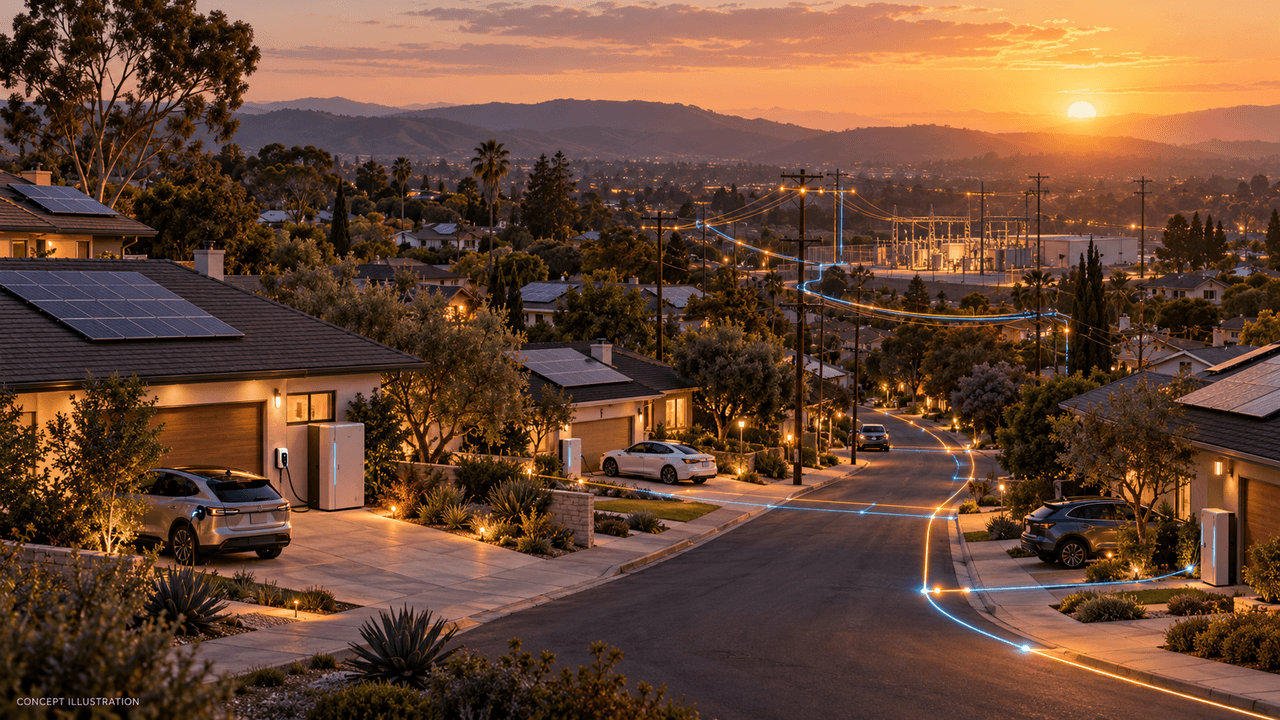
A neighborhood can run short of electrical capacity even when the wider power system has enough energy. The problem may be a particular transformer or distribution line carrying too much power during a busy evening. One response is to enlarge it. Another is to change when some of the demand arrives.
California is giving that second option a more formal place in grid planning. On October 29, the California Public Utilities Commission directed the state’s three large investor-owned utilities to develop a common framework for coordinating customer resources such as batteries, electric vehicles and flexible building systems. The announcement also calls for demand-flexibility scenarios in the 2028–2029 distribution planning cycle. [1]
The engineering idea is straightforward. A parked electric car may need enough charge by morning while offering considerable choice about when it receives that energy. A home battery may be able to supply part of a household’s evening demand. Coordinating those choices could reduce the highest load on a constrained local circuit. The usefulness of that flexibility depends on which circuit the resources serve and whether they are available at the hours that cause the problem.
Consider a deliberately simplified example. Twenty cars each charging at 7 kilowatts add 140 kilowatts to a neighborhood’s load. If their charging can be moved out of a two-hour peak, that removes 140 kilowatts during those hours and shifts 280 kilowatt-hours elsewhere. The drivers still need the energy. A successful schedule must find room for it later without creating another overload. These figures illustrate the arithmetic; they describe no measured California neighborhood.
Batteries introduce a second constraint. Power describes how quickly a battery can supply energy; stored energy determines how long it can continue. A system delivering 50 kilowatts for two hours needs at least 100 kilowatt-hours of usable energy before losses and operating reserves. A brief demand spike and an all-evening shortfall can therefore require very different solutions.
The CPUC’s published proposal, linked from its announcement as the approved proposal, requires evaluation of measurable benefits against the full additional costs of providing each service. It also separates an investment avoided altogether from one merely postponed. That is a central economic question: delaying construction can have value, but claiming the entire construction cost as a permanent saving would overstate the result. [2]
Paying participants, connecting devices, securing communications and maintaining dependable control all belong in the comparison. So does the fallback when batteries are depleted or drivers need their vehicles sooner. A grid planner needs evidence that the flexibility will still be available during the difficult hours used to size equipment.
The framework is also supposed to address interoperability, customer protections and participation by service providers. Utility implementation proposals will receive subsequent assessment. California has started a planning and rule-making process, with deployment and savings still to be established. [1]
The strongest outcome would be selective: build where new infrastructure is necessary, and use dependable flexibility where it can deliver the same service at lower overall cost. The test is a specific local upgrade, a credible alternative and a complete bill for both.
Sources
1. CPUC announcement, October 29
2. Proposal linked by CPUC, cost-effectiveness discussion, printed pages 35–36