Bedrock’s autonomous excavators face the test of a dependable shift
A $600 million financing round is intended to put more autonomous machines on construction sites. The case for wider adoption depends on completed earthwork, the people needed to support it and what happens when work stops.
Published October 28, 2026Analysis / Robotics / Autonomous Systems
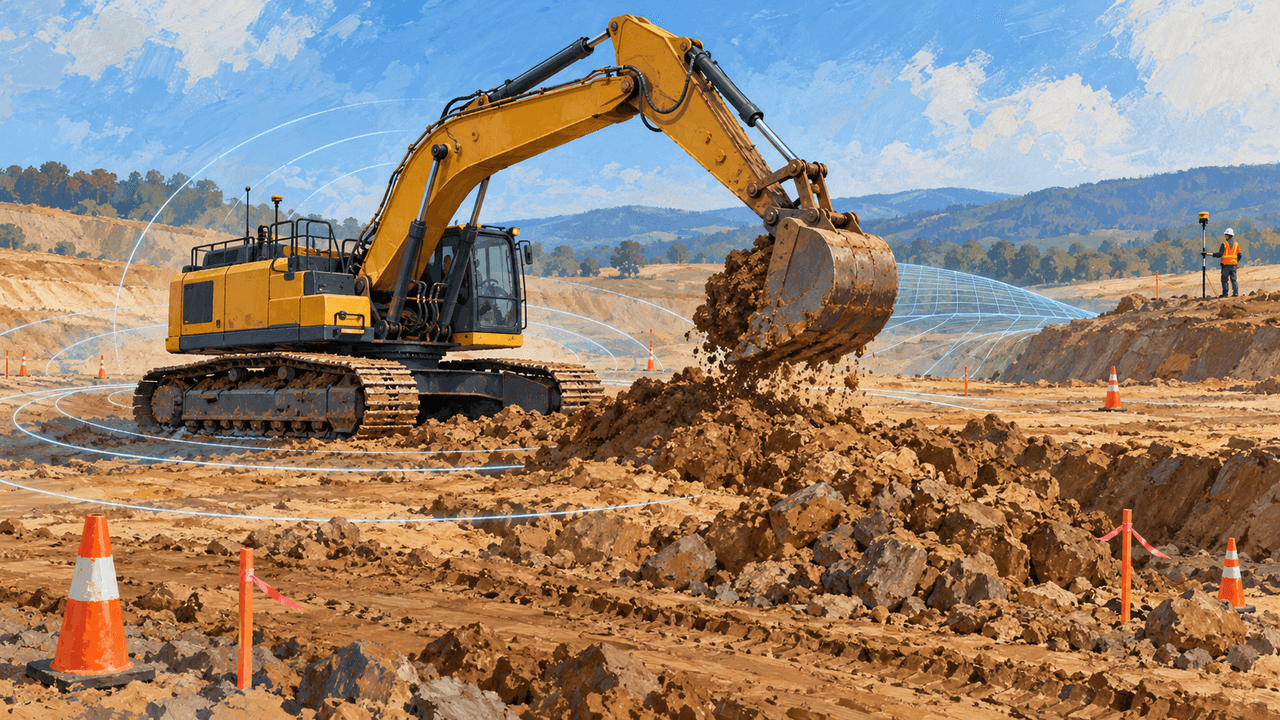
An excavator earns its place on a construction schedule by leaving work the next crew can use: soil removed, a trench at the required depth, a finished surface within specification. For a job that includes loading trucks, faster digging can yield little benefit if the trucks arrive late or the work area is blocked. Contractors adopting autonomy therefore need to assess an entire shift, including the people and equipment around the machine, even when the most visible change is an empty cab.
Bedrock Robotics announced a $600 million Series C financing on October 26, at a $4.1 billion valuation after the investment, with CapitalG and Emergence Capital leading the round. It also announced a wider customer footprint, including a Haydon deployment in Texas. The investment provides resources to put more autonomous excavators to work. It does not establish how much additional work each machine delivers over a full shift. 1
Bedrock’s August 17 announcement named deployments with Sundt Construction, Champion Site Prep and Zachry Construction. Its October release described August’s milestone as paid work. These are company-reported commercial deployments. Neither release nor Bessemer Venture Partners’ accompanying investor account supplies an independently measured comparison of complete shifts, including output, interruptions and supporting labor. 2
What a retrofit changes
Bedrock adds sensors and computing to existing equipment. It says installation can be completed within a day without permanent alteration. A site manager supplies the initial plan. The system uses its sensors to track the surroundings, selects movements toward the assigned result and controls the machine, taking over decisions an operator would otherwise make. 2
The attraction is understandable. Replacing an entire fleet would tie a decision about software and autonomy to a much larger equipment purchase. A retrofit can separate those decisions. Yet installation time is only the opening cost. Contractors also need to account for checking the newly equipped machine on site, worker training, changes to procedures and support when equipment or software behaves unexpectedly. The public financing announcement does not give the pricing or staffing detail needed to calculate those costs.
Bessemer describes watching two Caterpillar 352 excavators work without anyone in the cab near Austin, including loading a truck driven by a person. The account describes an observed operation, and Bessemer’s participation in the financing gives it a financial interest in the outcome. It provides no systematic measurements of output and time across a complete shift. 3
That human-driven truck also illustrates the coordination problem. If the next truck arrives late, an autonomous excavator may have nothing useful to load. If loading becomes faster, the constraint can move to hauling or unloading. Adding automated digging capacity without matching the rest of the operation could simply move the queue. The contractor’s gain depends on the arrangement of equipment and people around the machine.
Excavation research helps explain the decisions hidden inside a familiar movement. A target depth does not tell a machine where to stand or which part of the soil to remove next. In a 2023 paper, Lorenzo Terenzi and Marco Hutter describe a system that maps the site, chooses positions for the excavator, decides where soil should move locally and selects paths for the bucket. Each scoop changes the ground on which subsequent decisions depend. This is a separate research system, not an assessment of Bedrock. It illustrates the planning required to turn a desired hole into repeated machine movements. 4
For commercial work, those decisions also have to remain aligned with the contractor’s changing plan. A route for haul trucks may move. Another trade may need access. The intended final surface may be revised. The crucial question is how much human effort is required to translate each change into work the autonomous machine can resume confidently.
The people and pauses behind production
An empty cab does not describe the total labor required. A contractor needs to know who prepares the task, supervises progress, investigates stops and authorizes a restart. A remote specialist, an onsite technician and a foreman all consume time even when none is holding the excavator’s controls. The reviewed announcements do not disclose how many machines each support worker can routinely handle, or the frequency and duration of human interventions.
Support staffing can change the economics. One specialist supporting several machines may allow a contractor to expand output with a scarce pool of experienced people. Frequent interventions that demand immediate attention can limit that arrangement, particularly if several machines stop together. That is a scenario to evaluate, not a reported description of Bedrock’s current deployments.
Bedrock says its machines stop when a person or unauthorized object gets too close. Such a pause may show a safety measure working. Its cause and recovery deserve examination. An automatic stop alone, however, cannot establish an injury reduction or prove safety across every operating condition. 2
Maintenance remains physical work. Caterpillar’s excavator guidance calls for an inspection before each shift and attention to tracks, filters, cooling equipment and attachments. It identifies damage and wear that can affect performance and safety. Automation does not remove those obligations; it changes who must notice a developing problem and arrange the response. These are general equipment requirements, not evidence of maintenance shortcomings in Bedrock’s system. 5
A full accounting should include scheduled servicing, ordinary machine faults and problems specific to the autonomy equipment. Combining them into one downtime figure would conceal what needs improvement. Excluding them all would exaggerate the amount of productive capacity a contractor can actually schedule.
What a dependable shift would show
The strongest evidence would connect time records to accepted work. How much material reached its destination? Was the excavation within the specified grade, the required height or depth of the finished ground? How much rework followed? What fraction of the scheduled shift went to excavation, waiting, service or intervention? Those measures describe a job completed, rather than an isolated machine movement.
Comparisons also need similar conditions. Soil, rock, hauling distance, machine size and the required finish affect the work. A fast autonomous shift removing large volumes of soil from an open area cannot establish an advantage over a human operator working around buried services or producing a more demanding finish. Reporting the conditions and the range of outcomes would be more informative than a single best result.
Bedrock’s expansion increases the opportunity to collect that evidence. The financing can pay for field support, spare equipment and the work of adapting deployments to more contractors. It cannot substitute for the operating record those investments are meant to produce.
For builders, the eventual promise is practical: more work that can be scheduled with confidence and supported by the people available. The next proof point is a repeatable record showing what happened from the start of a shift to the accepted earthwork at its end, including the stops and the human effort in between.
Sources
Sources · 5
- https://www.globenewswire.com/news-release/2026/10/26/3388197/0/en/bedrock-robotics-raises-600-million-series-c-to-scale-autonomous-construction-equipment-across-u-s-sites.html
- https://www.globenewswire.com/news-release/2026/08/17/3346247/0/en/bedrock-robotics-launches-first-fully-autonomous-excavator-deployments-on-critical-u-s-infrastructure-projects.html
- https://www.bvp.com/news/bedrock-robotics-deploying-autonomous-equipment-for-the-built-world
- https://arxiv.org/abs/2308.11478
- https://www.cat.com/en_US/articles/ci-articles/your-six-step-excavator-maintenance-checklist.html