ANYmal X Brings Robot Inspection Into Hazardous Areas With Specific Limits
Zurich-based Swiss robot developer ANYbotics says customer deliveries have begun. The engineering challenge is keeping a moving machine from becoming an ignition source while making its observations useful to maintenance teams.
Published October 29, 2026Analysis / Robotics / Autonomous Systems
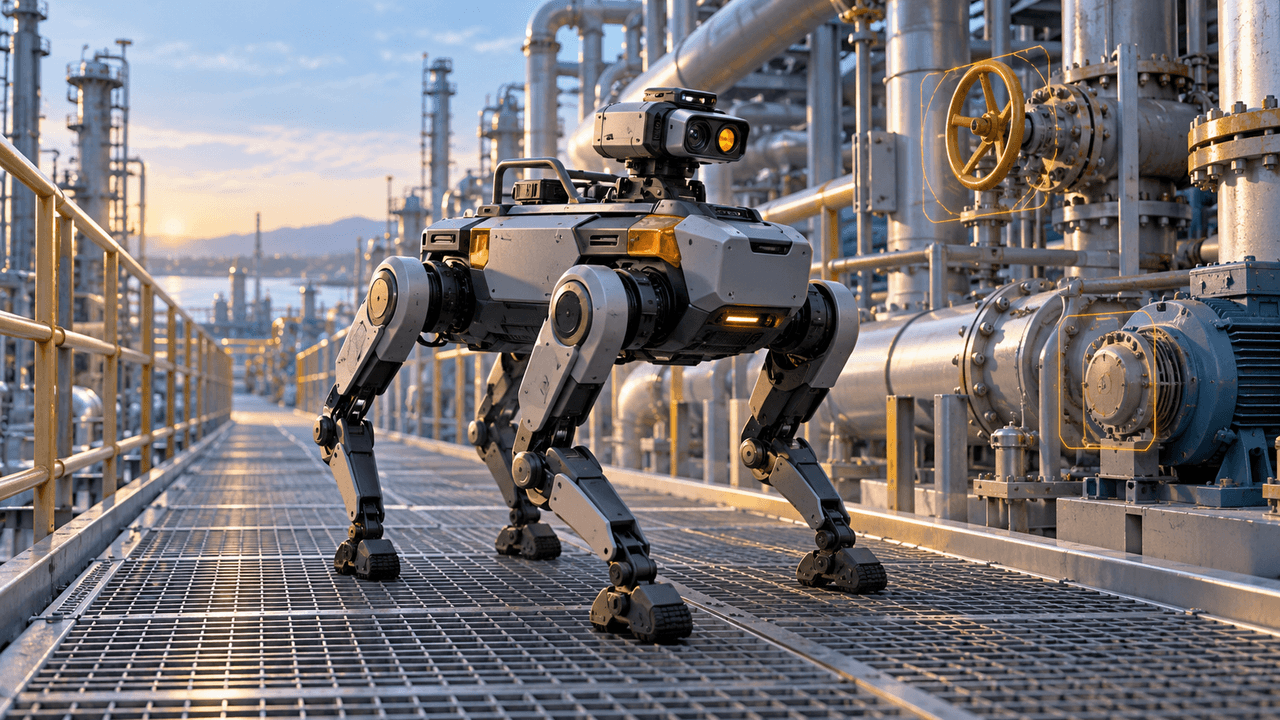
A pump can develop a fault long before a plant has reason to stop it. Its temperature may rise, its sound may change or a seal may begin to leak. Someone has to collect those clues, compare them with earlier readings and decide what action is justified. In an area where flammable gas may be present, the instrument brought in to investigate must not create another hazard.
ANYbotics said on October 27 that it had begun shipping ANYmal X to customers including Equinor and DSM-Firmenich. The four-legged inspection robot is intended for hazardous process areas in the international oil, gas and chemical industries. The announcement does not identify the receiving facilities. The deployment question is how reliably the robot can complete eligible inspection routes within a plant’s operating procedures. 1
That requires two kinds of engineering to work together. Explosion protection addresses potential ignition sources. Inspection engineering addresses whether the machine collects the right evidence from the right equipment. A robot can satisfy a defined protection requirement while producing a reading that still needs interpretation. Conversely, an excellent sensor does not make an ordinary mobile machine suitable for an explosive atmosphere.
What the approval covers
ANYbotics says Bureau Veritas, an independent testing, inspection and certification company headquartered in France, issued an ATEX EU-type examination certificate assessing the robot’s design. Bureau Veritas is the assessor; ANYbotics develops the robot for industrial operators. 4 5 The stated scope covers gas Zones 1 and 2, group IIB and temperature class T4. The manufacturer’s FAQ says IECEx, an international equipment-certification scheme, still awaits a production-line audit. Examining a design and checking how production units are manufactured are separate steps. 2
ATEX is the European Union’s framework for controlling explosive-atmosphere risks. Zone 1 describes places where an explosive gas mixture may occur occasionally during normal operation. In Zone 2, it is unlikely during normal operation and, if it occurs, lasts only briefly. 6 The gas group and temperature class further limit the gases and equipment surface temperatures covered. Operators must match the complete markings to their site’s hazards and applicable national requirements; the certificate is not permission to use the robot in every country or hazardous environment. 3
ANYbotics excludes Zone 0, explosive dust atmospheres and IIC gases such as hydrogen and acetylene from the stated use. Charging and nitrogen refilling occur outside the hazardous area. These limits have immediate planning consequences: the useful inspection route must connect eligible areas with an appropriate support location. A facility cannot infer suitability for a hydrogen installation or a dust hazard from a general description of the robot as explosion protected. 2
Ignition prevention reaches beyond enclosing the main computer. A mobile robot contains electrical equipment, motors, joints, surfaces that heat up and parts that move against one another. The manufacturer describes flameproof, pressurized and intrinsically safe protection: containing an ignition, keeping the hazardous atmosphere away from protected parts, or limiting energy in particular circuits. The applicable design and operating conditions determine how these protections work together. 2
This is why maintenance is part of the protection system’s practical value. A cover, connector or procedure that seems incidental to navigation may be relevant to the assessed configuration. Site teams need approved service arrangements and a way to identify changes that require review. The commercial promise depends on keeping the deployed equipment within its approved condition over time, not simply receiving a conforming machine on delivery day.
Turning a route into a useful record
The launch describes visual, thermal and acoustic inspection, with results associated with particular plant assets. A visual observation can show an instrument reading or a changed surface. Thermal sensing identifies temperature patterns; acoustic sensing can reveal sounds associated with equipment condition. An optional gas module adds another type of observation. 2 These measurements can support maintenance decisions, but they do not all measure the same physical property. 1
A repeatable route can improve comparison. If a machine returns to a similar position and observes the same component under comparable conditions, a change becomes easier to investigate. Yet operating context still matters. A pump running at a different load may sound different without having developed a fault. A reading made during startup cannot automatically be compared with one made during steady operation. The record needs enough context to distinguish equipment change from a change in the circumstances of measurement.
There is also a difference between collecting an anomaly and managing it. An alert needs to identify the asset, the evidence and its urgency. Someone must decide whether to inspect again, adjust operation or schedule repair. Sending every unusual reading straight into a work queue could burden the people the robot is meant to help. Suppressing too many could hide a developing problem. The useful balance depends on the consequences of missed findings and unnecessary interventions.
Plant geometry creates another set of conditions. A route that works during commissioning may later contain scaffolding, temporary hoses or a closed passage. A maintenance team needs a procedure for unfinished rounds and inaccessible assets, as well as a record of completed inspections. Otherwise a dashboard can present an orderly history while an important component quietly falls outside the routine.
Support must be included in the operating account. Preparing routes, reviewing findings, maintaining the machine and recovering from a stopped mission all require time. The question is whether those tasks allow fewer routine hazardous entries while preserving the quality and timeliness of inspection. An empty walkway during a demonstration cannot answer that question across months of changing plant conditions.
The evidence for sustained operation
ANYmal X’s development included a 2023 trial at Equinor’s K-Lab within the Kårstø gas-processing plant in Norway. 7 That history does not establish where the new deliveries will operate, and ANYbotics’ broader fleet figures can combine models and tasks with different demands. An operator assessing X needs results for sites resembling its own, including incomplete routes, support effort and alerts that did not correspond to faults.
The benefit could be substantial where routine observation currently requires people to enter eligible hazardous areas repeatedly. Robots can make those observations easier to schedule and preserve. The gain becomes concrete when maintenance teams can show which entries were avoided, which developing faults were identified and how much intervention the robot itself required. Those are operating outcomes; certification answers the narrower question of assessed protection within a defined scope.
ANYmal X’s reported deliveries bring that operating account closer to ordinary industrial practice. Its usefulness will be measured at the handoff from observation to action: an appropriately protected machine reaches the asset, collects interpretable evidence and leaves the maintenance team with a decision it can trust.
Sources
Sources · 7
- https://www.anybotics.com/news/anymal-x-launch/
- https://group.bureauveritas.com/legal-notice
- https://group.bureauveritas.com/group
- https://www.anybotics.com/robotics/anymal-x/
- https://www.hse.gov.uk/fireandexplosion/assets/docs/zoning.pdf
- https://www.hse.gov.uk/fireandexplosion/atex.htm
- https://www.anybotics.com/news/anymal-x-completes-five-week-test-program-at-equinor-lab/