The AI race is spreading beyond the chip
Getting useful computing capacity online is becoming a competitive advantage of its own. The choices companies make to secure it are drawing them deeper into software, construction, manufacturing and power.
Published October 25, 2026Analysis / Artificial Intelligence / Generative Models
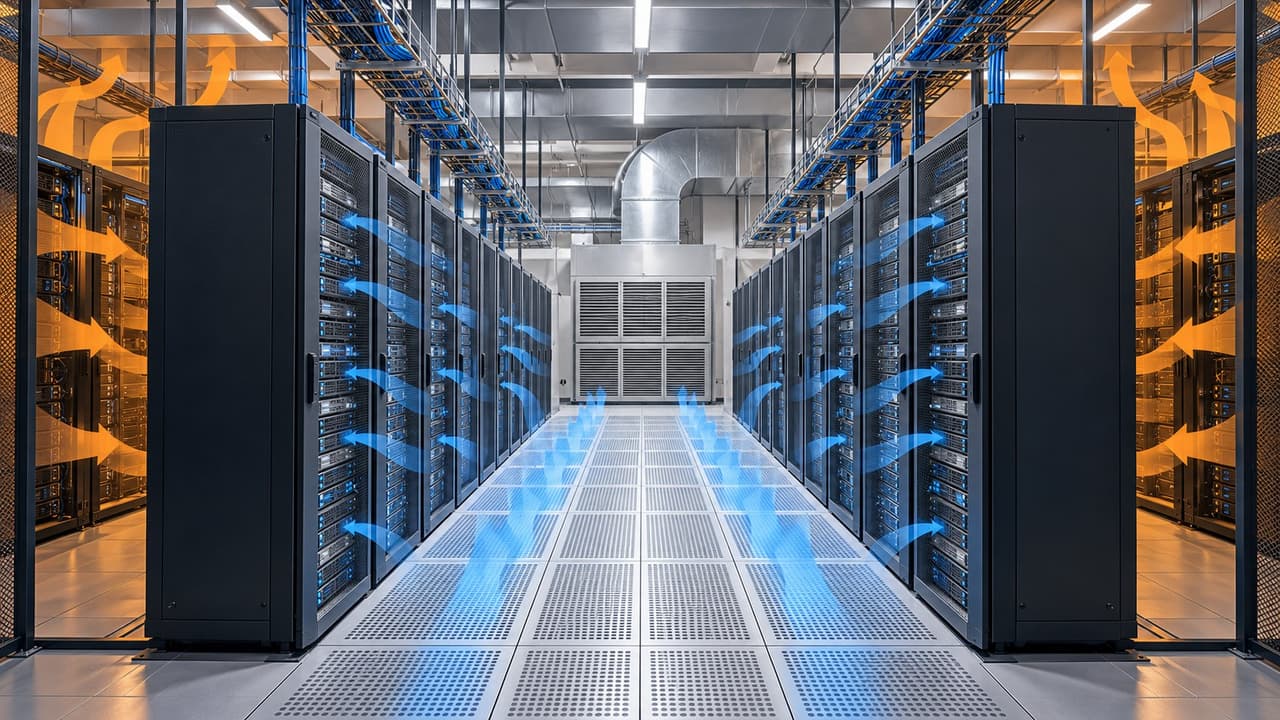
d-Matrix’s announcement of a new AI inference system this month carried a promise with particular appeal to data-center operators: it could go into buildings they already had. The air-cooled equipment would spare suitable facilities a liquid-cooling retrofit, the company said. d-Matrix announcement, October 12, 2026
Nine days later, NVIDIA offered another answer to the same problem. Its partners would assemble computing systems and their supporting infrastructure in factories, then deliver them in modular containers to prepared sites. Work that could delay an installation would happen before the equipment arrived. NVIDIA announcement, October 21
The two approaches point toward a broader contest in AI. Access to powerful chips remains essential. Increasingly, a supplier’s advantage can also come from getting those chips into service sooner and keeping them busy once they arrive. Electricity, buildings, software and construction schedules are becoming part of what computing companies must compete over.
That opens a path for newcomers whose machines fit infrastructure already available. It gives established suppliers a reason to take responsibility for more of the installation. And it encourages large buyers to reach further into their supply chains, sometimes as far as turbine components or spacecraft, to gain control over when computing capacity becomes usable.
An opening in buildings already standing
The appeal of air-cooled inference starts with a practical mismatch. A building may have power and room for servers while lacking the plumbing and heat-removal capacity for a particularly dense installation. Equipment that can deliver a useful service within those limits makes the building more valuable.
Inference, the work of running a trained model, offers room to make that trade. An operator serving a predictable set of requests can choose hardware around the job. A smaller or more specialized machine may provide enough speed without demanding the infrastructure required by a larger general-purpose system.
Positron’s Atlas is one example moving through that opening. The company said in September that more than 50 racks were being deployed at Oracle Cloud Infrastructure, with Parasail using the capacity to provide inference. The significance extends beyond the processors: a service provider can qualify the hardware and find suitable work for it, allowing customers to buy the service without operating a new kind of machine themselves. Positron release
d-Matrix has demonstrated another route into existing installations, dividing work between its Corsair accelerators and NVIDIA GPUs. That gives a specialist a chance to improve part of a service while working alongside equipment the customer already owns. It also makes integration part of the product: the combined system has to justify its extra hardware and communication costs. d-Matrix technical account
The opportunity has limits that matter commercially. Models grow, customers ask longer questions, and demand rises and falls. Hardware that performs especially well when a model fits its fastest memory can lose some advantage when the job changes. Switching platforms also requires teams to check answer quality, adapt software and learn how to operate the new fleet.
Those costs help explain why inference will reward more than a favorable chip benchmark. The buyer needs a dependable service at the required response time, with enough demand to keep the equipment occupied. A specialist can win that business when its savings survive the work of adoption. A flexible GPU fleet can remain valuable when tomorrow’s workload is less predictable.
Training creates a different buying problem. A long, coordinated training run places a premium on keeping a large group of processors working together. Interactive services must also make economical use of capacity between incoming requests. The same company may therefore have good reasons to buy different systems for developing a model and serving its users. Gimlet Labs’ explanation of inference workloads
A shorter wait becomes part of the product
For these hardware choices to pay off, the facility must be ready. A server’s electricity demand, the power used to cool it and the connection that supplies the building are related requirements with different schedules.
Federal regulators’ June action on large electricity users addressed connection studies, nearby generation and the allocation of grid costs. Equipment suppliers face pressure of their own: GE Vernova’s July update described a growing gas-power order backlog and reserved production slots, alongside plans to expand output. Securing electricity can itself become a substantial industrial project. FERC announcement, GE Vernova update
Where that is the constraint, the owner of an energized site or access to a credible delivery schedule has something valuable to offer. Buyers may accept different hardware, another location or a managed service to begin work sooner. They must weigh that earlier start against longer commitments and the risk that demand changes before the new capacity is needed.
This is also where the incumbent’s response becomes important. NVIDIA’s Dynamo software coordinates inference across machines, routes requests and reuses stored context. Improving how an existing fleet works can reduce the amount of new hardware a customer needs, while preserving familiar tools and operating practices. NVIDIA Dynamo
Factory integration addresses another source of delay. NVIDIA’s proposed DSX POD systems would bring computing, networking, power distribution and liquid cooling together before shipment. Deliveries are targeted for early 2027, and the installation claim assumes a site with power, cooling and supporting infrastructure already prepared. DSX POD announcement
That condition explains how the approaches can compete and coexist. An air-cooled system may help a customer avoid a building upgrade. A factory-integrated system may make a dense installation easier once the site is ready. Better software may let the customer postpone either purchase by getting more from the machines already installed.
Liquid cooling can also improve energy efficiency, particularly at high density. Air-cooled servers still need the building to collect their heat and reject it outdoors, sometimes through equipment using chilled water. The choice turns on the whole facility and the work it must support. Department of Energy design guide
The result is a broader competitive test for specialists. Their opening can shrink as GPU software improves, factory assembly becomes more effective or new power capacity arrives. It can widen where existing buildings remain the quickest practical route to customers.
Buyers reach further into the supply chain
With suppliers competing to remove different delays, large buyers have a reason to keep more than one route open. Some can develop their own alternative while continuing to buy established platforms.
Google is doing both. It introduced separate TPU designs aimed at training and inference in April, adapting its own computing architecture to different jobs. In October, it also announced further work with NVIDIA on a new generation of cloud systems. Its custom processors and purchased GPUs remain part of the same business. Google TPU designs, Google–NVIDIA collaboration
The attraction of that combination is choice. A company with enough predictable work can spread the cost of developing and operating custom hardware across a large service. Keeping a GPU offering lets it serve other workloads and customers. A qualified alternative can also give a buyer more room to negotiate over supply and schedules.
The control comes with obligations. The builder takes on development, software and capacity-planning risks. A smaller customer may prefer to pay a provider to manage those problems. Even for a hyperscaler, purchasing an established platform can be the sensible way to preserve flexibility.
SpaceX’s turbine-component effort carries this choice into manufacturing. Company job descriptions identify a new line in Bastrop, Texas, for industrial gas-turbine blades and vanes, with installation, commissioning and process-development work. In an August post reproduced by Techmeme, Elon Musk said internal casting could bring turbines online up to 18 months sooner. That is a forecast attached to a component-manufacturing effort, whose qualified output remains to be demonstrated. SpaceX manufacturing role, casting role, record of Musk’s statement
The apparent logic is to gain influence over a manufacturing step that can hold up the larger project. Bringing it inside the company could reduce dependence on an outside queue. It would also make SpaceX responsible for achieving reliable quality and production rates. A difficult factory ramp could replace one delay with another.
The company’s computing business already has experience with power-project dependencies. SpaceX acquired xAI in February. At Southaven, Mississippi, regulator records for MZX Tech describe temporary turbines, delays in stationary equipment and a planned transition to a permanent installation serving advanced computing facilities. Those operating plants are separate from the Bastrop component line. Acquisition notice, MDEQ record, agreed order
The episode shows how electricity can draw a computing company into fuel supply, maintenance, construction and emissions-control obligations. Reaching upstream may protect a schedule, but it concentrates more of the industrial risk on the operator. If outside supply expands or computing demand changes, capabilities built to overcome a shortage can become expensive commitments.
The search for control reaches orbit
Orbital computing takes the ambition further. A satellite carrying its own solar generation would obtain power outside the terrestrial grid. The computer would also have to carry much of the infrastructure that a server on Earth shares with a building.
Google and SpaceX are approaching that possibility differently. Google’s Project Suncatcher is a staged research program. On October 1, it reported the launch of a prototype built with Planet, followed by confirmed contact and initial operation. A planned paired mission would test computers working together through high-bandwidth links. These steps allow the company to learn about the design before making a larger production commitment. Google flight update, Planet mission plan
SpaceX’s published Starmind plans reach across a larger industrial system: computing satellites, a proposed factory, launch capacity and links through Starlink. The company identifies Starship’s reusable design and payload capacity as important to the effort. Coordinating those capabilities could offer an advantage, while a delay in any one could hold back the rest. SpaceX Starmind design
The physical requirements make that coordination essential. There is no external airflow in a vacuum to carry heat away. Internal systems must move heat to radiators, which release it through radiation. Solar arrays, storage and heat rejection must support the intended computing schedule. An efficient processor helps by reducing those burdens for a given amount of useful work. NASA thermal-control guidance, NASA power guidance
Useful service also requires dependable communications, protection and recovery from radiation-induced errors, and a way to replace aging equipment. A terrestrial operator can change a failed server during maintenance. An orbital operator must provide redundancy, servicing or another launch, while planning for collision avoidance and disposal. NASA reliability guidance, ESA space-environment report
The economics consequently depend on how much work the payload performs over its useful life. Falling launch costs help; so do sustained operation and equipment that remains useful long enough to recover its cost. A workload whose data already originates in orbit could have a different case from an Earth-facing service that must send requests and results through gateways.
Orbit must also compete with the data center that exists when the spacecraft is ready. During the development period, terrestrial inference can become more efficient, software can improve and new electricity can arrive. Those changes would raise the hurdle for an orbital service. Persistent constraints on Earth and successful, repeatable operation in space would strengthen its case.
That moving comparison runs through the entire industry. Specialists are trying to make more buildings useful. Incumbents are trying to make their platforms easier to deploy and operate. Large buyers are building alternatives and taking responsibility for selected parts of the supply chain.
The advantage will turn on which commitments produce dependable capacity at a cost customers can sustain. Owning more of the process can shorten a wait or create a new one. A machine that fits today’s building can win work now and lose its edge when the workload changes. The AI race is spreading beyond the chip because the companies paying for the machines need a path from purchased equipment to productive service.
Sources · 25
- https://www.d-matrix.ai/announcements/squadron-compute-clusters/
- https://nvidianews.nvidia.com/news/nvidia-introduces-dsx-pod-ai-factories-to-accelerate-europes-infrastructure-deployment
- https://www.prnewswire.com/news-releases/positron-ai-raises-875-million-at-a-5-billion-valuation-to-bring-its-next-generation-inference-silicon-to-market-302874601.html
- https://www.d-matrix.ai/accelerating-ai-inference-with-attention-ffn-disaggregation/
- https://gimletlabs.ai/blog/low-latency-spec-decode-corsair
- https://www.ferc.gov/news-events/news/ferc-launches-aggressive-targeted-action-speed-large-load-integration
- https://www.gevernova.com/news/articles/ge-vernova-releases-second-quarter-2026-financial-results
- https://developer.nvidia.com/dynamo
- https://nvidianews.nvidia.com/news/nvidia-introduces-dsx-pod-ai-factories-to-accelerate-europes-infrastructure-deployment
- https://www.energy.gov/sites/default/files/2024-07/best-practice-guide-data-center-design.pdf
- https://cloud.google.com/blog/products/compute/tpu-8t-and-tpu-8i-technical-deep-dive
- https://cloud.google.com/blog/topics/ai-infrastructure/google-cloud-infrastructure-at-nvidia-gtc-berlin-2026
- https://job-boards.greenhouse.io/spacex/jobs/8743358002
- https://job-boards.greenhouse.io/spacex/jobs/8770229002
- https://www.techmeme.com/260829/p14
- https://x.ai/news/xai-joins-spacex
- https://opc.deq.state.ms.us/ai_info.aspx?ai=12592
- https://earthjustice.org/wp-content/uploads/2026/07/agreedorder.pdf
- https://blog.google/innovation-and-ai/models-and-research/google-research/project-suncatcher-prototype/
- https://www.planet.com/pulse/planet-to-build-and-operate-advanced-space-platform-for-project-suncatcher-moonshot/
- https://www.spacex.com/spacexsi/starmind
- https://www.nasa.gov/smallsat-institute/sst-soa/thermal-control/
- https://www.nasa.gov/smallsat-institute/sst-soa/power-subsystems/
- https://nescacademy.nasa.gov/video/147d092767fa4ba389f2a4ec6214543a1d
- https://www.esa.int/Space_Safety/Space_Debris/ESA_Space_Environment_Report_2026