AI Helps Redesign a Cancer Cell Therapy Component. The Laboratory Still Decides What Works
Anthropic and Generate Biomedicines report a compact signaling component developed through repeated design and experiment. The result shows a promising way to organize research, well before evidence of patient benefit.
Published October 29, 2026Analysis / Frontier Tech / Synthetic Biology

A cancer treatment built from living cells has to do more than recognize its target. It must turn recognition into an appropriate response. Too little activity may leave the target untouched; activity in the wrong circumstances creates a different problem. Engineering that response means changing a biological system whose behavior cannot be settled by the plausibility of a proposed design.
Anthropic’s October 27 account of six drug-development partnerships includes a concrete attempt to shorten part of a chimeric antigen receptor (CAR), an engineered protein that redirects an immune cell toward a chosen target. Generate Biomedicines reports three rounds of design and experimental feedback, producing a much shorter intracellular domain, the portion inside the cell that helps transmit the activation signal. The work is a company report of preclinical research, conducted before testing in people, rather than a demonstrated benefit for patients. 1 2
The strongest question raised by this case is how artificial intelligence (AI) changes the work between a scientific objective and an informative experiment. Generating more candidate sequences is useful only if researchers can choose sensible tests, interpret their results and use the failures to improve the next round. The collaboration offers a view of that process, with scientists retaining responsibility for what enters the laboratory.
Recognition is only the beginning
CAR T-cell therapy modifies T cells, immune cells involved in attacking diseased cells. A receptor on the cell’s surface recognizes a selected marker, or antigen, on another cell. The engineered receptor connects that recognition to machinery inside the T cell. The National Cancer Institute describes approved CAR T-cell treatments for several blood cancers, while also explaining serious risks and the difficulties of extending the approach to solid tumors. Existing therapies provide the medical context; they do not establish that this new component works in people. 3
A receptor can be understood as a connection across the cell membrane. Its outside portion encounters the target; its inside portion helps recruit the cellular activity that follows. Changing the internal portion can therefore affect what the cell does after recognition, even when the target-recognizing part remains the same. A compact design must preserve useful communication across that connection, rather than merely remove genetic instructions.
Generate’s report identifies a 45-amino-acid intracellular domain, compared with 154 amino acids in its reference design. Amino acids are the units from which proteins are assembled. The reported shortening concerns that internal component, not the entire receptor or the whole therapy. The team reports improved receptor expression, meaning more receptors at the cell surface, and functional responses in experimental systems. These observations support further investigation of the component; they do not measure survival, symptom improvement or safety in patients. 2
Shortening can have value beyond making a smaller molecule. Biological engineering often has a limited allowance for the instructions delivered into a cell. Space used for one function cannot simultaneously hold another. Anthropic presents the project as a way to create room for additional instructions relevant to future cancer treatments. Whether that space can be used effectively is a subsequent design problem, requiring its own experiments. A compact signaling component does not supply the missing functions automatically. 1
Experiments change the next design
Scientists set objectives and reference sequences, reviewed designs, steered the agents and selected candidates. Agents searched literature and proposed sequences; measurements informed later rounds. Generate also reports that models shared wrong predictions and missed experimental gains. The process therefore used experiments to challenge the proposals, rather than treating agreement among models as confirmation. 2
An iterative process can be more informative than a large one-time collection of suggestions. Suppose an initial experiment shows that several shortened components remain active while others fail. Researchers can ask what changed between them, decide which explanation is plausible and select another experiment that separates competing explanations. The next batch then tests a more focused question. This is an explanatory example of the reasoning loop, not an additional reported result from Generate.
The quality of that loop depends on the measurements. More receptors at the cell surface and more effective target-cell killing answer related but different questions. A quantity that is easy to measure can become a poor substitute for the behavior the treatment ultimately needs. Researchers therefore need to examine whether a candidate improves one property at the expense of another, and whether its apparent advantage survives a different test setting.
Controls make those comparisons interpretable. If the candidate and reference receive different amounts of delivered instructions, an apparent design advantage could reflect the amount supplied. If experimental conditions change between rounds, a better result could have several explanations. The scientific task includes choosing comparable conditions and documenting the differences that remain. AI can help analyze that record, but it cannot repair an experiment whose crucial comparison was never made.
The value of human oversight is particularly visible when the objective itself needs revision. A system optimizing a single score may become very good at that score. Scientists must decide whether the score still captures the intended biology. Their contribution is not confined to approving a final sequence: it includes defining success, recognizing misleading measurements and choosing which uncertainty the next experiment should reduce.
A research gain must survive the rest of development
The Food and Drug Administration separates laboratory discovery and preclinical work from clinical research in people, regulatory review and subsequent safety monitoring. Each stage addresses questions the preceding one cannot finish. A candidate’s useful behavior in an experimental system is a reason to advance the investigation, not a shortcut around those stages. 4
For this collaboration, a broader productivity claim would require an account of the entire research effort. How many proposed designs were rejected? Which experiments changed the team’s interpretation? How much specialist review and laboratory capacity did the process consume? A successful candidate demonstrates that the route can yield something worth studying. It does not, on its own, show that the route is cheaper or faster than a comparable program using a different workflow.
There is nevertheless a practical opportunity. When software can maintain the connection between a proposed sequence, the reason it was proposed and the measurements that followed, later decisions become easier to inspect. Failed designs can become usable evidence rather than discarded output. The payoff would be a research process that learns more from each experimental round and leaves other scientists enough information to challenge its conclusions.
Generate’s compact component gives that promise a tangible form. Its importance will grow if the biological result survives further testing and the method can be reproduced beyond the original collaboration. The laboratory has supplied an early answer about one engineered component. Turning that answer into a medicine remains a much larger scientific and clinical undertaking.
Sources
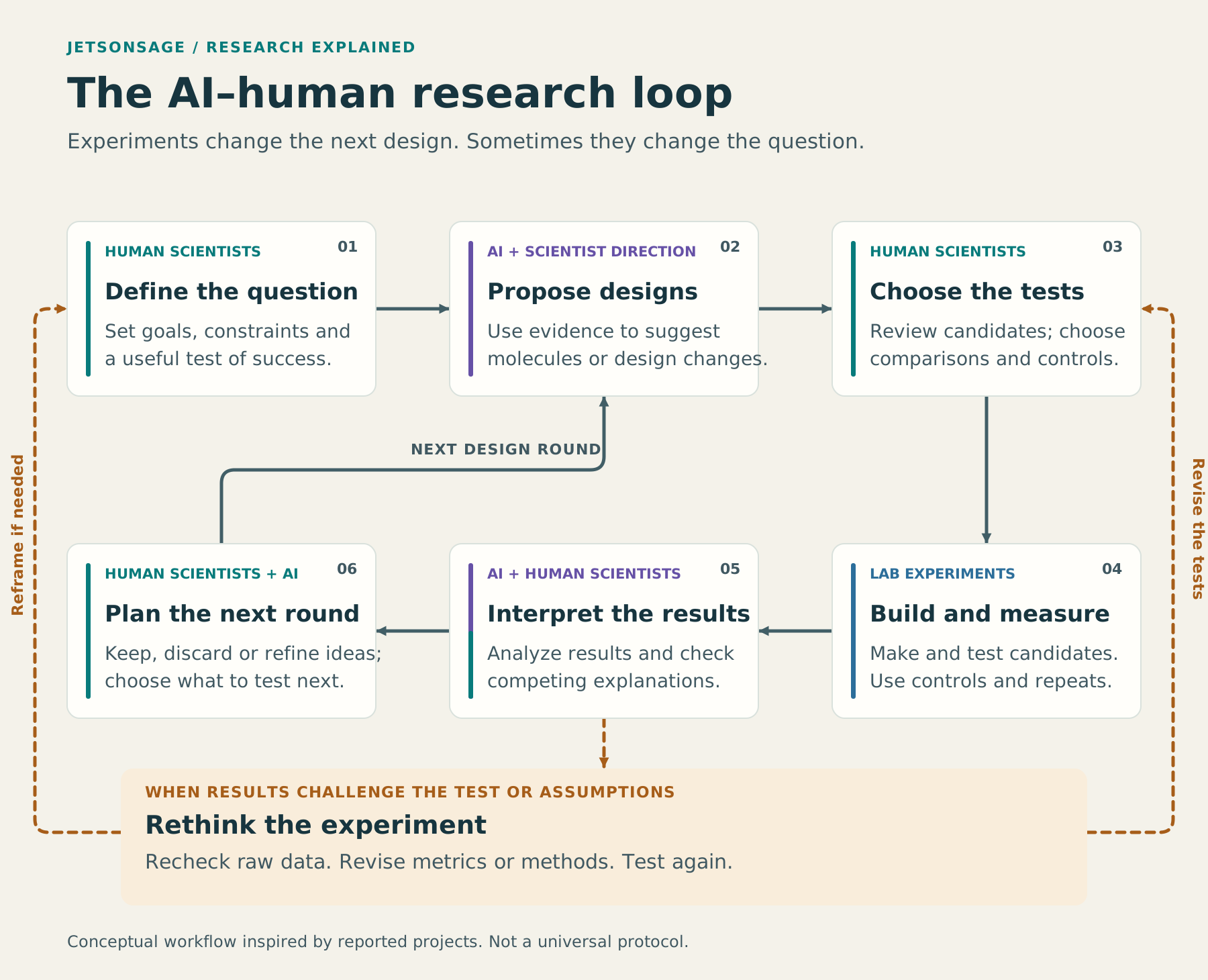
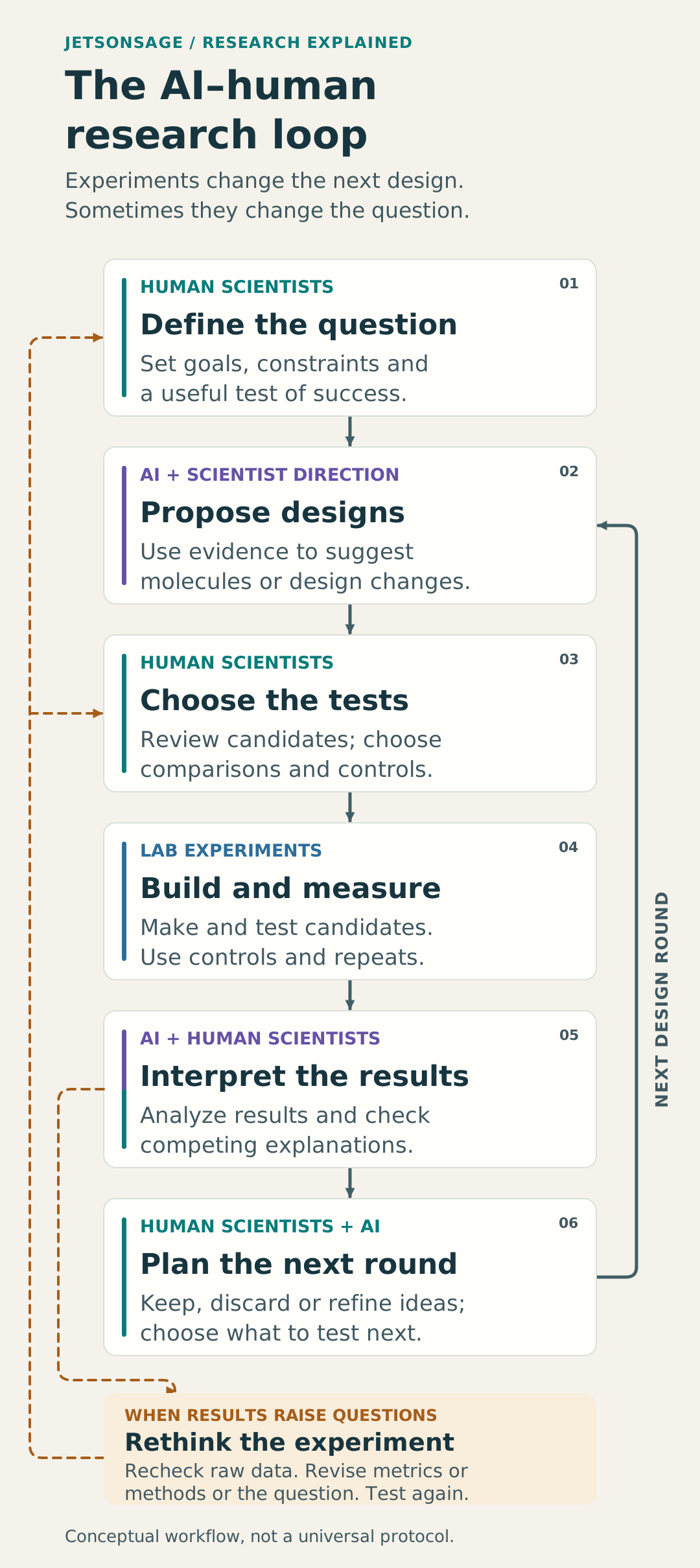
Scientists define the question; AI with scientist direction proposes designs; researchers choose tests; the lab builds and measures; AI and scientists interpret results; scientists and AI plan the next round, returning to design. Optional feedback can revisit tests or reframe the question when assumptions fail. Conceptual workflow, not a universal protocol.
Sources · 4
- https://www.anthropic.com/research/early-progress-drug-development
- https://generatebiomedicines.com/publications/refactored-intracellular-domains-enhance-car-expression-and-function/
- https://www.cancer.gov/about-cancer/treatment/research/car-t-cells
- https://www.fda.gov/patients/learn-about-drug-and-device-approvals/drug-development-process