Zipline brings drone delivery to the neighborhood scale
A new Walmart agreement would add 300 sites as delivery drones become a more familiar service. The expansion puts the machinery on the ground, and the experience of people below, at the center of the story.
Published November 8, 2026Intelligence / Transportation / Modular Logistics
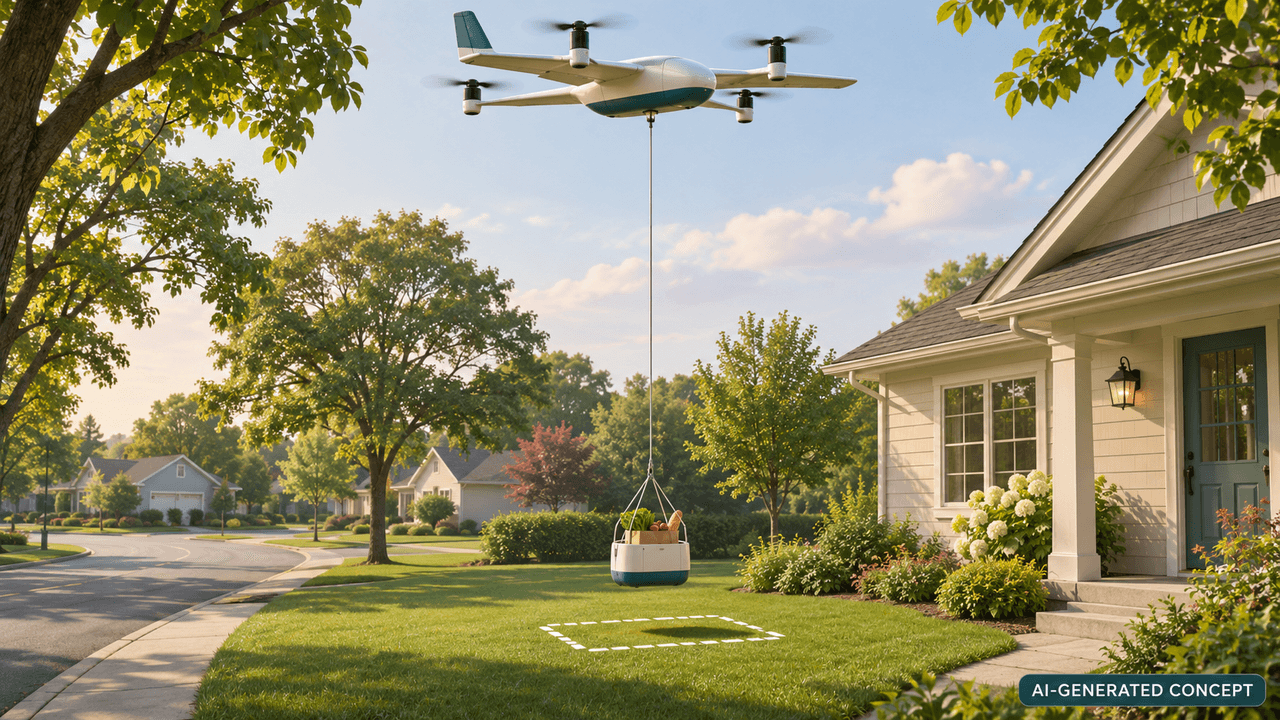
A grocery delivery by drone still depends on someone getting the groceries ready. The order has to be packed, loaded and sent to the right address. An aircraft may avoid a traffic jam, but the service succeeds when all those ordinary steps work together.
Zipline is preparing to build much more of that system. On November 5, the company announced $1.5 billion in new financing and a multiyear agreement with Walmart for 300 additional delivery sites. It plans to expand US manufacturing and hiring. The sites are planned additions; the announcement does not provide a complete opening schedule. [1]
There is already substantial activity to build on. Zipline says it has completed more than one million deliveries in Dallas–Fort Worth this year. It reports that its median order in October reached the customer 19 minutes after checkout. Those are company figures, and the announcement does not provide an independently audited operating dataset. [1]
For households within reach, a dependable service could make a forgotten ingredient or a small grocery order easier to obtain. Expanding that convenience means finding places to charge aircraft and load packages, fitting into store routines, and earning acceptance from neighbors who may hear the flights without ordering anything themselves.
The machinery behind the doorstep delivery
Zipline’s home-delivery design separates the aircraft from the final drop. The aircraft stays overhead while a smaller delivery device descends on a tether, steers toward the destination and places the package. In its description of the system for Mendocino Farms, Zipline also explained how restaurant staff would load orders at docks and connect delivery to existing ordering software. [2]
That ground connection deserves attention. A restaurant has to finish the meal before a fast flight can help. Store staff need a workable place to load it. Charging equipment must support the flow of orders. The usefulness of the aircraft therefore depends partly on decisions made inside kitchens, beside stores and across a local delivery area.
FAA documents make the infrastructure more tangible. A draft environmental assessment for proposed Zipline operations in five Texas metropolitan areas describes separate charging installations and pickup kiosks. Its proposed operating envelope includes a maximum payload of eight pounds. The capacities and flight counts in the proposal describe what was being assessed, not measured daily demand or proof that the whole network is operating. [3]
The FAA also says drone hubs must comply with applicable state and local land-use requirements. Airspace authorization is one part of establishing a service. The practical work of choosing and approving locations continues on the ground. [3]
A quieter flight is part of the service
On October 27, Zipline announced a flight-control update that uses wind measurements and an onboard sound model to adjust how its aircraft move into and out of wing-supported flight. Its fixed-wing design allows most motors to stop during cruise, according to the company. [4]
Zipline says the update, combined with other improvements, reduced overall sound exposure per flight by 68 percent compared with its 2025 fleet, based on internal modeling. That percentage describes the company’s sound-exposure measure. It should not be read as an independently established reduction in perceived neighborhood loudness. [4]
The change is relevant because delivery is repetitive. People living near a busy departure point may experience a different pattern of sound from someone receiving one package. The FAA identifies aircraft noise as a central public concern and encourages community engagement alongside environmental review. [3]
The environmental opportunity depends on the trip
Small electric aircraft offer a plausible way to reduce the energy used to move small packages. In a 2022 study in Patterns, Carnegie Mellon researchers combined 188 quadcopter test flights with modeling to compare delivery modes. Their results favored drones carrying very small parcels under the studied conditions; electric cargo bicycles produced still lower greenhouse-gas emissions per package. [5]
“Regions with cleaner electricity would benefit more from adopting drones to transport small packages,” researcher Thiago Rodrigues said in Carnegie Mellon’s account of that work. [6]
Those experiments were not a test of Zipline’s aircraft. Their value here is to show why the comparison matters: package weight, the electricity supply and the efficiency of the alternative delivery route affect the result. The study identifies delivery intensity, or packages delivered per distance traveled, as a major influence on the comparison. [5]
For a neighborhood, the useful question is what a drone trip replaces. An urgent, light order that would otherwise send a car out on its own presents a different opportunity from packages already grouped on an efficient delivery route. Evaluating the expanding network will require that kind of trip-level evidence, together with service availability, completed orders and the experience of nearby residents.
Zipline’s new agreement gives it room to make drone delivery a more common part of daily life. As the sites open, their strongest evidence will be the ordinary work they perform: orders arriving reliably, stores handling them smoothly and communities finding the service worth having overhead.
Sources
1 Zipline financing and Walmart expansion announcement
2 Zipline description of its Mendocino Farms delivery system
3 FAA public involvement and environmental review for drone operations
4 Zipline acoustic flight update
5 Rodrigues and colleagues drone energy study
6 Carnegie Mellon explanation of the drone energy research