Claude Fable Designs Three Working Electronic Prototypes
Anthropic links circuit design software and physical assembly in an early hardware demonstration, with human engineers building the devices.
Published November 10, 2026Analysis / Artificial Intelligence / Generative Models
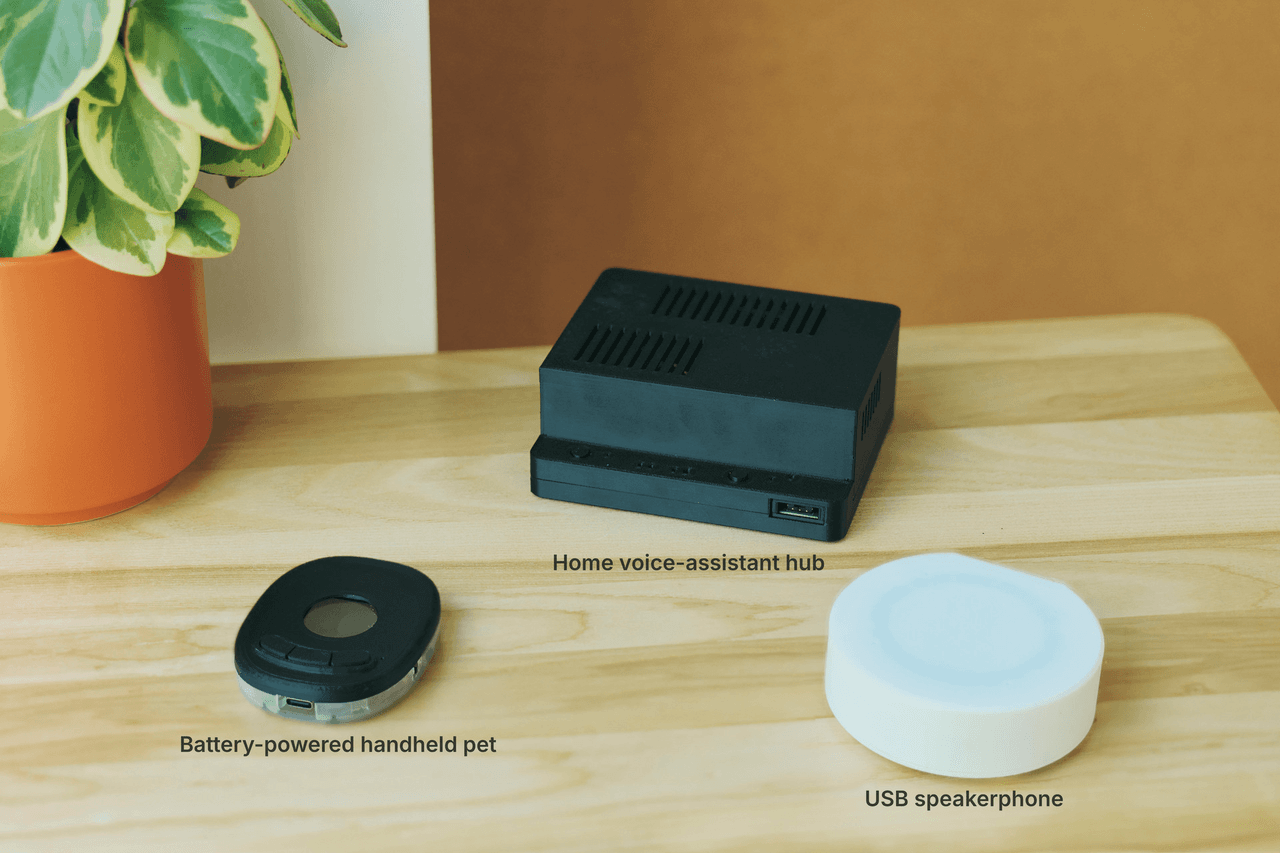
Anthropic reported on November 9 that Claude Fable 5.2 designed a speakerphone, a home voice-assistant hub and a handheld virtual pet, including their circuit boards, cases and software. Engineers at Diode Computers built the devices from those files. All three worked with their original electrical designs, according to the companies' account. 1,2
For a small engineering team, assistance across those steps could bring more ideas to the workbench. A specialized sensor or research instrument needs circuitry, packaging and software before anyone can test it as an object. Artificial intelligence (AI) that helps coordinate the early design could reduce the specialist time required for each prototype. The value would come from getting to a version an engineer can hold, measure and improve.
The demonstration accompanied Anthropic's release of Fable 5.2 and Mythos 5.2. Its strongest evidence is the three assembled objects. The electronics report comes from Anthropic and its commercial partner Diode, whose engineers performed the physical work. Broader replication would establish how reliably other teams could reproduce the result on different devices and parts. 1,2
The challenge is coordination. A circuit has to fit inside its case, its components have to be available, and its software has to operate the hardware actually built. A change to one part can force changes elsewhere. Bringing those decisions together is where a capable assistant could make prototyping more accessible, particularly for teams with limited engineering specialties in-house.
Working through the physical details
One revealing moment involved the speakerphone's mute switch. In the digital model, it blocked the printed circuit board (PCB) from dropping straight into the case. Claude found that the PCB could enter at roughly a 25-degree angle, then swing flat, and added that movement to the assembly instructions. Elsewhere, it reassigned chip connections to make room for tracks beneath touch-sensitive controls. 2
These are the kinds of details that connect a drawing to an object. The path a PCB takes during installation matters alongside its final position. Catching a collision before fabrication gives an engineer another chance to revise the design while changes are still relatively easy.
The work builds on an earlier collaboration. In December 2025, Anthropic described training Claude with Diode on reference designs: the supporting circuitry needed to make a particular chip operate. That required reading manufacturers' documentation and expressing the result in Diode's Zener language, which describes circuit schematics. Engineers then reviewed the designs. The new demonstration extends that earlier focus into complete devices, including their mechanical packaging and firmware, the software running on their electronics. 3
Part of a broader move into engineering
AI already has a history in hardware design. Google reported in 2021 that reinforcement-learning methods were being used in production to help lay out its next generation of tensor processing unit (TPU) computing chips. Chip floorplanning places large circuit blocks within a silicon design while balancing constraints such as wiring and congestion. The Claude demonstration tackles a different level of the problem: arranging purchased components on a PCB and coordinating it with a case and software. 4
On November 3, OpenAI reported a related experiment with GPT-6 Astra: a handheld device for talking to Codex. Two employees developed the design in under a week as a side project, and a contract manufacturer produced a small prototype batch in under a month. OpenAI said manufacturing preparation required several rounds of review to address production limits, tolerances and assembly details the model had missed. 5
Those accounts show how assistance can extend across engineering disciplines, while the manufacturing process supplies another test of the design. For another team to judge the benefit, it would need the cost of the model's work alongside fabrication changes and human review. A prototype produced quickly can still require substantial effort before its behavior and durability are understood.
Reading the evidence behind the scores
Anthropic reports a score of 83.5 out of 100 for Fable 5.2 at maximum effort on BenchCAD 2.1, compared with 44.4 for Fable 5.1. These are company-reported results on a public benchmark, with partial credit. 1
BenchCAD's published tasks involve reconstructing parts and assemblies or recovering a circuit schematic from images. Its scoring compares submitted geometry or circuitry with a reference. Such tests measure particular engineering skills; a product-development claim would also need evidence from fabrication and use. The maintainers changed the evaluation between versions 2.0 and 2.1, so a direct comparison with the figures in OpenAI's earlier 2.0 report would require both models to be tested under a common version. 6,7
Access and physical validation
Fable 5.2 is generally available through Claude applications, the Claude Platform and major cloud providers. Mythos 5.2 remains restricted to approved organizations. The two share an underlying model, with Fable carrying additional cybersecurity and biology safeguards. Organizations can apply for Mythos through Anthropic's verification programs for those fields. 1,8
Hardware teams also need to consider their design data. Anthropic's standard policy for these models retains prompts and outputs for at least 30 days for safety monitoring. Eligible organizations can seek arrangements associated with Enterprise Frontier Safeguards, including a transition to monitoring data held in customer-controlled infrastructure. Teams working on confidential designs would need terms suitable for the information they plan to supply. 8
The devices still await electrical validation, antenna tuning, thermal testing and certification, according to the electronics report. Designs intended for mass production would face further manufacturing requirements. The research team's next goals include more complex PCBs and the ability to “learn from measurements taken on the finished devices.” 2
Those measurements would connect the design process to the behavior of real components and materials. An engineer could compare a predicted result with a measured one, investigate the difference and revise the next prototype.
Sources
1. Anthropic, Claude Fable 5.2 and Mythos 5.2 launch and benchmark results, November 9, 2026
2. Anthropic, Testing Claude on real-world electronics design, November 9, 2026
3. Anthropic and Diode, Making Claude a better electrical engineer, December 12, 2025
5. OpenAI, Accelerating engineering for the physical world, November 3, 2026
6. BenchCAD public repository and task definitions
7. BenchCAD 2.1 release notes and version-comparison warning
8. Claude Help Center, Covered Models, availability and data policies, checked November 10, 2026
Sources · 8
- https://www.anthropic.com/claude-fable-and-mythos-5-2
- https://www.anthropic.com/research/claude-electronics-design
- https://claude.com/resources/articles/making-claude-a-better-electrical-engineer
- https://research.google/blog/chip-design-with-deep-reinforcement-learning/
- https://openai.com/index/accelerating-engineering-for-the-physical-world/
- https://github.com/BenchCAD-org/benchcad-2-main
- https://github.com/BenchCAD-org/benchcad-2-main/releases/tag/v2.1
- https://support.claude.com/en/articles/15425695-covered-models