AIRoA Teaches Two Armed Robots With Handheld Demonstrations
A shared gripper carries recorded human movements into robot work. The reported 78 percent task score includes credit for partly finished jobs.
Published November 10, 2026Analysis / Robotics / Humanoid Robotics
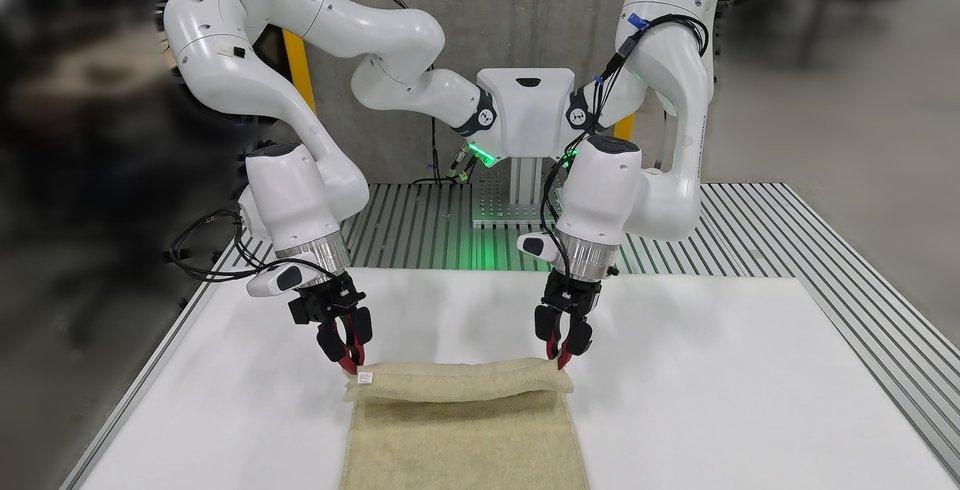
Japan's AI Robot Association (AIRoA) released AIRoA-0 on November 6, a system that learns manipulation from 16,151 hours of people performing tasks with camera-equipped handheld grippers. Its demonstrations include folding towels, sorting small parts and opening a pencil case. The same tools can later become a robot's hands, carrying a close-up view of the work from the demonstration to the machine. 1,2
The tools, called Yielding Universal Bidigital Interface (YUBI) grippers, reduce the need to reserve a robot whenever someone records a lesson. A person holds a gripper in each hand and performs the task. The recordings capture the tools' movement, how far their jaws open and what their wrist cameras see. A robot equipped with those grippers can learn from the resulting data. 2,3
That arrangement could broaden who can teach robots and where useful demonstrations can be gathered. A laboratory could record a skill away from its robot installation, then use the examples to adapt the system for that job. The practical gain depends on how reliably the machine transfers those lessons when the room, objects or sequence changes.
AIRoA reports a 78 percent average score across ten tasks on a two-arm Franka robot, compared with 27 percent for the strongest comparison model. Each task was tested 15 times, and partly finished work earned partial credit. The figure measures average task progress under that scoring protocol. A count of jobs completed from beginning to end would answer a further question about reliability. 2,3
A shared tool bridges two bodies
A human hand and a robot arm move differently. YUBI reduces part of that mismatch by keeping the working tool and camera perspective consistent. The system describes where the gripper should go; each robot's own controller translates that target into arm movement. AIRoA has demonstrated the approach on Franka, TX-G2, OpenArm and UR platforms. 2,3
The idea has a history. The Universal Manipulation Interface (UMI) introduced a portable handheld-gripper approach in 2024, with demonstrations that transferred to different robots. Its contribution was careful coordination of the recording tool and the robot-control interface. The camera position and representation of movement supply information that an ordinary video leaves for another system to infer. 4
AIRoA's addition brings a large demonstration collection together with mechanisms for following multistep jobs. AIRoA-0, shortened to A-0, learns which parts of its wrist-camera images matter, estimates the current stage of a task and uses recent movement history. Opening a pencil case illustrates the problem: a close-up of the gripper beside the case could belong to several stages of the job. Information about the last movement helps establish what should happen next. 2,3
As research lead Yueh-Hua (Kris) Wu and colleagues write, “nothing in the data shows a robot acting, failing or recovering.” The difficulty follows from the source of the new recordings: a person supplies the movements, while a robot must eventually carry them out. Learning to recover from the machine's own errors remains an additional deployment challenge. 3
Reading the comparison
The Franka tests took place at a site absent from the demonstration recordings. The comparison models received the same task demonstrations for post-training, the stage that adapts a pretrained system to particular work. A-0's task scores ranged from 30 percent for earbuds to 97 percent for color sorting. The ten-task comparison table covers the Franka; evidence from the other robot platforms consists of selected demonstrations. 3
A-0 begins with Physical Intelligence's pretrained pi0.5 base. That model family learns from robot data among other sources. AIRoA's handheld-only collection claim therefore describes its new recording campaign and adaptation path. The resulting system also carries experience inherited through its starting model. 3,5,6
For a team considering automated work, the difference between task progress and a finished job is consequential. Sorting some items correctly may earn credit while leaving a person to complete the tray. Evaluation records that separately count complete jobs, human interventions and recovery attempts would show how the aggregate score translates into the work a customer receives. Those measures would also make comparisons between different learning systems easier to interpret.
What a laboratory can reuse
AIRoA has released code and model weights. On November 10, the project page still marked the 16,151-hour dataset as “Coming soon,” alongside broader text describing a full release. The published assets give a laboratory a starting model and a task-adaptation recipe, with the dataset's availability to check separately. Access to the weights requires acceptance of Gemma terms. 2,6,7
The recipe uses eight H200 graphics processing units (GPUs) and takes under four hours to adapt the model to a new task, according to AIRoA. That is a specified computing setup, with its own cost and access requirements. A team also needs compatible grippers, cameras and robot controllers, plus time to record examples and check the resulting behavior. 2,7
Portable recording moves part of the teaching work away from scarce robot hardware. The machine remains necessary for integration and evaluation. A laboratory adopting the method would need to compare the time saved during demonstration collection with the work of setting up the tools, adapting the model and supervising repeated runs on the actual task.
Sources
1. AIRoA release announcement, November 6, 2026
2. AIRoA-0 project page and current release status
4. Chi and colleagues, Universal Manipulation Interface, 2024
5. Physical Intelligence and colleagues, pi0.5, April 22, 2025