A Mobile Robot Factory Begins a Construction Trial at a Texas Solar Farm
An assembly line and robotic transport vehicles are being tested at Tormes Solar, where the project owner wants to learn how automation performs on an active construction site.
Published November 15, 2026Intelligence / Robotics / Autonomous Systems
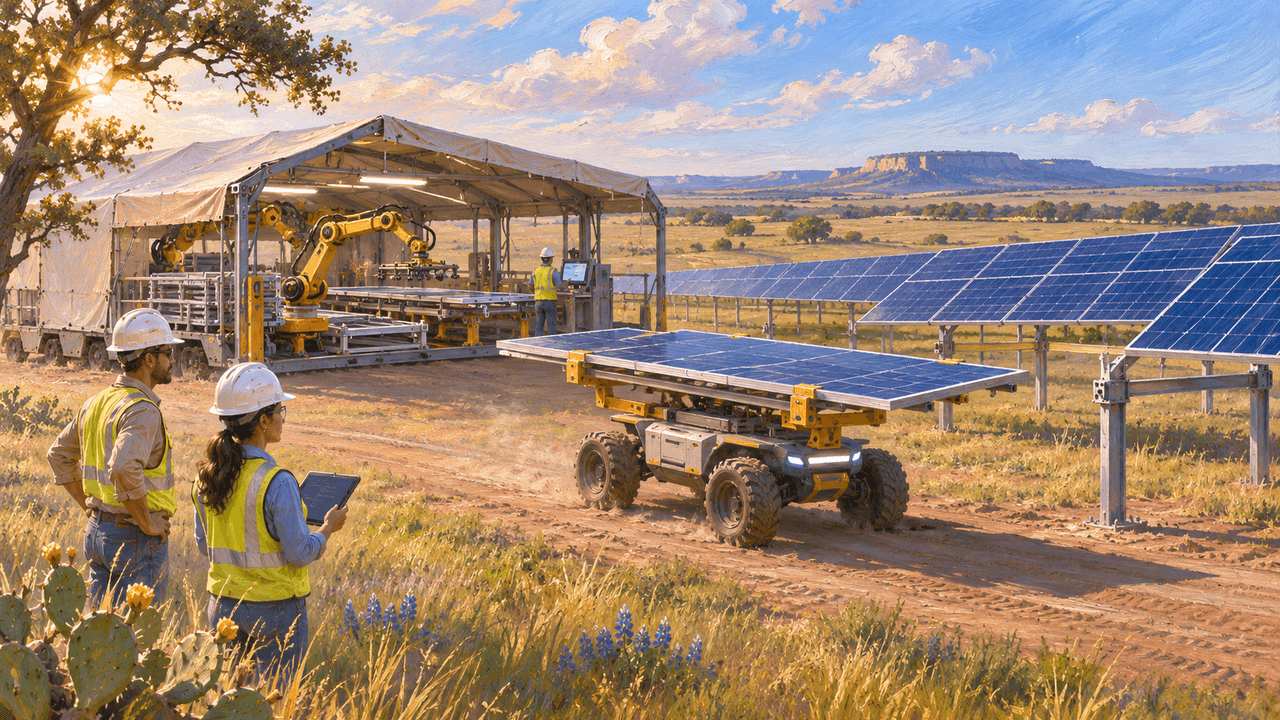
Solar panels arrive at a construction site as heavy sheets of glass and silicon. Crews must connect them to steel structures, move them into position and repeat the process across a vast field. The work puts the pace of a solar project partly in the hands of people lifting, fastening and transporting its components.
At the Tormes Solar project in Navarro County, Texas, Matrix Renewables is moving some of those jobs into a mobile robotic factory. The developer announced on November 12 that it is deploying Terabase Energy’s Terafab V2 with construction contractor SOLV Energy. The equipment is being tested on part of a project whose panels have a combined rated capacity of 457 megawatts of direct-current power.
A shorter building schedule can bring electricity sales forward and reduce the financing costs accumulated during construction. Mechanizing repetitive lifting could also ease some of the physical demands on installation crews. Those potential benefits give developers reasons to test robots beyond the controlled conditions of an indoor factory.
Matrix describes Tormes as a proof of concept for construction that could continue around the clock. Its trial will assess speed, quality, safety and cost, using a combination of autonomous and remotely controlled vehicles.
Bringing assembly to the panels
Terafab changes the sequence of construction. In a conventional installation, crews erect the tracker structure in the field and attach panels there. A tracker rotates a row of panels toward the sun; a long steel member called a torque tube helps support and turn the assembly.
Terafab attaches panels to those tubes in an on-site production line. Equipment checks the assembled units before rovers carry them toward their installation positions. Organizing repeated tasks around a factory station gives the machinery a more consistent working environment, while the transport vehicles handle the journey across the site. Terabase technical announcement
In March, Terabase reported that V2 had completed field testing. It advertised a two-minute production cycle and said a single line operating continuously could install panels with a combined rated capacity above 20 megawatts each week. Sustaining that pace requires dependable equipment, materials arriving on schedule and coordination with the crews preparing the field.
Earlier systems provide some operating history. In November 2023, Terabase reported completing a 17-megawatt portion of Arizona’s 225-megawatt White Wing Ranch project. The Tormes trial extends that experience to the newer platform and its rover system. White Wing Ranch deployment
A broader push to automate installation
Solar automation reaches beyond panel handling. In Australia, a project supported by the Australian Renewable Energy Agency will manufacture robotic equipment for driving the steel piles that anchor solar structures. That effort also includes developing autonomous drilling and nighttime operation. Together, the projects show engineers tackling several separate stages of construction, each with its own terrain, safety and equipment demands. ARENA project record
The U.S. Department of Energy supported Terabase’s field-factory development with a $1 million award in 2019. Its account of the work emphasized shifting heavy lifting to machinery while workers oversee construction—a division of labor now being tested at progressively larger sites. DOE project background
Matrix’s chief operating officer, Giora Salita, described the purpose as “testing new technologies under real conditions.” For Tormes, that means recording how the equipment performs through interruptions, variable ground conditions and the daily movement of materials. Those operating records will help determine how widely Matrix uses automated construction across its future projects. Matrix announcement