A Chinese Truck Stop Links Battery Swapping With Wind, Solar and Storage
An installation in Ningde combines renewable generation, stored electricity and truck charging, testing how a freight stop can become a more flexible electricity customer.
Published November 15, 2026Intelligence / Energy / Advanced Battery Tech
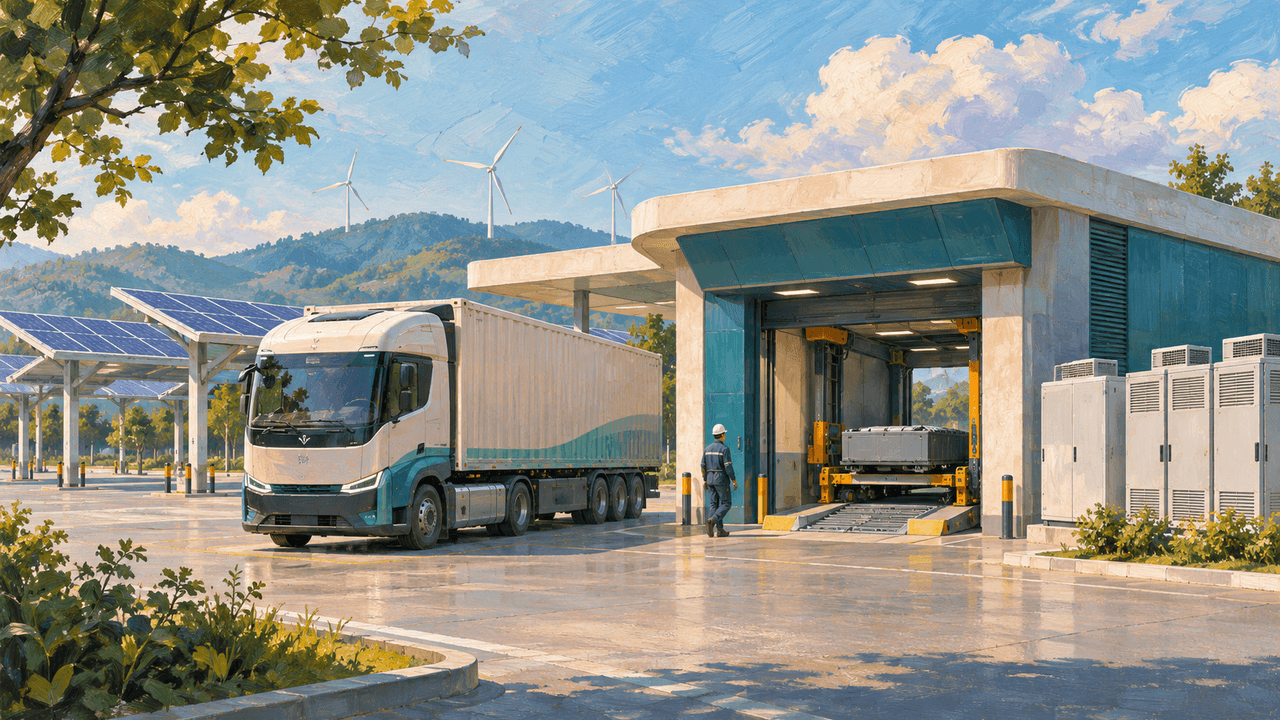
An electric truck can leave a battery-swapping station with a charged pack while its depleted one stays behind. For the driver, the appeal is a shorter stop. For the station operator, that separation creates room to choose when batteries recharge—and to fit some of that work around the availability and price of electricity.
CATL’s Qiji battery-swapping business and GCL Energy Technology have brought that approach into an energy demonstration in Ningde, on China’s southeastern coast. GCL says the installation, beside the G15 Shenhai Expressway, entered service on November 12.
The station combines 94 kilowatts of wind and solar capacity with 930 kilowatt-hours of storage, five-minute battery swaps and megawatt-class charging. Its grid-connected microgrid prioritizes renewable electricity, stores surplus energy and releases it during demand peaks. GCL forecasts annual renewable-energy consumption of up to 120,000 kilowatt-hours. GCL announcement
The arrangement gives the operator several ways to manage a busy freight stop. Spare truck batteries provide time to schedule recharging. Storage equipment can supply part of a short surge in demand. Electricity from the wider grid fills the remaining requirement. How effectively those pieces work together will depend on truck arrivals, battery availability and local electricity prices.
Charging to a different timetable
Battery swapping already has a foothold in Chinese freight operations. At Yantian port in Shenzhen, CATL announced an operating chassis-swap station in November 2024, serving trucks with 342-kilowatt-hour batteries. The company said compatible vehicles from different manufacturers could use it and described five-minute swaps. That earlier project helps explain the operational appeal: a charged battery can be waiting when a truck arrives. CATL’s Yantian announcement
Spread across a year, Ningde’s forecast renewable-energy use amounts to as much as roughly 329 kilowatt-hours a day—a JetsonsAge calculation dividing the announced annual figure by 365. Operating records would show how that energy divides between on-site generation and any renewable electricity bought through the grid, and what share of the station’s total demand it supplies.
For an operator, shifting charging by even part of a day can change the bill. Electricity tariffs can charge different prices at different hours; some also charge for a customer’s highest power demand during the billing period. Storage and carefully timed charging can reduce exposure to those expensive periods. These are established demand-management mechanisms described by the U.S. Department of Energy, with their value determined by the applicable tariff. DOE demand-flexibility guidance
A truck stop becomes part of a larger network
Ningde also connects to GCL’s Juxing AIVP virtual-power-plant platform. GCL describes software that coordinates station equipment and supports participation in electricity markets. GCL announcement
A virtual power plant links equipment spread across multiple locations so that it can respond together. Singapore’s Energy Market Authority gives examples including adjusting vehicle-charger power, storing solar electricity and coordinating batteries. A participating charging station can therefore contribute by reducing its grid draw at a useful moment, subject to its customers’ needs and the local market’s rules. EMA explanation
For freight operations, the practical constraint is the queue. A station needs enough charged packs available for incoming trucks. Scheduling has to balance that service obligation against the opportunity to buy cheaper electricity or provide grid support. Battery wear, spare-pack inventory and equipment costs also belong in the financial calculation.
The installation introduces perovskite tandem solar technology into the station as well, according to GCL. Tandem cells combine light-absorbing layers tuned to different parts of sunlight, offering a route to more electricity from a limited panel area. Durability and manufacturing consistency remain central engineering tests for this technology. GCL announcement · DOE’s technical explanation
A useful operating record would connect these pieces: how long drivers wait, how much renewable electricity reaches their batteries, how the station’s peak grid demand changes and what each delivered kilowatt-hour costs after equipment expenses. Those measurements would let other freight operators judge whether the Ningde configuration suits their routes.