Lydian’s Utah Battery Shows How Data Centers Could Use Less Gas
Four-hour lithium storage is already operating for the grid serving Meta. Planned 100-hour iron-air batteries would tackle longer shortages, with charging losses, construction costs and weather determining how far the combination can go.
Published November 15, 2026Analysis / Energy / Advanced Battery Tech
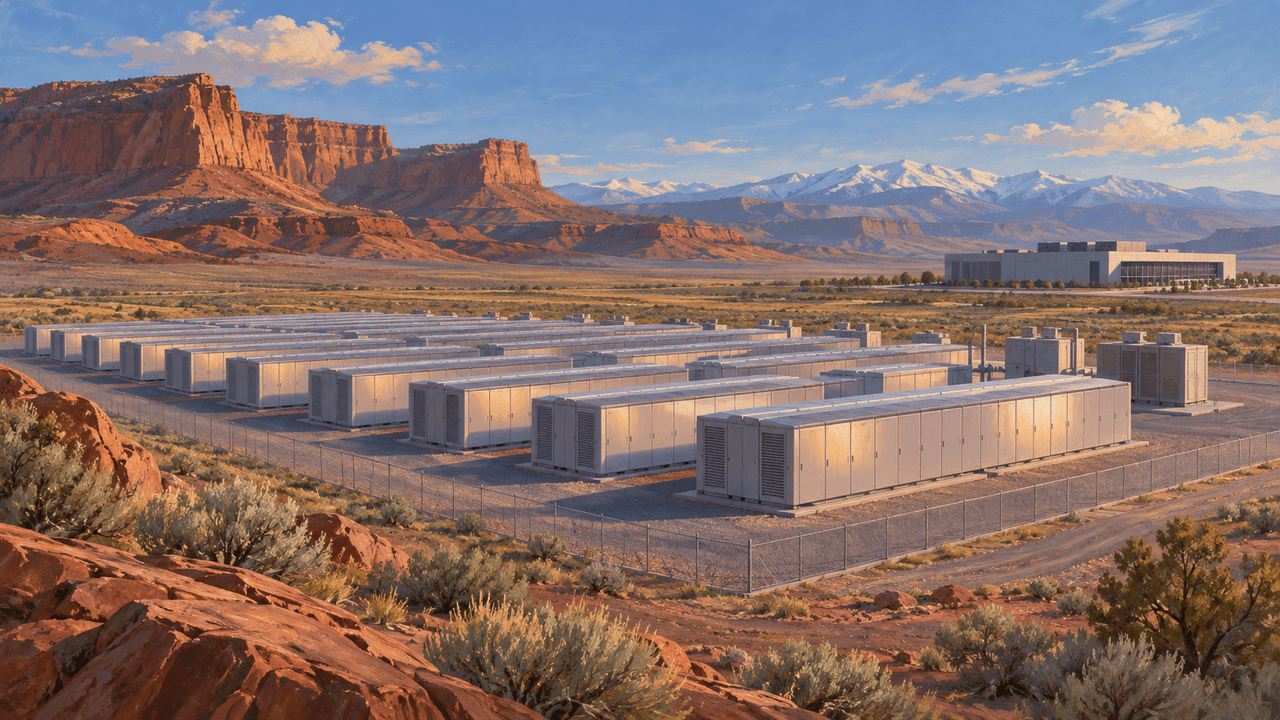
Lydian Energy has brought a large battery into service on the Utah grid supporting Meta’s Eagle Mountain data center. The Faraday project can deliver 150 megawatts for four hours, giving PacifiCorp another source of power for periods when electricity is especially valuable. Lydian announced the milestone on November 10; the battery began commercial operation on September 18. [1]
For data-center operators seeking cleaner power, that is a useful piece of infrastructure. Solar production falls as evening approaches, while servers and cooling equipment keep drawing electricity. A battery charged earlier can serve part of that demand after sunset. The reduction in gas use depends on its charging electricity and which generators its discharge displaces.
A second kind of battery is being developed for the harder stretches: several days when renewable generation falls short. Google and Xcel Energy have announced plans for a 300-megawatt, 30-gigawatt-hour Form Energy iron-air installation in Minnesota, designed for 100 hours of discharge. Crusoe has separately reserved 12 gigawatt-hours of Form’s storage for artificial intelligence (AI) data centers, with deliveries intended to begin in 2027. [2, 5]
Together, the projects point toward a power system in which different batteries do different jobs. Efficient lithium-ion storage can handle frequent, shorter shifts; lower-cost energy capacity could make iron-air useful for longer gaps. How much gas this combination can replace depends on the renewable plants feeding it, the grid connecting it and the hours it must cover. The economics begin with those hours.
What Faraday adds to the grid
Faraday is a battery energy storage system (BESS) that uses lithium iron phosphate, a lithium-ion chemistry widely used in stationary storage. Lydian describes it as a standalone system contracted to PacifiCorp under a long-term storage agreement through Schedule 34 in support of Meta. It shares a substation and interconnection with the adjacent Faraday solar plant. [1]
“Faraday BESS enhances PacifiCorp’s reliable, contracted capacity for Utah customers,” Kim Smith, Lydian’s chief operating officer, said in the announcement. [1]
The arrangement places Faraday within a shared electricity system. Its value comes from delivering power where and when that system needs it. Sharing existing connection infrastructure also helps explain the practical appeal of adding batteries alongside established generation.
Evaluating its climate benefit will require an account of when it charges, which generators supply the additional charging electricity and which generators reduce output when it discharges. Nearby solar creates an opportunity; hourly operations establish the result. Meta’s contract supports a grid resource, while the data center continues to depend on the wider network for electricity and reliability.
The difference between four hours and four days
A battery has two essential ratings. Power, measured in megawatts, describes how quickly it can deliver electricity. Energy, measured in megawatt-hours, describes how much it can deliver over time. Dividing energy by power gives the duration at full output.
Faraday’s 600 megawatt-hours divided by 150 megawatts yields four hours. The proposed Form installation’s 30,000 megawatt-hours divided by 300 megawatts yields 100 hours, or four days and four hours. The Minnesota project would have twice Faraday’s power and 50 times its stored energy. Those figures describe the announced configurations and their different assignments. [1, 2]
A constant one-gigawatt data-center campus makes the scale easier to see. Here, one gigawatt means the total facility load, including computing, cooling and electrical overhead. This is an illustrative campus, independent of the actual loads at Meta or Google.
It would consume 24 gigawatt-hours each day and 8.76 terawatt-hours in a 365-day year. Carrying the entire load through four hours with zero generation or imports would require one gigawatt of battery output and four gigawatt-hours of usable stored energy. A 100-hour interval would require the same output power and 100 gigawatt-hours.
Seven installations matching Faraday’s ratings would total 1.05 gigawatts and 4.2 gigawatt-hours. The 100-hour case would equal three and one-third of the planned Google/Xcel battery’s power and energy ratings. These are sizing comparisons, before allowing for reserves, unavailable equipment and operating margins.
The planned Minnesota battery itself could supply 30 percent of that hypothetical campus’s load for 100 hours. Its 300-megawatt output rating limits how much of the load it can serve at once. Crusoe’s 12-gigawatt-hour reservation, meanwhile, describes energy volume across a supply agreement; each installation’s eventual power rating and deployment arrangements will determine the service it provides. [2, 5]
Why two chemistries may work better together
Lithium-ion batteries store and release energy by moving lithium ions between electrodes. Their efficiency helps when the same equipment charges and discharges frequently. A daily cycle that shifts electricity from a sunny afternoon into the evening loses less energy when the battery returns a large share of what went into it.
Form’s iron-air battery uses a different reaction. During discharge, oxygen from the air reacts with iron to form rust. Charging reverses the process, restoring metallic iron and releasing oxygen. The company uses a water-based, nonflammable electrolyte. Cheap, abundant materials offer a route to storing large amounts of energy for long periods. [6]
That design carries an efficiency trade-off. A 2025 lithium-ion cost study by the National Renewable Energy Laboratory (NREL) assumes 85 percent round-trip efficiency: roughly 85 units of electricity returned for every 100 used to charge. Form’s 2024 planning assumptions put iron-air at 40 to 45 percent. These system-level figures are planning assumptions for the respective technologies. [7, 8]
The difference favors a division of labor. A developer could use lithium-ion batteries for frequent daily shifts and preserve the larger iron-air reserve for less frequent, prolonged shortages. Some events would call for both, with dispatch determined by the load, remaining charge and weather forecast. The appropriate mix would emerge from modeling the site and surrounding grid.
Gas displacement can also proceed in stages. Renewables and storage may first cut a gas plant’s running hours while that plant remains available for difficult periods. Replacing its capacity altogether requires enough dependable alternatives to cover those periods as well. The first outcome saves fuel and reduces combustion emissions; the second additionally changes the investment in backup supply.
Refilling a large battery is a power-system job
Supplying 100 gigawatt-hours from an iron-air installation at 40 to 45 percent round-trip efficiency would require approximately 222 to 250 gigawatt-hours of charging electricity over a complete cycle. That arithmetic assumes the cited efficiency applies to the operating cycle. The electricity serving the campus while the battery refills comes on top of that requirement.
If a developer wanted to replenish that energy within seven days, the battery would need an average charging input of about 1.32 to 1.49 gigawatts throughout the week, alongside the campus’s one-gigawatt load. Meeting that refill target would require sufficient battery charging capacity, generation and grid capacity during the available windows. A shorter refill deadline would make the task more demanding.
By comparison, restoring the four gigawatt-hours delivered by an 85-percent-efficient lithium-ion system would take about 4.71 gigawatt-hours of input. This is one reason to reserve more efficient storage for frequent cycling when the full system economics favor it.
Google’s proposed Minnesota arrangement already reflects a portfolio approach. Its announcement includes 1,400 megawatts of wind and 200 megawatts of solar alongside the Form battery, plus support for smaller distributed batteries on Xcel’s system. Wind and solar are generation; the battery shifts energy they or other grid resources produce. Their combined nameplate ratings describe equipment capacity, while hourly output determines how much demand the portfolio can meet. [3]
The regulatory process remains active. In its October 29 earnings release, Xcel said it expected a Minnesota decision on the Google electric-service agreement in early 2027. The Google service agreement still needs approval, and the 100-hour battery remains a planned grid resource. [4]
Putting prices beside the hours
The available cost figures show why developers are pursuing both chemistries. They also come from different years and different stages of commercialization.
NREL’s June 2025 study projects a 2026 midpoint of $308 per kilowatt-hour for a complete four-hour lithium-ion system, expressed in 2024 dollars. Applied to the hypothetical one-gigawatt, four-gigawatt-hour battery, that yields about $1.23 billion in overnight capital cost. The study was prepared in early 2025, excludes later tariff changes and serves as a planning benchmark. Actual procurement terms would establish a project’s price. [7]
Form’s June 2024 Pacific Northwest study sets out a future installed-cost target of $15 to $20 per kilowatt-hour for 100-hour systems at gigawatt-scale manufacturing around 2030. At that target, a one-gigawatt, 100-gigawatt-hour installation would cost $1.5 billion to $2 billion. Its stated scope includes construction, development and grid interconnection at roughly 100-megawatt project scale, before tax credits. The table leaves its dollar base year unspecified and says initial projects would cost more. [8]
At Form’s target, storing 25 times as much energy could remain in the same broad capital-cost range. This comparison spans different forecast dates and dollar bases. Bids, warranties and operating records will determine the practical outcome.
A gas plant provides another reference point. The U.S. Energy Information Administration (EIA), in its 2026 modeling assumptions, put a new multi-shaft combined-cycle plant at $1,032 per kilowatt in 2025 dollars. Scaling that benchmark to one gigawatt gives about $1.03 billion in overnight plant cost, before financing and local adjustments. Its reference design becomes available in 2028, so the figure also belongs to a planning model. [9]
The continuing fuel bill is substantial. At EIA’s assumed heat rate of 6.226 million British thermal units (Btu) per megawatt-hour and the national 2025 average received-gas price of $3.85 per million Btu, generating 8.76 terawatt-hours would cost about $210 million a year for gas alone. That is an illustrative year of uninterrupted full output. At the latest rolling-year price through August 2026, $4.05, the same calculation rises to about $221 million. Each additional dollar per million Btu changes the annual bill by roughly $54.5 million. [9, 10]
The storage figures buy equipment that moves electricity through time. The gas figures buy generating equipment and, separately, fuel. A comparable service-cost calculation must price the complete supply portfolio, including charging electricity or the facilities producing it, then use the same financing assumptions, reliability requirement and analysis period for every option. Maintenance, replacements, delivery infrastructure, site conditions, incentives and carbon costs also belong in that calculation.
Charging prices deserve particular attention. At an illustrative $30 per megawatt-hour of input electricity, the energy purchased to charge a battery costs about $35 per megawatt-hour returned at 85 percent efficiency, or $67 to $75 at 40 to 45 percent. Those are charging-energy costs alone. Otherwise-curtailed renewable output could lower them, while scarce electricity during a difficult recharge period could raise them.
Frequency matters as much as efficiency. A reserve used only during occasional shortages can justify more charging losses if it saves enough on storage capacity and other dependable supply. A frequently cycled battery earns more value from high efficiency. Form’s cited planning assumptions allow 1,500 to 2,000 equivalent full-power discharge hours annually, reinforcing its role within a larger supply portfolio. [8]
The weather and the wires decide the result
A useful design has to survive a sequence of events: a cloudy, calm period, a partially depleted battery, equipment maintenance and the next weather system arriving before reserves have recovered. Annual renewable-energy totals conceal that sequence.
Researchers at Pacific Northwest National Laboratory examined simulated hourly generation across thousands of U.S. wind and solar plants, together with regional demand. Their benchmark found that drought characteristics varied by region and that events combining weak renewable output with high load were more severe than supply droughts alone. Some daily-defined droughts lasted up to six days. The findings illustrate why storage sizing requires regional weather and demand records. [11]
One hundred hours is a useful engineering capability with a finite energy budget. Residual wind or solar output can stretch it; heavy demand and depleted initial reserves can shorten the coverage a site receives. A defensible plan would test many historical weather years, outages and transmission constraints against a specified reliability standard, then examine how changing conditions affect the result.
Grid-connected systems can draw on geographically separated generation, shared reserves and diverse demand. Transmission capacity determines how much of that help reaches the site. An islanded data center has to provide the corresponding support within its own electrical system, including voltage and frequency control, equipment redundancy and a way to restart after a shutdown. Faraday and the proposed Google/Xcel resources belong to the grid-connected category. [1–4]
Computing flexibility can help where workloads permit it. Deferring a batch job or moving it to another region reduces demand during a shortage, but essential services and time-sensitive work still establish a floor beneath the load. A realistic design would specify how much computing can move, for how long and with what consequences for service.
Crusoe’s agreement supplies evidence of commercial demand for iron-air: reserved volume, pricing and delivery terms, beginning in 2027. Form says the batteries will come from its Weirton, West Virginia factory. Turning those orders into dependable capacity requires manufacturing throughput, commissioned projects and operating performance at the promised scale. [5]
Faraday contributes something already in service: a four-hour resource connected to a utility system. The next test is whether multi-day storage can arrive at a price and performance that makes a larger renewable share practical. For data-center developers, the decisive evidence will be a power plan that accounts for the difficult hours and the recharge afterward, with a full cost for delivering that reliability. That is where a collection of battery announcements becomes a credible alternative to burning more gas.
Sources
Sources · 11
- https://www.businesswire.com/news/home/20261110822031/en/Lydian-Energy-Brings-150-MW-Faraday-Battery-Storage-Project-Online-in-Utah-Under-Long-term-Agreement-with-PacifiCorp
- https://newsroom.xcelenergy.com/news/xcel-energy-to-power-new-google-data-center-in-minnesota
- https://formenergy.com/technology/battery-technology/
- https://docs.nlr.gov/docs/fy25osti/93281.pdf
- https://blog.google/innovation-and-ai/infrastructure-and-cloud/global-network/data-center-pine-island/
- https://s202.q4cdn.com/586283047/files/content_files/Xcel-Energy-Earnings-Release-Q3-2026.pdf
- https://formenergy.com/wp-content/uploads/2024/06/Form-Energy-Navigating-the-Pacific-Northwest-Energy-Challenges-06.26.2024-1.pdf
- https://www.eia.gov/outlooks/aeo/assumptions/pdf/EMM_Assumptions.pdf
- https://www.pnnl.gov/publications/standardized-benchmark-historical-compound-wind-and-solar-energy-droughts-across
- https://formenergy.com/form-energy-crusoe-announce-agreement-for-12-gigawatt-hours-of-iron-air-batteries-for-ai-data-centers/
- https://www.eia.gov/electricity/monthly/epm_table_grapher.php?t=table_4_01continued