On Tiangong, Slower Atoms Give Quantum Experiments More Time
A laser-cooled cloud on China's space station reached a record-low expansion temperature, opening a longer window for studying matter and developing precision instruments.
Published November 8, 2026Intelligence / Space Development / Base Development
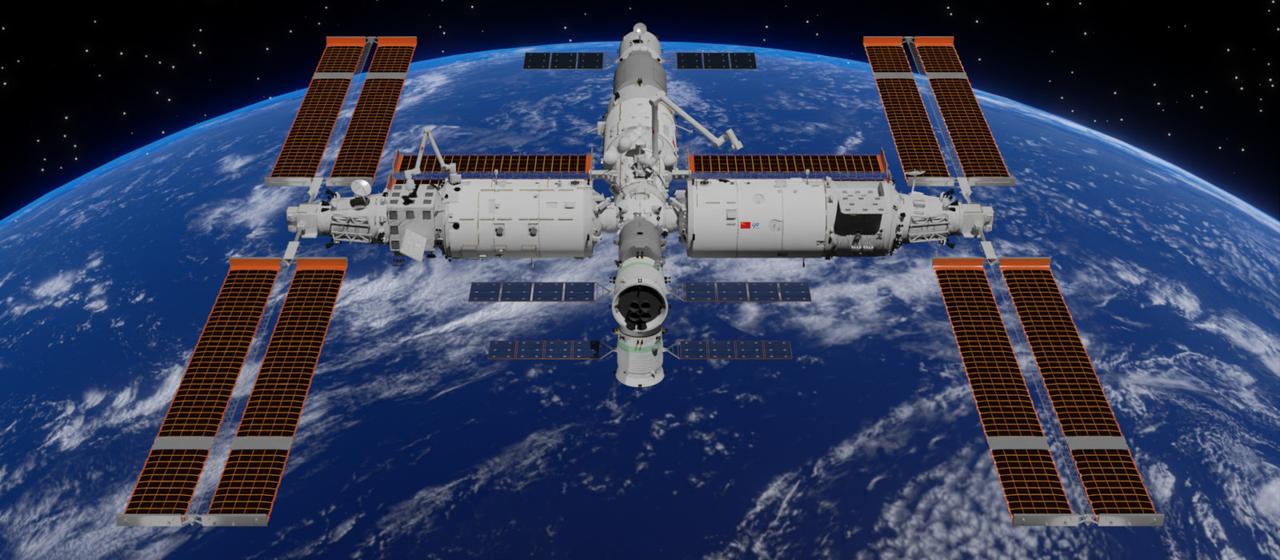
Researchers using China's Tiangong space station have slowed a cloud of atoms so thoroughly that they could watch it expand for seven seconds. In the small world of quantum experiments, that extra time could help scientists follow subtle changes in matter and measure forces that would otherwise be difficult to detect.
The team, including researchers at Peking University and the Chinese Academy of Sciences' Shanghai Institute of Optics and Fine Mechanics, reported the result in Science on November 5. About 20,000 rubidium atoms reached an equivalent temperature of 9.7 picokelvin, roughly ten trillionths of a degree above absolute zero. The number describes how slowly the released cloud spreads, rather than the temperature of the equipment around it. [1, 2]
Cold atoms are useful because their quantum behavior can be controlled and observed. They can serve as experimental stand-ins for more complicated materials, or as the working elements of instruments sensitive to acceleration and gravity. Both uses benefit when a cloud stays compact long enough for researchers to manipulate it and read what happened. [4]
Tiangong offers an advantage that a ground laboratory must work hard to reproduce: the atoms and their apparatus are falling around Earth together. That shared free fall lets researchers use gentler traps and follow released atoms for longer. The new experiment combines that orbital setting with a laser-based cooling system, extending the tools available for quantum research in space. [1, 2]
Cooling with light
The experiment uses an optical dipole trap, in which focused laser light holds neutral atoms. After cooling, many atoms occupy the same quantum state, forming a Bose-Einstein condensate. Such a cloud gives researchers a collective quantum system whose behavior can be studied on a scale much larger than an individual atom. [1, 5]
According to Peking University, the team first produced a quantum-degenerate gas through laser cooling, trapping and evaporative cooling. A further stage used two sets of crossed laser beams with different widths and trapping strengths to reduce the cloud's expansion energy. The experiment required careful control of laser frequency and power, mechanical vibration and the measurement itself. [2]
The reported 9.7-picokelvin value comes with uncertainty of minus 2.7 and plus 3.2 picokelvin. It is an equivalent temperature inferred from the atoms' motion as the cloud expands. Seven seconds describes the free-expansion observation time; demonstrating an interferometer that maintains coherent, separated atom waves over several seconds is a further step. [1, 5]
The hardware has a longer history than this week's announcement. Peking University says development began in 2015 and the experimental rack reached orbit with the Mengtian laboratory module in October 2022. The November paper reports a result from that established research platform. [2]
A record built on earlier experiments
Cold quantum gases have already been studied in orbit and in brief periods of weightlessness on Earth. In 2021, Christian Deppner and colleagues reported an equivalent temperature of about 38 picokelvin using a condensate in a Bremen drop-tower experiment. Their method combined the cloud's own collective motion with a magnetic lens that slowed its expansion in three dimensions. [3]
A separate study published in Nature Communications in December 2022 reported roughly 52 picokelvin aboard NASA's Cold Atom Lab on the International Space Station. That team also demonstrated precise control over where the atoms were placed and how they were released. Those details are central to a useful sensor: a small uncertainty in a cloud's starting position or velocity can become an error in the measurement. [4]
Tiangong's result lowers the reported expansion-temperature benchmark while adding an optical route to preparing the gas in microgravity. The authors emphasize that optical traps offer good access for additional laser beams and can accommodate a broader range of atomic magnetic properties. That flexibility could help researchers design experiments around different atoms and interactions. [1]
From a cold cloud to a measuring instrument
An atom interferometer uses atoms' wave-like behavior to measure a physical effect. In a typical arrangement, laser pulses split and recombine the matter waves, and the resulting pattern records differences accumulated along their paths. Extending the time between those operations can make small effects easier to resolve, provided the experiment maintains control of the atoms and the disturbances around them. [6]
In comments reported by CGTN and republished by the Chinese Academy of Sciences, MIT physicist and Nobel laureate Wolfgang Ketterle called the Tiangong achievement “an excellent starting point to advance atomic thermometry and precision measurements.” [5]
The immediate beneficiaries are researchers building those experiments. Peking University points to future combinations of the platform with optical lattices, tunable interactions and high-resolution imaging. Optical lattices use patterned light to arrange atoms in regular structures, allowing scientists to explore how many particles behave together under controlled conditions. [2, 5]
For space-based sensing, the next evidence will come from complete instruments: how accurately they measure a chosen quantity, how well they control systematic errors and how consistently they operate. The Tiangong result supplies a more slowly expanding starting cloud for that work. Its practical importance will grow as researchers turn those additional seconds into measurements. [4, 5]
Sources
1. Wei Xiong and colleagues, “Quantum gases below 10 picokelvin in space,” Science, November 5, 2026. https://doi.org/10.1126/science.aea5324
2. Peking University, announcement of the Tiangong ultracold-atom result, November 6, 2026. https://pkunews.pku.edu.cn/info/2881/3325821.htm
3. Christian Deppner and colleagues, “Collective-Mode Enhanced Matter-Wave Optics,” Physical Review Letters, August 30, 2021. https://doi.org/10.1103/PhysRevLett.127.100401
4. Naceur Gaaloul and colleagues, “A space-based quantum gas laboratory at picokelvin energy scales,” Nature Communications, December 22, 2022. https://doi.org/10.1038/s41467-022-35274-6
5. CGTN, “China's Space Station Sets New Atomic Cooling Record,” republished by the Chinese Academy of Sciences, November 6, 2026. https://english.cas.cn/newsroom/cas-in-media/202611/t20261106_1213502.shtml
6. NASA, “Quantum Technologies Take Flight,” updated August 14, 2024. https://science.nasa.gov/science-research/science-enabling-technology/technology-highlights/quantum-technologies-take-flight/
Image credit: Shujianyang / Wikimedia Commons, CC BY-SA 4.0. Rendering preserved without alteration; the experiment operates inside the Mengtian laboratory.