STEP connects a robot’s view of the ground with its next move
A humanoid completed 98 of 100 indoor obstacle trials. The study also exposes the limits of walking without fresh visual information.
Published November 10, 2026Intelligence / Robotics / Humanoid Robotics
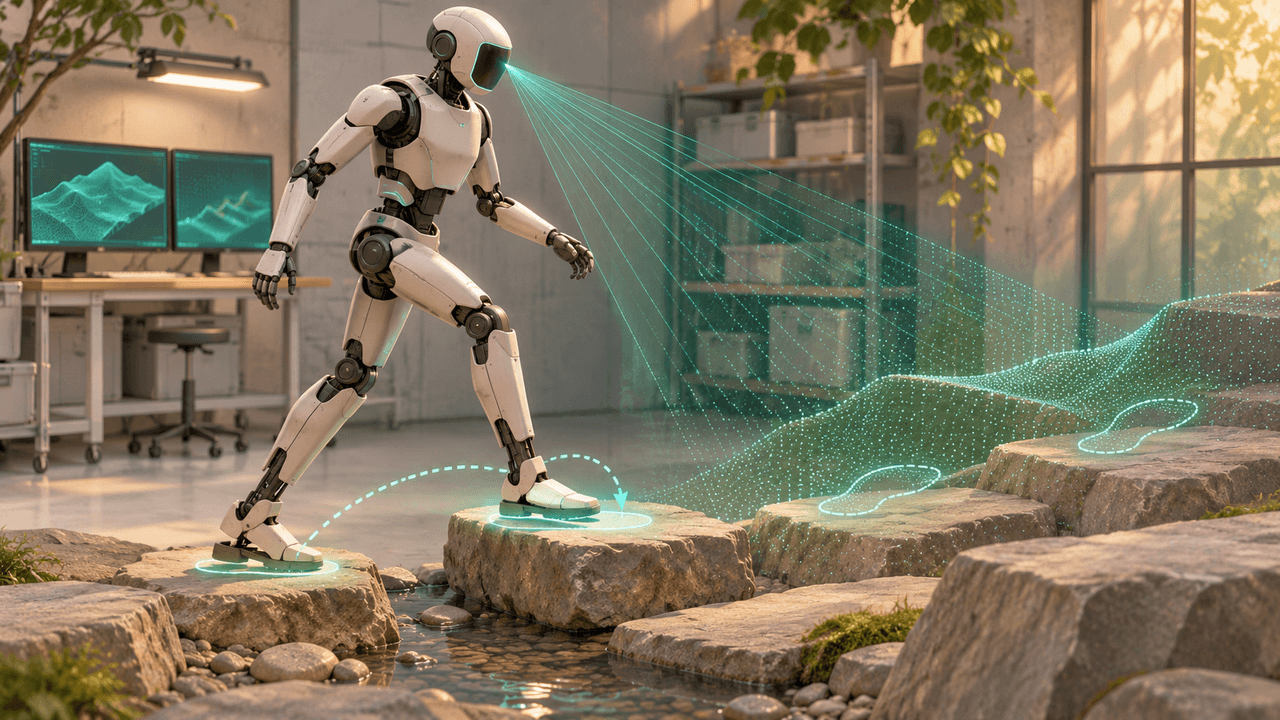
A staircase is ordinary architecture for a person and a demanding test for a robot. A useful machine has to place its feet while its body is moving, then arrive in a position from which it can take the next step. Getting through a building depends on many such small decisions.
In a November 5 preprint, Youhao Lyu and colleagues report 98 completed indoor obstacle trials out of 100 using STEP on a Noetix E1 humanoid. Success required stable standing after traversal, without human intervention. [1]
STEP combines depth images with body-sensor information. Training includes predicting how that combined state changes after an action, connecting perception with the consequences of movement. [1]
That is a worthwhile direction for robots intended to work in places built for people. A machine that needs every route simplified for it leaves part of the job to the building’s owner. But dependable access requires more than clearing an impressive obstacle once.
A small test with a clear boundary
Each condition received 20 trials: stairs, a platform, a gap, stepping stones and backward stairs. Both failures involved the 70-centimeter gap. Hardware trials tested STEP alone; comparisons used simulation. [1]
“Sustained depth dropout remains challenging,” the authors write. All tested methods failed simulated gaps and stepping stones with frozen depth images. Backward stair traversal does not establish online learning or reconstruction of unseen terrain. [1]
From an obstacle to a route
The next useful evidence would put the controller through longer routes with varied lighting, surfaces and interruptions, and report how often a person has to rescue or reset it. An inspection round or a delivery job contains transitions between obstacles as well as the obstacles themselves.
STEP is an early research result, not a deployment record. Its promise is a closer connection between perception and movement. For a robot’s future coworkers, the eventual benefit would be simple: fewer places where useful work has to stop at the stairs.
Sources
1. Lyu and colleagues, STEP: Spatiotemporal Training with Explicit Prediction for Perceptive Humanoid Locomotion. Preprint submitted November 5, 2026. Abstract; Sections III, IV-C and IV-D; Tables V and VI. Hardware results and quotation are author-reported.