Germany Puts Hydrogen Backup Power to the Test
A 34 MW turbine in Lingen will test how renewable hydrogen can supply the grid. Its eventual value depends on the fuel bill and the length of the power shortage.
Published November 8, 2026Intelligence / Energy / Next-Gen Renewables
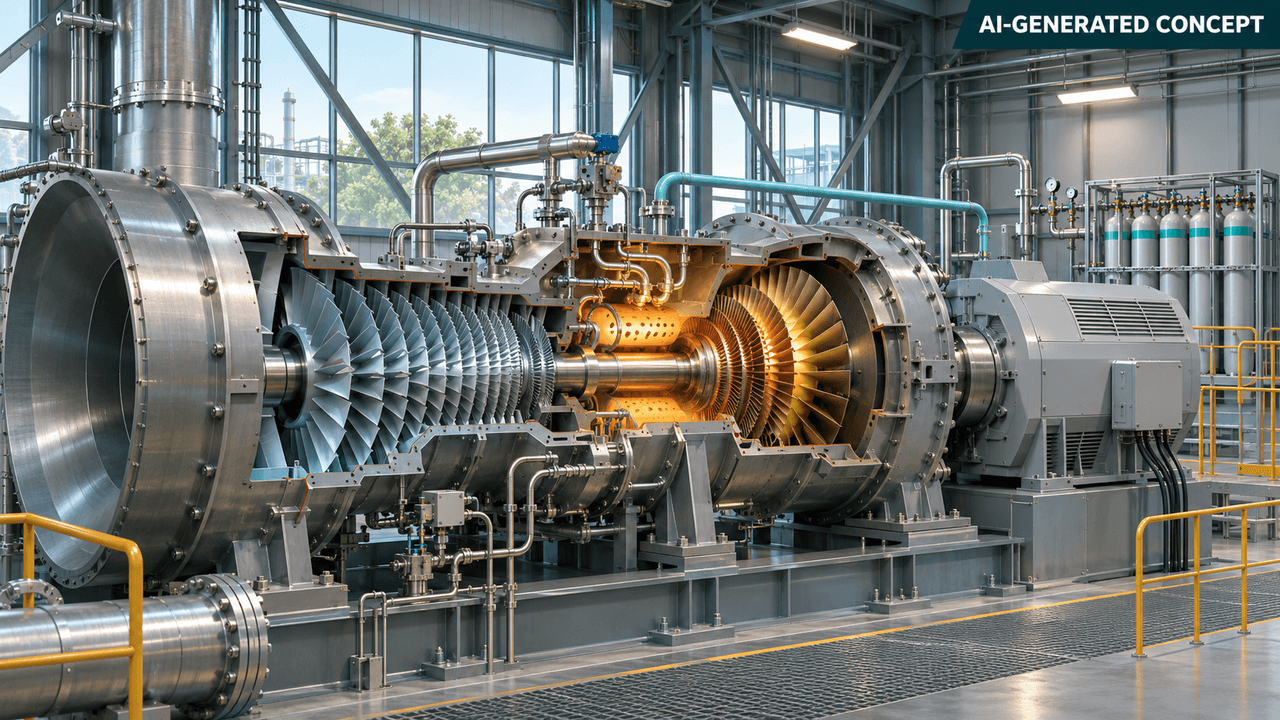
At a power station in northern Germany, engineers are preparing to turn renewable electricity back into electricity. The detour runs through hydrogen: use power to split water, keep the resulting fuel, then burn it when the grid needs it. A new 34-megawatt turbine in Lingen has entered trials aimed at making that sequence practical at industrial scale. [1]
The attraction is the ability to wait. Wind and solar can produce energy hours, days or months before it is needed. Storing some of that output as hydrogen could give a power system a fuel reserve to draw on through an extended shortage of renewable generation. [2]
RWE and Kawasaki Heavy Industries marked the start of trial operations at the Emsland power station on November 6. The companies plan several months of testing, including operation with up to 100 percent hydrogen. The trial will feed hydrogen directly from nearby GET H2 Nukleus electrolyzers powered by renewable electricity. The turbine can also use natural gas or blends of the two fuels. [1]
The commercial question is how much a dependable reserve is worth. Turning electricity into hydrogen and back consumes energy at both stages. A plant intended for occasional shortages also has relatively few operating hours in which to recover its construction cost. Lingen offers a place to measure the machinery that would sit at the end of that supply chain. [3]
Controlling a different flame
Hydrogen changes the engineering inside a gas turbine. Its flame travels faster than a natural-gas flame, and its lower energy content per unit of gas volume requires larger fuel flows for a given output. Burning pure hydrogen removes carbon dioxide from fuel combustion, while the hot flame can still produce nitrogen oxides, air pollutants that need to be controlled. [3]
Kawasaki has developed two approaches to that problem. One uses water injection to reduce nitrogen-oxide formation. The other, called Micro-Mix, divides combustion among many small, fast-mixing cells and controls emissions without injecting water or steam. Kawasaki reports that the respective approaches were demonstrated at its Kobe installation in 2018 and 2020. [4]
The original Lingen plan called for testing both combustion systems, scaling up principles previously demonstrated in 1 MW versions in Japan. It also proposed varying the turbine load between 30 and 100 percent, a way to examine how the equipment behaves as demand changes. That 2021 announcement envisaged a possible mid-2024 start. The project has now reached its field-trial stage. [5]
“The operational experience gained will be key for the deployment of even larger turbines,” Nikolaus Valerius, chief executive of RWE Generation, said in the commissioning announcement. [1]
The price of storing electricity as fuel
A simple energy budget shows why efficiency matters. The U.S. Department of Energy lists 55 kilowatt-hours of electricity per kilogram of hydrogen as its 2022 system benchmark for one common electrolyzer technology. Hydrogen contains about 33.3 kilowatt-hours per kilogram on a lower-heating-value basis, which excludes heat recovered by condensing water vapor. [6, 7]
Assume a turbine converts 40 percent of that fuel energy into electricity. Each kilogram would return about 13.3 kilowatt-hours, or roughly 24 percent of the electricity used to make it. Compression and storage would add further losses. This illustrative calculation combines a historical electrolyzer benchmark with an assumed turbine efficiency. Lingen’s results could differ. [3, 6, 7]
The same arithmetic translates a hydrogen price into a power price. At an assumed delivered fuel price of €4 per kilogram and 40 percent conversion efficiency, hydrogen alone would cost about €300 for each megawatt-hour of electricity generated. Halving the fuel price halves that figure. Construction, maintenance and financing come on top. The €4 price is chosen for illustration. A project estimate would require the actual supply contract. [7]
Those costs make the intended operating pattern crucial. A reserve plant that runs for a few difficult weeks can contribute to reliability while consuming relatively little fuel over a year. Its owner still needs enough revenue to keep the equipment available between those periods. Evaluating such a plant requires comparing complete supply plans that meet the same reliability requirement, including the cost of storing enough energy for a prolonged shortfall.
Fuel supply is growing from a small base. The International Energy Agency’s 2026 Global Hydrogen Review reports that low-emissions hydrogen production rose 20 percent in 2025 to almost one million tonnes. It expected the category to exceed one percent of world hydrogen production in 2026. High costs, uncertain demand and incomplete infrastructure continue to constrain expansion. [8]
The fuel reserve has to be built too
“Hydrogen would be good for seasonal and long-term storage,” Sandia National Laboratories chemical engineer Tuan Ho said in a 2024 account of his team’s research. Large underground stores are central to that prospect. Salt caverns provide one option, while researchers are investigating depleted oil and gas reservoirs, including whether hydrogen can be recovered cleanly and kept from escaping. The geology available near a plant helps determine its choices. [2]
Lingen sits within an effort to assemble this wider infrastructure. Gas-network operator OGE describes GET H2 Nukleus as a connection between hydrogen production and industrial customers, with existing gas pipelines being converted and a new link planned to a hydrogen salt-cavern store at Gronau-Epe. Such shared networks could let a power generator draw on fuel produced and stored beyond its own site. [9]
Independent research shows how much location can matter. A 2024 Nature Communications study modeled renewable-hydrogen supply to industrial users across the United States. Storage requirements varied sharply with local wind and solar output. Where suitable underground sites were unavailable, storing hydrogen in a liquid chemical carrier introduced additional equipment, energy use and cost. The study concerned steady industrial supply, but it illustrates why a turbine’s location and fuel arrangements belong in the economic assessment. [10]
What the Lingen trial can establish
The commissioning announcement describes the trial’s scope without reporting efficiency, emissions or commercial operating-cost results. [1] Useful measurements would show how performance changes with hydrogen concentration and electrical load. Buyers could then estimate fuel consumption and judge how much dependable capacity a larger plant could provide.
Lingen moves hydrogen backup power into a setting where those questions can be tested with industrial equipment. If the machinery performs well, utilities will have a stronger basis for designing a reserve that turns stored renewable energy into power during the hours when it is most valuable.
Sources
1. RWE, Hydrogen-fuelled power generation: RWE and Kawasaki commence trial operations with 34-MW gas turbine in Lingen, November 6, 2026. Trial stage, fuel supply and Valerius quotation. Read source
2. Sandia National Laboratories, Sandia studies subterranean storage of hydrogen, April 4, 2024. Tuan Ho quotation and underground-storage research. Read source
3. Baringa for the UK Department for Energy Security and Net Zero, Hydrogen to Power Costs and Barriers, published January 14, 2026. Pages 7–9, 40–41 and 59–63 cover operating roles, turbine performance and combustion requirements. Benchmarks concern generic plant types, not the Lingen unit. Read source
4. Kawasaki Gas Turbine Europe, Hydrogen technology. Manufacturer descriptions of diffusion-flame and Micro-Mix combustion and earlier demonstrations. Read source
5. RWE, RWE and Kawasaki plan to build one of the world’s first 100% hydrogen-capable gas turbines on industrial scale in Lingen, Germany, December 9, 2021. Original test plan and schedule. Read source
6. U.S. Department of Energy, Technical Targets for Proton Exchange Membrane Electrolysis. The system table identifies 55 kWh/kg as 2022 status, distinct from later targets. Read source
7. U.S. Department of Energy, Program Record 9013, Energy requirements for hydrogen gas compression and liquefaction as related to vehicle storage needs, 2009, page 1. Used for hydrogen’s 33.3 kWh/kg lower heating value. Energy-return and euro-cost examples are JetsonsAge calculations using explicitly stated assumptions. Read source
8. International Energy Agency, Global Hydrogen Review 2026, executive summary. Production figures and barriers to deployment. Read source
9. OGE, GET H2 Nukleus. Description of the planned production, transport, storage and industrial-use network. Network plans are distinct from the turbine trial. Read source
10. Hanna Breunig and colleagues, Achieving gigawatt-scale green hydrogen production and seasonal storage at industrial locations across the U.S., Nature Communications 15, 9049, October 19, 2024. DOI 10.1038/s41467-024-53189-2. Public copy held by the U.S. national laboratory. Read source