Runway opens its video-trained robot model to developers
Praxis-1’s public code and weights let developers adapt a video-trained model to their own robots, with performance measured in simulation and controlled physical tests.
Published November 13, 2026Intelligence / Robotics / Autonomous Systems
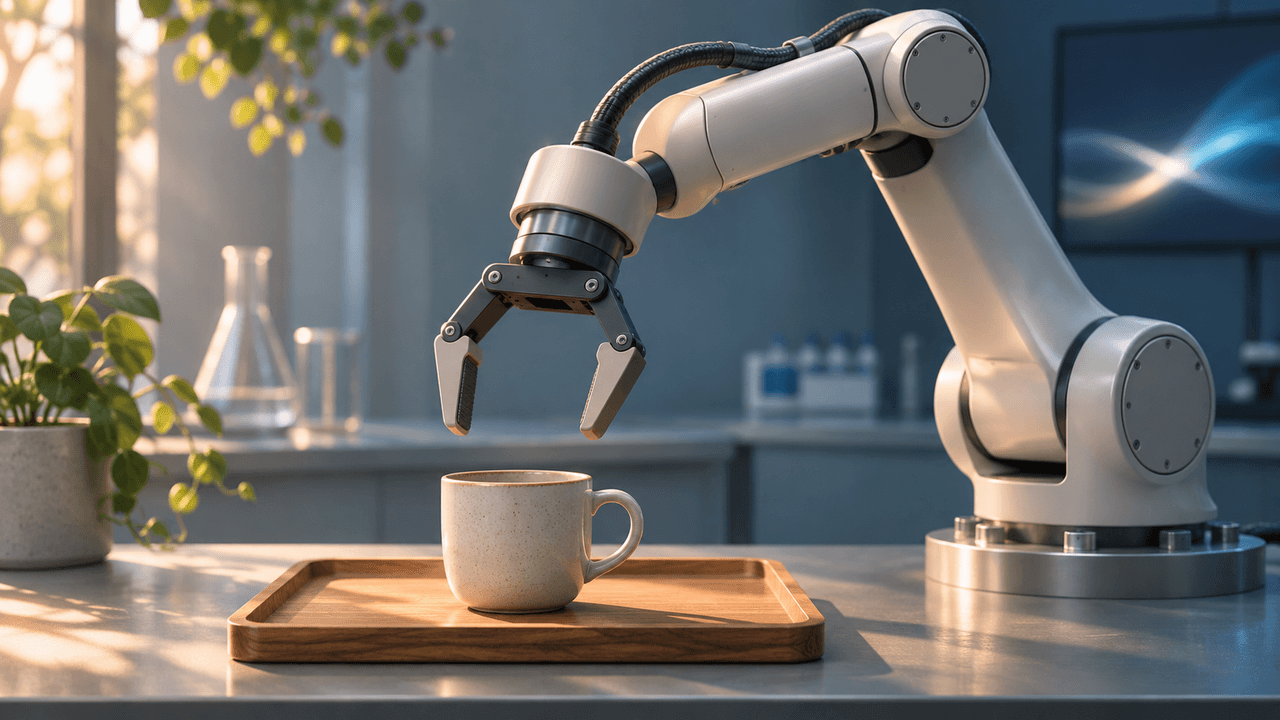
Runway released the code and model weights for Praxis-1 on November 11, giving robotics developers access to a system that learns from video and turns instructions into physical movements. The release follows its September introduction through partners working with machines including industrial arms and warehouse robots.
The system gives a team a starting model to adapt to its own robot and tasks. Runway says the release uses the Apache 2.0 license, which permits commercial use subject to its terms. Its public repository includes ready-trained versions for particular robots, simulation tools and instructions for further training.
Praxis-1 takes a written instruction, camera images and the robot’s current pose. It predicts roughly 1.6 seconds of movements along with video of the result it expects to see. The robot carries out a sequence, takes another look at its surroundings and continues. That repeated observation allows its actions to respond to the changing scene.
The model first learns from general video, then receives further training involving human activity and robot movements. Runway’s technical report explains the premise: “A model trained to predict that video learns how objects behave, how hands move and what a task looks like partway through.” Training on a particular robot then connects that visual knowledge to the commands its motors can execute.
Its most prominent benchmark result comes from simulation. The RoboLab-120 leaderboard records 555 successful trials out of 1,200 for Praxis-1, reported as 46.2%: 120 tabletop tasks attempted ten times each. The same table lists FLUX 3 Action at 515 successes, or 42.9%. These are controlled simulated tasks; the leaderboard also includes other types of systems with higher scores.
Runway reports a separate physical-robot comparison on ten manipulation tasks, with ten attempts at each on the same Franka FR3 test rig. Praxis-1 completed 88 of the 100 attempts, compared with 80 for FLUX 3 Action. Those company-reported tests and the released demonstration videos show laboratory performance. Reliability across changing equipment, objects and workplaces still depends on testing the intended application.
Running the standard version requires substantial hardware. The documented setup uses 16-bit weights and an Nvidia graphics processor with at least 80 GB of memory. A compressed version reduces the size of parts of the model, but the repository says peak memory on an RTX 5090 has yet to be measured and that the relevant consumer-GPU path has not been tested with a robot repeatedly acting and observing. The particular trained model and compression settings therefore need their own checks.
Adapting the system also requires examples from the target task or machine. Runway identifies failures involving similar-looking objects, vague instructions and long sequences requested in a single prompt. The public release lets developers investigate those boundaries directly, including how much additional training data and engineering work a useful task requires.