A German Town Plans a Battery That Builds Upward
Gaggenau plans a €15.2 million zinc-bromide installation that stacks battery units vertically, with construction targeted for 2027 and commissioning for 2028.
Published November 13, 2026Briefs / Energy / Grid Technology
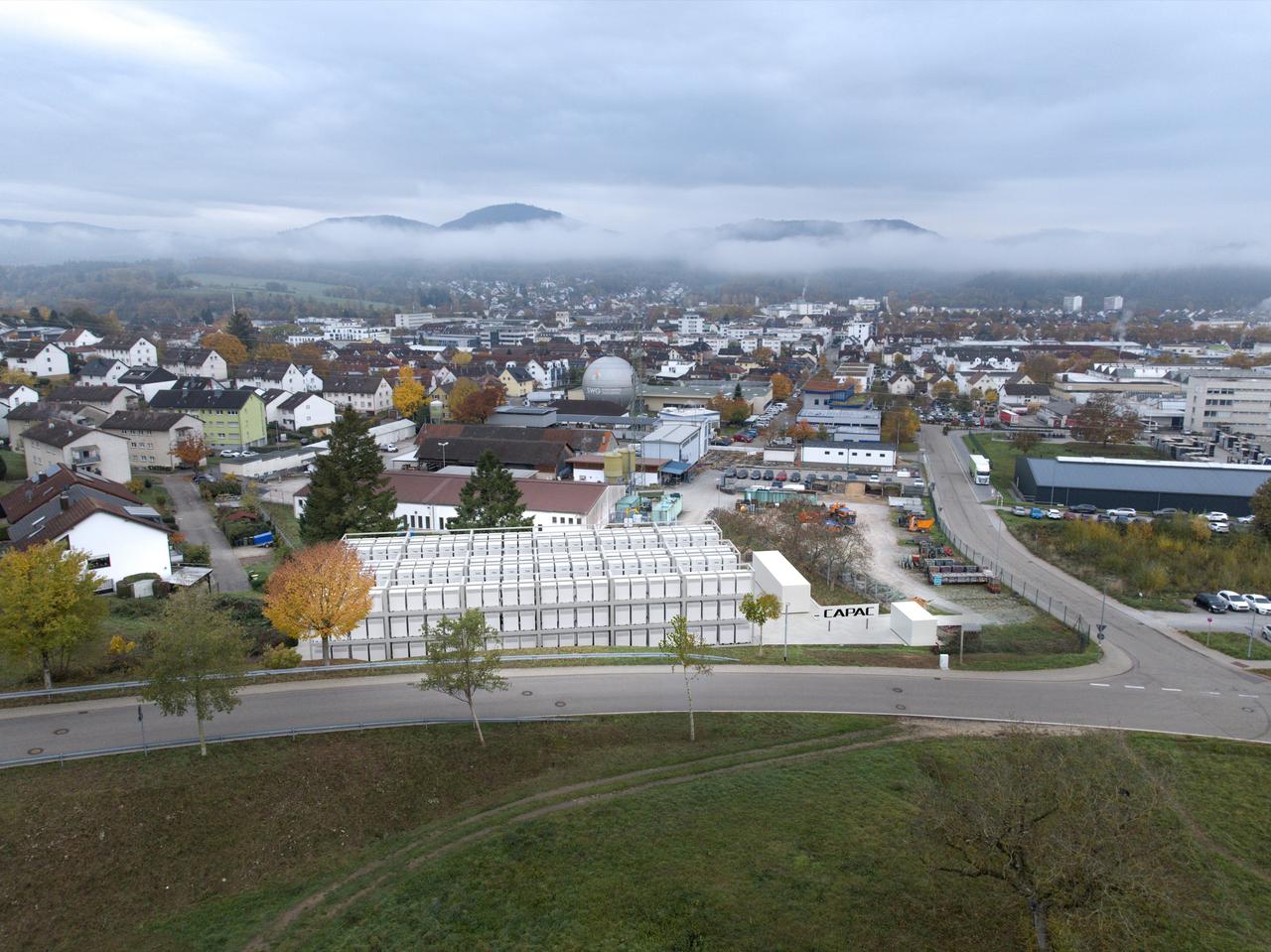
Gaggenau's municipal utility plans to stack battery units above one another at a former liquefied-gas site. The arrangement would use the site's height to make room for electricity stored for later in the day.
The proposed zinc-bromide installation is designed to deliver 7.5 megawatts and store 30 megawatt-hours—a four-hour supply at its rated power. The utility announced the project on November 10, with construction planned for 2027 and commissioning in 2028.
Stadtwerke Gaggenau and JP Holding plan to invest approximately €15.2 million. CAPAC will handle engineering, procurement, integration and construction using Eos batteries. The project expects revenue from electricity trading and grid services.
Storage in a smaller footprint
Eos's Indensity design places modular battery units in a steel support structure. The units can sit beside one another and on multiple levels, giving designers another way to fit storage into a constrained industrial site.
Inside the sealed batteries, charging stores energy by depositing zinc on an electrode. A water-based electrolyte—the liquid that carries charged particles—allows ions to move between the electrodes during charging and discharge. Eos describes the chemistry as suited to storage over several hours.
The equipment still needs thermal management. Eos's technical account describes internal fans that move air through each Core unit, and its datasheet specifies forced ambient air.
The datasheet's four-hour column lists a maximum 81% round-trip efficiency—the energy returned compared with the energy put in—for a cycle from 20% to 80% state of charge and back, subject to other optimal conditions. This measures the unit on its direct-current side. The future plant's performance will need to be assessed at the grid connection, including losses when converting between direct current and the grid's alternating current, as well as other operating losses.
Dividing the announced budget by the planned 30,000 kilowatt-hours of capacity gives about €507 per kilowatt-hour. This is a project-budget ratio; operating costs and the electricity delivered over the plant's life will determine its overall economics. Commissioning and subsequent operation will show how well the stacked design uses the site and earns revenue from shifting electricity between hours.
Primary sources
Sources · 5
- https://www.stadtwerke-gaggenau.de/de/Home/Startseite/AktuellesNeu/Aktuelles2/Stadtwerke-setzen-auf-stapelbaren-Batteriegrossspeicher_72819.html
- https://www.presseportal.de/pm/182853/6387979
- https://www.eose.com/technology/
- https://www.eose.com/insight/eos-indensity/
- https://www.eose.com/wp-content/uploads/2026/03/900-0139_00-Eos-Indensity-Core-Datasheet.pdf