Prometheus rehearses the starts a reusable rocket needs
Tests in Germany bring a simpler starting method, a new combustion chamber and more capable ground facilities into Europe’s reusable-engine program.
Published November 10, 2026Intelligence / Space Development / Advanced Propulsion
A rocket returning to Earth may need its engine to come back to life after the climb into space. A later burn can slow the vehicle for landing, placing a demanding requirement on the machinery that powered its ascent. Engineers developing Europe’s Prometheus engine are working through that sequence on the ground. [2]
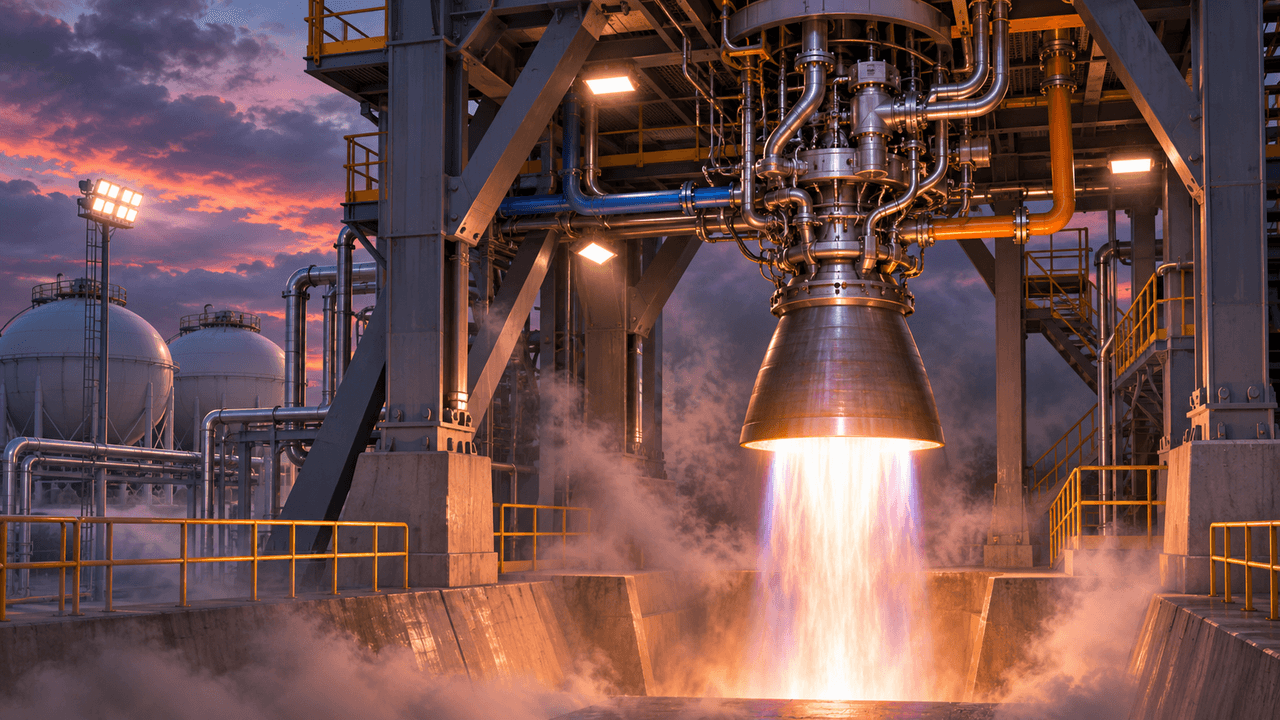
On October 29, the methane-fueled engine completed several hot-fire tests at Lampoldshausen in Germany. The European Space Agency and the German Aerospace Center, DLR, announced the results on November 6. The campaign tested an upgraded facility alongside a newly manufactured combustion chamber, adding practical evidence to a program aimed at making European rocket engines easier to build and reuse. [1]
ArianeGroup, which develops Prometheus for ESA, reported a particularly useful result: the engine started with the pressure available at its inlets, dispensing with a separate high-pressure starter system. The potential advantage is simpler starting hardware, an attractive prospect for an engine intended to work repeatedly. [1] [3]
Prometheus had already demonstrated four consecutive ignitions at ArianeGroup’s Vernon site in France on June 20, 2025. That earlier campaign accumulated operating time and helped engineers refine the engine and its subsystems under different thrust profiles. The latest work extends that development to the P5 test stand and a different starting arrangement. [4]
Preparing for another burn
A restart begins well before the next flame appears. After a hot run, the test team must shut down the engine and its supplies safely, drain and purge the feed systems, and restore the required pressures and temperatures. Coordinating those steps repeatedly is part of the engineering problem. [2]
“Up to five ignitions in a single test day place high demands on the coordination of the test stand systems,” said Anja Frank, head of the DLR Institute of Space Propulsion, in the center’s announcement. DLR says the updated facility can automate that preparation and reproduce it reliably. [2]
P5 belongs to ESA and is operated by DLR. Its methane upgrade gives engineers another place to investigate the behavior of a large engine as it moves through successive operating phases. ArianeGroup says the campaign also validated the stand for long-duration firing with liquid oxygen and methane. More capable ground facilities allow teams to examine these sequences before committing an engine to flight. [1] [3]
Building an engine for repeated use
The manufacturing work addresses another part of the same ambition. The tested combustion chamber used cold gas spray, a process that drives metal powder at high speed onto a component, where it bonds to the surface. ArianeGroup is using additive manufacturing extensively to simplify complex parts and shorten production. [3]
Fuel choice also shapes the design. ESA says methane can be handled at warmer temperatures than liquid hydrogen and avoids the soot problems associated with kerosene in reusable engines. Prometheus pairs it with liquid oxygen. An electronic regulation system is designed to adjust thrust over a broad range, giving a future vehicle the control it needs as its flight changes from ascent to descent. [5]
ESA’s stated manufacturing ambition is substantial: an engine that costs roughly one-tenth as much to build as the preceding generation of 1,200-kilonewton engines. That figure is a design target. The case for lower launch costs will ultimately depend on how the hardware performs in service, how much work it needs between flights and how often it can fly. Reducing chamber costs would contribute to that larger calculation. [5]
The path toward flight
ArianeGroup is preparing an improved version, Mark 2, for a test campaign at Vernon. Prometheus also forms part of ESA’s Themis reusable-stage demonstration effort, connecting engine development to the work of controlling and recovering a complete rocket stage. [3] [4]
The October result remains a ground demonstration. It does not establish flight qualification, repeated recovery or an operating cost per launch. The public announcements leave the precise number and duration of that day’s burns unspecified. Those details will matter as the program builds evidence about endurance and repeatability. [1] [2] [3]
For Europe, the useful advance is a growing ability to test the routines that reusable launchers depend on. A simpler start, a chamber built by a different process and a facility ready for demanding sequences each address a piece of the work. Their value will become clearer as successive engines run longer and the technology moves into flight demonstrations. [1] [3] [4]
Sources
1. ESA. Prometheus reusable rocket engine fires up at improved test bench. November 6, 2026.
2. DLR. Prometheus test marks significant milestone for reusable rocket engines. November 6, 2026.
3. ArianeGroup. Prometheus reusable rocket engine reaches new development milestone with hot-fire test on DLR’s P5 test bench. November 6, 2026.
4. ESA. Prometheus fires up once again and again. July 2, 2025.
5. ESA. Prometheus. July 2, 2025.
Sources · 5
- https://www.esa.int/articles/about-us/directorates/space-transportation/future-space-transportation/prometheus-reusable-rocket-engine-fires-up-at-improved-test-bench
- https://www.dlr.de/en/latest/news/2026/prometheus-test-marks-significant-milestone-for-reusable-rocket-engines
- https://press.ariane.group/essai-a-feu-du-moteur-reutilisable-prometheus-au-banc-p5-du-dlr-une-nouvelle-etape-cle-de-developpement-518213/?lang=eng
- https://www.esa.int/articles/about-us/directorates/space-transportation/future-space-transportation/prometheus-fires-up-once-again-and-again
- https://www.esa.int/articles/about-us/directorates/space-transportation/future-space-transportation/prometheus