GE and BETA Give a Regional Aircraft an Electric Boost at Takeoff
GE Aerospace and BETA Technologies have added takeoff to the flight phases in which their modified Saab 340B uses electric assistance.
Published November 8, 2026Intelligence / Transportation / Urban Air Mobility
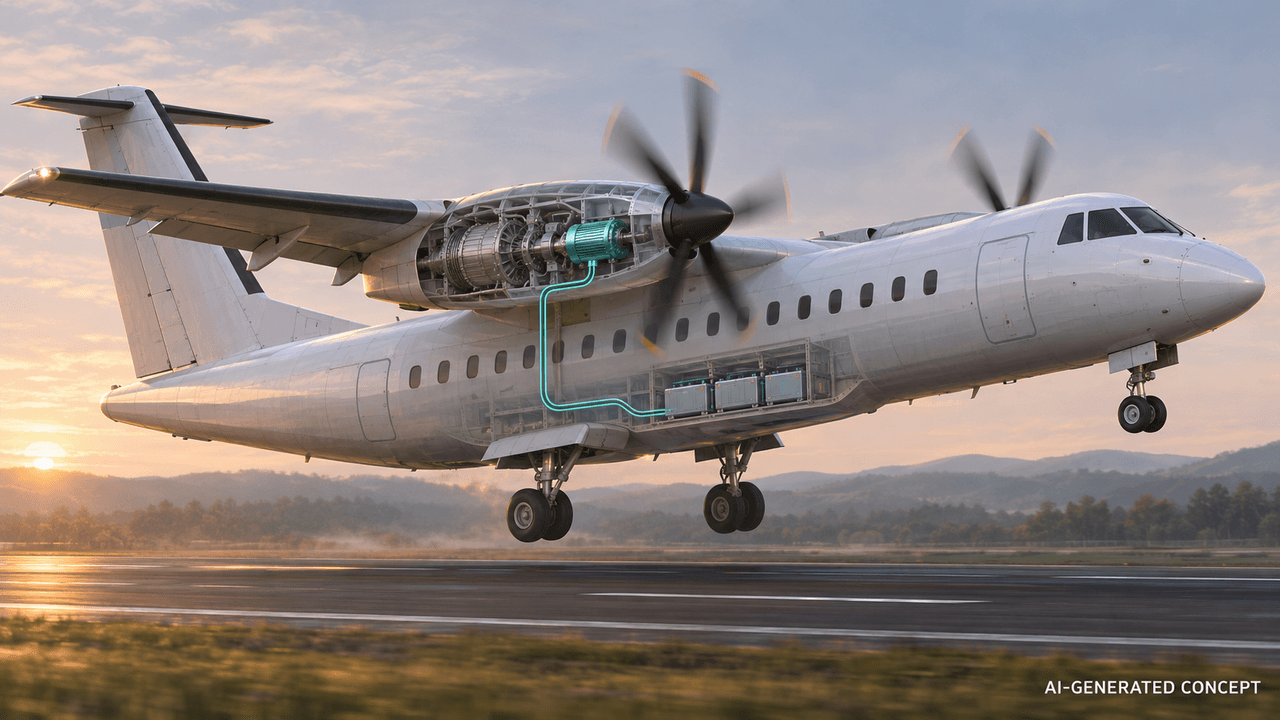
An ordinary-looking regional airplane has taken off with an unusual division of labor: a turbine burning fuel, and batteries helping turn a propeller. GE Aerospace and BETA Technologies announced the demonstration on November 4, adding takeoff to the flight phases in which their hybrid system has supplied electric assistance. For electric aviation, the interesting development is how much can change inside an aircraft that still looks familiar. [1]
The test used a modified Saab 340B at BETA’s facility in Plattsburgh, New York. A conventional GE CT7 engine powered one side; the right-hand engine combined turbine and electric power. GE reported a quieter departure based on early observations, without publishing a noise measurement or a takeoff fuel-saving figure. [1]
That gives the story a different focus from the race to launch electric air taxis. The Saab is a flying laboratory for propulsion technology, while BETA’s ALIA program includes purpose-built electric aircraft. Lessons from combining turbines, motors and batteries could reach aircraft beyond either design. [2, 5]
The central engineering question is how to make those components work together throughout a flight. A battery can contribute power when needed, while a motor-generator can also replenish it. The value depends on the complete system: its weight, cooling, reliability and energy use. Getting the hardware airborne allows engineers to test those tradeoffs outside a laboratory. [2, 4]
Electric power joins another phase of flight
Previous tests used electric assistance in climb and cruise, with regeneration during cruise and descent. The newly announced departure extends that work to takeoff. GE describes it as a first for a hybrid-assisted aircraft designed for passenger operations at commercial-airliner altitudes. The announcement does not establish a scheduled passenger service. [1]
The program had already flown above 30,000 feet in May 2026. Its public debut followed at July’s Farnborough International Airshow. Keeping those dates separate matters: the November news concerns assisted takeoff, rather than the first flight of the hybrid testbed. [2, 4]
In an October account of the program, Christine Andrews, GE Aerospace’s executive hybrid electric systems leader, explained the flexibility: “We’re able to pull power off of the batteries as well as recharge the batteries in flight.” That earlier comment describes the system’s capability, rather than a new measurement from the takeoff test. [4]
A familiar aircraft with demanding new hardware
BETA served as systems integrator for the high-altitude demonstration. BAE Systems supplied its batteries, and Boeing subsidiary Aurora Flight Sciences supplied the nacelle, the enclosure around the engine. GE’s equipment included motor-generators and electronics that convert and control electrical power. The right-hand installation used an inverted nacelle for additional ventilation. [2]
Cooling is one of the practical obstacles to putting substantial electrical power aboard an aircraft. NASA describes years of research into thermal management, batteries and lighter power systems, followed by integration with the engine and airframe. Tests in 2022 simulated conditions at 45,000 feet before the system progressed to flight. [3]
Ralph Jansen, an aerospace engineer at NASA’s Glenn Research Center, captured the appeal of that familiar exterior in NASA’s July report: “It’s just like a regular plane, which is probably the best thing of all.” For passengers, a successful propulsion change would ideally require very little thought at all. [3]
What the demonstration leaves to prove
The larger ambition is lower fuel consumption and operating costs. The published reports do not yet establish how much this takeoff demonstration would save across a complete commercial trip. Those answers require measured performance, including the consequences of carrying the electrical equipment. [1, 3]
GE connects the work to CFM International’s RISE technology program, whose broader goal exceeds a 20 percent fuel-burn improvement over engines in service today. That target covers a collection of technologies and is not a measured saving from the Saab’s electric assistance. RISE remains a demonstration program, not an engine on sale. [2]
The useful next evidence will be detailed noise results and whole-flight energy data, followed by proof that a production system can deliver those benefits reliably. For now, the achievement is concrete: electric power has helped a regional aircraft leave the runway. [1]
Sources
1. GE Aerospace takeoff announcement (November 4, 2026).
2. GE Aerospace high altitude announcement hosted by BETA (July 20, 2026).
3. NASA on the hybrid electric flight demonstration (July 20, 2026).
4. GE Aerospace account of the high altitude flight program (October 27, 2026).
5. BETA company timeline (Accessed November 6, 2026).
Sources · 2
- https://www.geaerospace.com/news/press-releases/ge-aerospace-partners-beta-technologies-worlds-first-hybrid-electric-assisted
- https://investors.beta.team/news-events/press-releases/detail/114/ge-aerospace-partners-with-nasa-beta-technologies-and-boeing-on-worlds-first-high-altitude-hybrid-electric-flight