COMAC Flies Its Electric Regional Aircraft With a Crew Aboard
Two pilots and a flight-test engineer flew aboard COMAC’s CE-25A in Binzhou, China, on November 14, completing the electric regional aircraft’s first piloted flight.
Published November 15, 2026Intelligence / Transportation / Urban Air Mobility
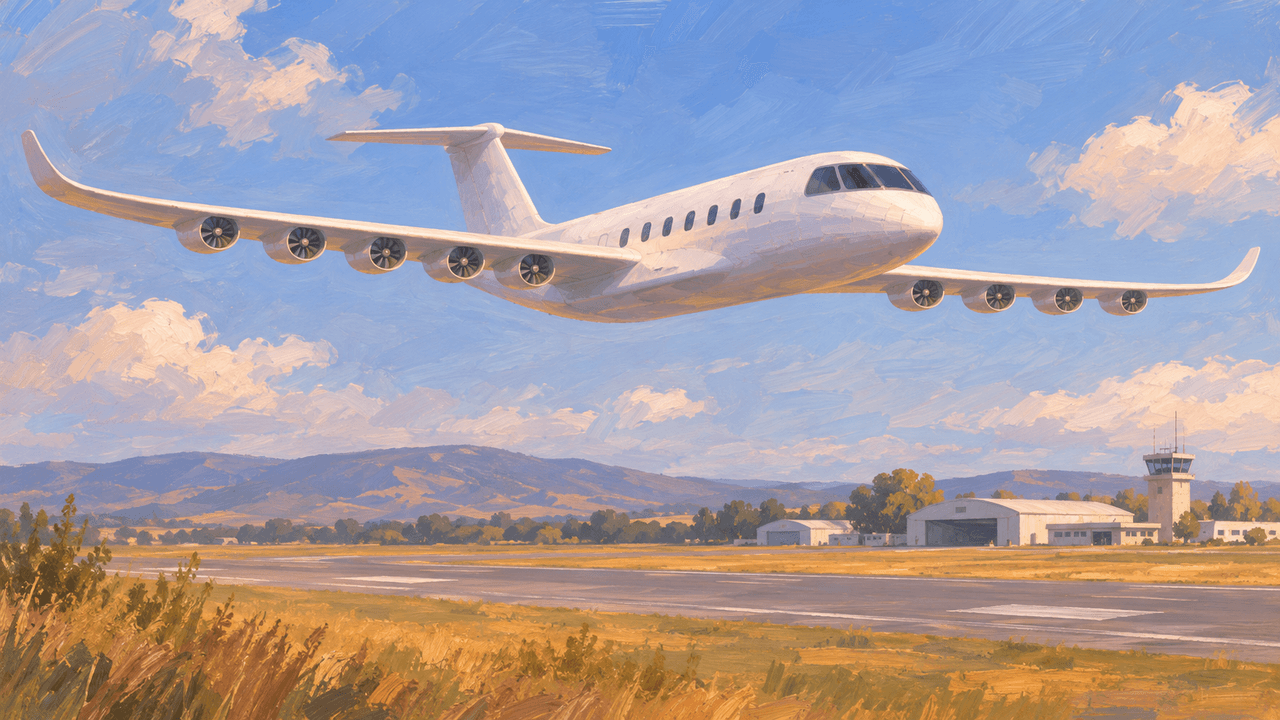
Two pilots and a flight-test engineer flew aboard COMAC’s CE-25A in Binzhou, China, on November 14, completing the electric regional aircraft’s first piloted flight. Xinhua reported the milestone after speaking to COMAC. Xinhua
Designed for 19 passengers and a 400-kilometer range, the aircraft targets trips between nearby cities. Electric propulsion could change the energy, maintenance and airport infrastructure needed to serve those routes.
COMAC reports 16 minutes and 38 seconds airborne, covering 60.4 kilometers, within a test lasting 57 minutes and 46 seconds. The 400-kilometer figure describes the design goal. Company statement
The program previously completed 19 uncrewed flight validations following its February 2 first flight. Piloted testing brings the crew directly into evaluating the aircraft’s systems and handling.
Moving the motors onto the wing
COMAC uses electric ducted fans distributed over the wing: several electrically driven fans, each enclosed by a surrounding duct. COMAC statement
Electric propulsion gives designers considerable freedom over where to place motors. The air moved by a propeller or fan also interacts with the wing. With careful design, propulsion can help the wing produce lift as well as drive the aircraft forward.
NASA explored those interactions through its X-57 research. Its planned configuration placed small propellers along the wing’s leading edge to increase airflow during takeoff and landing, while separate wingtip motors supplied cruise propulsion. The research illustrates the opportunity to design the wing and power system together. The particular benefits achieved by the CE-25A will emerge from its own testing. NASA’s X-57 overview
Power must reach the motors through cables, switching equipment and controls, while the aircraft carries the weight of that system and removes the heat it produces.
The battery is an aircraft system
COMAC’s development partners include CATL and Shanghai Jiao Tong University. Xinhua
For an electric aircraft, energy density describes how much energy can be stored for a given weight. The installation around the cells includes connections, protective enclosures, cooling and monitoring. Each component contributes to the mass that the wings must lift.
A 2021 NASA study described X-57 cells rated at 225 watt-hours per kilogram forming a complete pack rated at 149 watt-hours per kilogram. Packaging changes the figure relevant to an aircraft designer, who must account for the entire system. NASA battery-scaling study
“It’s a lot of power, and one battery system has to deliver it, and it’s got to fit in the plane,” NASA project manager Brent Cobleigh said in a 2019 account of the X-57 work. Its engineers developed packaging that could contain a failing cell and prevent the problem spreading through the pack. NASA Spinoff
Different routes toward regional service
Eviation’s Alice demonstrator flew for eight minutes in Washington state in September 2022; the company’s passenger design accommodated nine travelers. That flight provided an earlier American example of electric regional-aircraft testing. Eviation’s flight announcement
Heart Aerospace is pursuing a larger hybrid design. Its current ES-36 specifications describe 36 seats, a 200-kilometer all-electric range and a 1,200-kilometer hybrid range, with entry into service targeted for 2031. These remain development targets. The architectures reflect different choices about passenger capacity, stored energy and the routes an airline could serve. Heart Aerospace
For operators, dependable range must come with reserves, manageable battery replacement costs and enough time between flights to recharge. Those conditions will shape ticket economics alongside motor efficiency.
China’s aviation regulator has accepted COMAC’s type-certificate application. The company identifies transport-category CCAR-25 standards as its certification framework; passenger service depends on completing that process. Xinhua