A Berkeley Robot Learns the Give-and-Take of a Greeting
Social Humanoid uses a person’s movement to shape its next response, bringing a familiar social skill into a supervised robotics experiment.
Published November 8, 2026Intelligence / Robotics / Humanoid Robotics
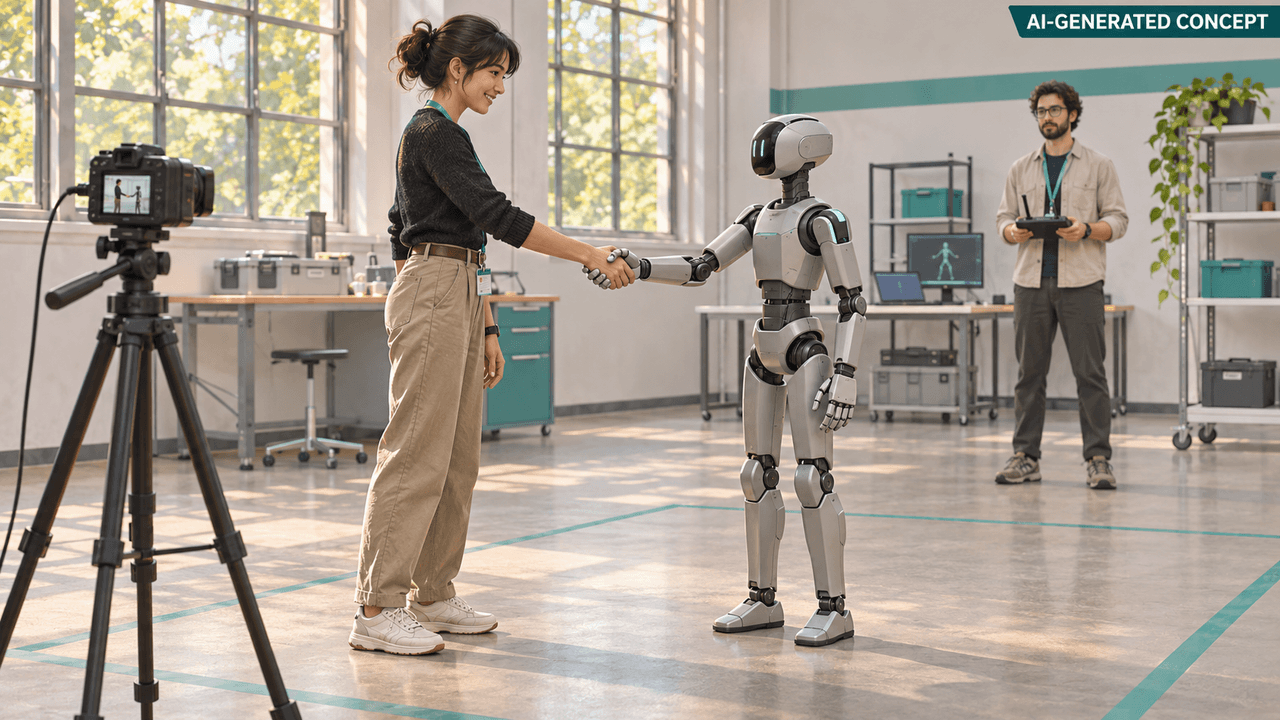
In a Berkeley-led team’s demonstration, a person offers a hand to a small humanoid. The machine reaches back and bends forward after the handshake. Its task is familiar to anyone greeting another person: keep adjusting as the other person moves. [2]
The system, called Social Humanoid, was developed by researchers at the University of California, Berkeley, Sony and Meta. It generates a robot’s response from live video of a human partner. Its demonstrations include high-fives, hugs and walking together, with a Unitree G1 supplying the arms, legs and balance. [2]
A greeting brings several problems together. An outstretched hand offers a location to reach, a clue about what is happening and a deadline that keeps changing. A machine sharing space with people needs to handle that give-and-take even when the person moves differently from the example it learned.
The work, described in a paper posted November 5, remains a supervised experiment. A tripod-mounted camera watches the interaction, most computing runs off the robot, and a separate operator can interrupt its motion. The contribution is a way to connect a person’s changing movement to the machine’s next action. [1]
Teaching two different bodies to meet
The researchers built training examples from five motion-capture datasets of people interacting, converting the recordings into 260 hours of paired human–humanoid motion. That conversion has to preserve where two bodies meet: shrinking a person’s movements to fit the shorter G1 can leave the other person reaching to the wrong height. [2]
Their method first adapts one person’s movement to the robot, then adjusts the recorded partner’s pose to preserve the interaction. It gives the learning system examples of how a smaller mechanical body and a human body can coordinate. A shared motion vocabulary lets the software represent both, predict their movement and generate the robot’s response. [2]
NVIDIA’s SONIC controller supplies the final stage: turning a desired movement into coordinated action. SONIC’s own research uses large collections of human motion to train a general-purpose movement controller, with demonstrations spanning navigation, teleoperation and object handling. Social Humanoid builds another layer above that foundation, choosing a response to a nearby person. [1] [3]
Several kinds of progress
Related research is advancing different parts of this problem. Ready-to-React, presented at ICLR 2025 by a team including Zhejiang University and Shenzhen University, generated responsive movement between virtual characters, using boxing as a demanding test. Each character’s next move depended on the interaction so far. Its setting offers a way to study timing and anticipation before dealing with a physical machine. [4]
NVIDIA’s Metatron work tackles the motor-control side. A developer can supply goals for a hand, foot or torso, and the controller coordinates the rest of the body. Its hardware examples include steering, sitting and physical guidance. This gives robotics researchers another way to connect a chosen task to whole-body movement. [5]
Physical sociability also has a substantial history. In research published in 2023, Alexis Block and colleagues tested HuggieBot’s responses to gestures made during a hug. Their work included ratings from 32 users with one version of the robot and a further study with 16 users of HuggieBot 3.0. Those experiments asked how people experienced the contact, bringing perception and preference into the evaluation. [6]
Taken together, these projects show why a convincing social robot needs several kinds of evidence. Generating a suitable movement, carrying it out on hardware and making the encounter comfortable each requires its own test. Progress in one area becomes more useful when it can be connected to the others.
What the trials establish
Social Humanoid’s authors report 30 real-robot trials per behavior across four participants. High-fives succeeded in 90 percent of trials; handshakes, waves, hugs, bending and linked arms reached 100 percent. Success meant an appropriate completed response with the robot upright and the operator remaining hands-off. [1]
These results support further work on responsive movement. For close contact, the authors state that “physical contact is not actively regulated.” Force control, human comfort and the social appropriateness of responses remain subjects for further study. [1]
For the person standing opposite the machine, the questions are immediate: does it respond at the expected moment, make contact gently and let the encounter end? Broader trials across body sizes and movement abilities would show how consistently the system meets those expectations.
Sources
1. Social Humanoid paper, experiments and system-safety appendix
2. Social Humanoid project, method and hardware demonstrations
3. NVIDIA SONIC research project
4. Ready-to-React research project, ICLR 2025
5. NVIDIA Metatron research project
6. Block and colleagues, In the Arms of a Robot, ACM Transactions on Human-Robot Interaction (2023)