America is rebuilding its rare earth supply chain
New mines are attracting attention while processing plants and magnet factories begin to change what the country can actually produce
Published November 8, 2026Intelligence / Materials / Smart Materials & Programmable Matter
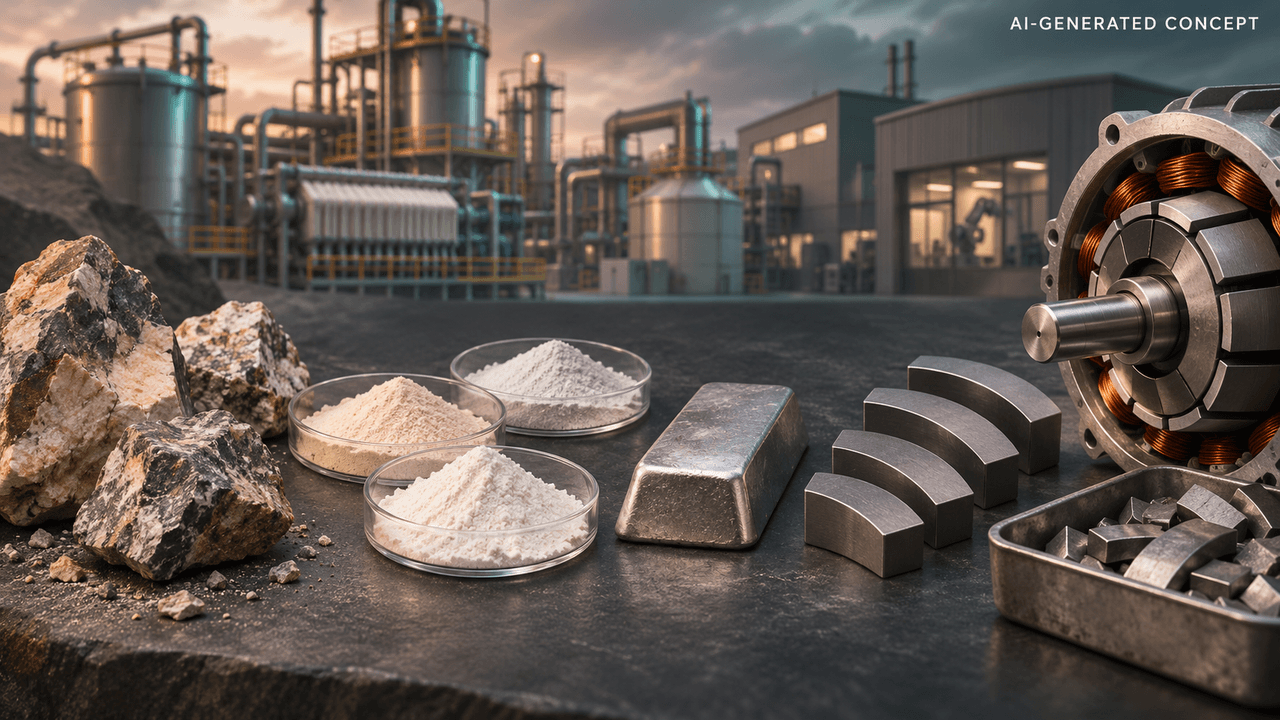
American manufacturers are beginning to get an alternative to a supply chain that has run overwhelmingly through China. In California, MP Materials produced more than 1,000 metric tons of separated neodymium-praseodymium oxide in the third quarter of 2026. In Texas, the company completed General Motors’ qualification process for magnets and said saleable deliveries were beginning in the fourth quarter. Years of mining, chemical engineering and factory construction are starting to produce something a customer can use. [1]
That matters far beyond the mining industry. Powerful permanent magnets help make electric motors compact and efficient. They are used in many electric vehicles, wind turbines, industrial machines and defense systems. When China tightened exports in 2025, shortages forced some automakers to cut production. A relatively small component could hold up a much more expensive finished product. [3,38]
The giant discoveries in Wyoming and promising samples from Montana offer another possibility: a much larger American source of the minerals themselves. But their development schedules stretch well beyond the factories now opening. Ramaco’s Brook Mine is preparing for a pilot plant in 2027. Halleck Creek’s latest study models commercial production in 2031. Sheep Creek is still seeking permission for exploratory drilling. [7,10,12]
The United States is making progress at several stages at once, with markedly different levels of certainty. It has measured production from an established mine and separator, new magnet factories, successful laboratory and pilot runs, and a growing collection of projects awaiting financing or construction. Understanding which advances can supply manufacturers soon requires following the material all the way from the ground to the finished magnet.
What America has to rebuild
Rare earths are a family of 17 elements, rather than a single commodity. The magnet business is especially concerned with the light rare earths neodymium and praseodymium, usually sold together as NdPr, and the heavy rare earths dysprosium and terbium. NdPr supplies the main rare-earth ingredient in neodymium-iron-boron magnets. Small additions of dysprosium or terbium can help certain magnets resist demagnetization at high temperatures. Samarium serves a different magnet chemistry, samarium-cobalt, with demanding industrial and defense applications. Rare earths also have important uses outside magnets. [5,38]
The production chain has several distinct stages. A mine extracts rock and concentrates the valuable minerals. Chemical treatment releases the rare earths. Separation divides a mixed stream into the desired products, often oxides. Metallization converts oxides into metals, which can then be alloyed and manufactured into magnets. Manufacturers must qualify those magnets for particular applications. Success at one stage does not establish that the next stage is available. [38]
China’s advantage grows as material moves downstream. The International Energy Agency estimates that in 2024 China accounted for 60 percent of global mining of the four main magnet rare earths, 91 percent of their refining and 94 percent of sintered rare-earth permanent-magnet production. Those figures describe different activities, not interchangeable measures of the same market. [3]
The United States already mines substantial quantities. The U.S. Geological Survey estimates 2025 domestic production at 51,000 metric tons of rare-earth-oxide equivalent in mineral concentrates, compared with 8,900 tons of compounds and metals. Its estimated net import reliance for compounds and metals was 67 percent. That measure excludes much of the dependency embodied in imported motors, magnets and finished products. China supplied 71 percent of direct U.S. compound and metal imports over 2021–2024, a multiyear measure rather than a 2026 snapshot. [4]
Mountain Pass is producing at meaningful scale
MP Materials’ Mountain Pass operation in California provides the clearest evidence that domestic separation can expand beyond demonstration quantities. Its 1,018 metric tons of NdPr oxide in the third quarter represented a 41 percent increase from a year earlier. The company separately reported 12,887 tons of rare-earth-oxide content in concentrate. The much larger concentrate number should not be mistaken for finished magnet material. [1]
MP’s latest filing says it stopped all sales to Chinese customers in July 2025 and did not renew the Shenghe offtake agreement when it expired in January 2026. That is a consequential change for a company whose earlier business depended on shipping concentrate into the Chinese processing system. Its domestic development now includes the Independence magnet facility in Fort Worth. [2]
Heavy rare earths remain less advanced. MP began additional processing of its mixed heavy-bearing stream during the third quarter and expected separated terbium and dysprosium by the end of 2026. At the November 7 cutoff, that remained a target. The company’s reported NdPr volumes cannot be used as evidence of sustained Dy or Tb production. [2]
GM qualification demonstrates that magnets meet a customer’s requirements. The next evidence to watch is repeat shipments, accepted products and sustained output as production rises. [1]
White Mesa is extending the chemistry to heavier elements
Energy Fuels is adapting the White Mesa Mill in Utah, an established uranium-processing site, to rare-earth production from monazite. In March 2026, the company announced one kilogram of 99.9 percent-pure terbium oxide, following approximately 30 kilograms of dysprosium oxide, from U.S. monazite. These were pilot quantities, but they demonstrated an ability to isolate two particularly consequential magnet ingredients. [5]
The larger equipment is still being built. Energy Fuels’ November filing puts completion of its new terbium and dysprosium circuits as early as the first quarter of 2028. Their design capacities are approximately 21 and 122 metric tons a year, respectively. Existing NdPr capacity is about 1,000 tons annually, which is a plant rating rather than a statement of actual yearly output. [6]
Feedstock and scheduling help explain the gap. White Mesa’s present arrangement shares equipment between uranium and monazite campaigns. The next monazite campaign is planned after a uranium run extending into the second quarter of 2027. The heavy expansion is being timed to expected concentrate from the Donald project in Australia, whose final investment decision was still targeted for the end of 2026. Domestic refining can therefore reduce dependence on China while continuing to rely on imported ore. [6]
Energy Fuels also has a much larger proposed expansion, with completion targeted for mid-2029 and subject to licensing, financing, feedstock and an investment decision. Its planned acquisition of magnet maker VAC had not closed as of the November update. Both remain development plans. [39]
The Wyoming discoveries are moving through harder tests
Brook Mine, near Sheridan, drew attention in 2023 with comparisons to deposits in western China. Its rare earths occur in coal and surrounding sedimentary material. Ramaco has mined material for testing and holds a coal-mining permit over part of the property. Its rare-earth estimates remain inferred resources, with substantial geological uncertainty and no demonstrated economic viability. Declaring a reserve requires stronger evidence that a defined portion can be mined economically under specified conditions. [8]
In February 2026, Ramaco switched its proposed process to high-temperature carbochlorination, broadening its potential products to include gallium, alumina and quartz. Much of the rare-earth output would be a mixed carbonate sold to third-party refiners. The plan still needs downstream separation capacity. Gallium and germanium, although strategically important, are not rare-earth elements. [8]
The November 3 update reported laboratory recoveries averaging 92 percent for NdPr and 97 percent for dysprosium and terbium combined. These results support further testing of the process. They do not establish continuous plant performance, product qualification or profitable commercial recovery. Ramaco now expects completion of the pilot plant in the second half of 2027, alongside further study work. Refinery financing and prospective sales arrangements remain under discussion. [7]
Halleck Creek, farther south in Wyoming, has the scale behind the billion-tonne headlines. American Rare Earths reports about 2.63 billion tonnes of mineralized rock containing approximately 8.65 million tonnes of total rare-earth oxides. The rock averages roughly 0.33 percent total rare-earth oxides. Its size is significant, but only a fraction of the contained material is the magnet elements, and only a fraction of those can ultimately become saleable products. [9]
The September 2026 Cowboy State Mine study makes those constraints unusually visible. It models a first phase processing 4.5 million tonnes of ore a year, producing about 2,500 tonnes of NdPr oxide annually, with commercial production beginning in 2031. Estimated initial capital rose from $456 million in the previous study to $900 million. No ore reserve has been declared. [10]
The study also lowered assumed product recoveries to 58.2 percent for NdPr, 28.7 percent for terbium and 12.4 percent for dysprosium. The especially low heavy-rare-earth recoveries show why a deposit’s total size can give a misleading impression of its ability to relieve a specific shortage. The new estimate remains a scoping study, and the company says its EXIM letter of interest is not committed financing. [10]
Physical work is progressing. The October quarterly report recorded 18 completed feasibility-stage drill holes and the start of crushing test-mined material. The pilot pathway includes concentration in Wyoming and separation work at Saskatchewan Research Council in Canada, with separated oxide targeted for late in the second quarter of 2027. That international demonstration can inform an eventual U.S. commercial plant without constituting an operating domestic supply chain today. [11,40]
Other mines offer different kinds of potential
Sheep Creek in Montana remains an exploration project despite its selected high-grade samples and strategic attention. Montana received an application in October for 45 core holes from three drill pads. The federal permitting record expressly excludes commercial extraction and ore processing from the proposed work. Its FAST-41 listing makes the review more visible; it does not authorize a producing mine. Representative drilling and metallurgical testing must establish what the deposit can reliably yield. [12,13]
Bear Lodge in Wyoming is farther along in process demonstration. Rare Element Resources reported on November 2 that its Upton demonstration plant had produced a total rare-earth oxide intermediate in September. Commissioning of separation equipment was continuing toward commercial-grade separated NdPr. The company expected remaining federal and state permits for Bear Lodge in early 2028. A mixed intermediate is useful evidence of progress, but it leaves a material step before qualified individual products. [14]
Round Top in Texas is being developed by USA Rare Earth as part of a broader processing and magnet business. In its August update, the company expected its definitive feasibility study to be completed in the fourth quarter and published in early 2027. Its Colorado demonstration facility had produced qualification samples of Dy and NdPr oxides from recycled magnet swarf, the fine waste from magnet manufacturing. Those samples demonstrate a processing capability on that feedstock, not commercial recovery from Round Top ore. [15]
Elk Creek in Nebraska adds a different model: rare earths alongside niobium, scandium and titanium. NioCorp’s August feasibility study incorporated rare-earth reserves and products, including planned average annual output of 672 tonnes of NdPr oxide, 67 tonnes of dysprosium oxide and 17 tonnes of terbium oxide. Upfront capital is estimated at about $1.85 billion. Portal construction is underway, but production and full financing remain ahead. In October, EXIM reiterated a financing target of about 65 percent of upfront capital while due diligence continued. The study’s reliance on premiums for non-Chinese products is an important commercial assumption. [35,36]
Ucore’s Bokan-Dotson Ridge deposit in Alaska is another longer-term candidate, distinct from the company’s nearer-term Louisiana refining investment. Its heavy-rare-earth fraction includes yttrium and other elements, so it cannot be read as an equivalent percentage of valuable Dy and Tb. California’s Colosseum project also has rare-earth exploration ambitions, but these are separate from its gold-development case and remained subject to legal uncertainty in November. Neither belongs in a tally of current U.S. rare-earth supply. [37,41]
New processing companies are filling different gaps
Ucore is building the Louisiana Strategic Metals Complex around its RapidSX separation technology. Its October 27 update targeted installation, testing and commissioning of the first machine in the first half of 2027, followed by customer qualification. The initial machine is designed for about 600 tonnes a year of contained total rare-earth oxide input. A larger proposed configuration would reach approximately 9,600 tonnes of annual input capacity. These are design-throughput figures, not current output of finished magnet oxides. [17,18]
Phoenix Tailings has an operating metallization facility in Exeter, New Hampshire. Its opening announcement described an initial 200-ton annual production capability, with NdPr metal and dysprosium-iron alloy among the first products. Actual annual shipments were not disclosed in that announcement. The distinction matters because making metal from supplied oxides addresses a different bottleneck from separating the elements out of a mixed feed. [19]
Phoenix is also expanding upstream. On November 5 it announced support for its Rochester, New York, Freedom Separation project, designed to process more than 18,000 tons of feedstock into more than 4,400 tons of separated oxides annually at full capacity. Production is scheduled to ramp in 2027 and reach full production in 2028. A $500 million federal conditional loan commitment and an estimated $54.2 million package of state, local and infrastructure incentives support the plan, with conditions and approvals still applying. The Rochester project should be counted separately from Exeter’s existing operations. [20]
ReElement Technologies uses chromatographic separation for recycled material and primary concentrates. It reports daily rare-earth oxide production at its smaller Noblesville, Indiana, validation facility. Its larger Marion campus received an air permit in August, and the company announced operation of its first commercial-scale germanium column. The broader rare-earth refinery is still being developed. [21,46]
ReElement’s additional project with POSCO International would combine separation with a prospective downstream magnet business. POSCO’s May announcement described a planned $200 million investment, an initial 3,000-ton annual separation phase and eventual expansion to 6,000 tons, with mass production targeted for 2028. The sourcing plan includes overseas material. Such partnerships broaden the non-Chinese industrial network while leaving the United States connected to international mines and suppliers. [22]
Magnets are beginning to find American customers
The United States is no longer limited to proposals for large-scale sintered-magnet manufacturing. eVAC says its Sumter, South Carolina, factory began commercial production in 2025, including automotive-traction-grade magnets. Its approximately 2,000-ton annual nameplate capacity describes potential factory output, not disclosed shipments. Noveon also manufactures sintered magnets in the United States. ABB’s own announcement confirms a supply agreement for its North American motor operations, an important indication of customer demand rather than simply a producer’s expansion ambition. [23,24]
USA Rare Earth commissioned the first phase of its Stillwater, Oklahoma, facility in March 2026. Its August update retained a target of a 600-ton annualized production rate by the fourth quarter. A target run rate is not the tonnage produced over an entire year, and the update did not establish that the target had been reached. Its newer Blacksburg, South Carolina, project broke ground in September, with commissioning targeted for 2028 and planned annual capacities of 6,400 tons of magnets and 5,000 tons of strip-cast metal and alloy. [15,16]
Vulcan Elements adds a defense-focused route. It announced Army selection for small-drone magnets in September while building a larger factory in Benson, North Carolina. Its stated 10,000-metric-ton annual capacity and 2027 commissioning date are expansion targets, distinct from its existing Research Triangle Park operations. [44,45]
These factories create potential domestic buyers for the oxides and metals being developed elsewhere. But their presence alone does not establish that all inputs are American or free of Chinese processing. A credible claim of independence needs the origin of the feedstock and the location of separation, metallization, alloying and magnet manufacturing to be traceable.
Allied capacity is already part of the response. Lynas’ March 2026 agreement with the Pentagon created a framework for approximately $96 million in oxide purchases over four years. The company said it had changed the earlier arrangement because construction of its planned Texas heavy-separation plant remained uncertain. Supply through Australia and Malaysia can help American customers, while remaining different from an operating U.S. refinery. [32]
Recycling and industrial waste could add supply sooner
Recovering rare earths from used equipment offers a route that does not begin with opening a new mine. Cyclic Materials opened its Mesa, Arizona, facility in September. Its 25,000-ton annual capacity refers to magnet-bearing products entering mechanical recovery, not 25,000 tons of recovered magnets or rare-earth oxides. The company’s planned South Carolina recycling and refining campus targets 2028 operations, initially producing 600 tonnes of mixed rare-earth oxide annually and eventually 1,800 tonnes. A long-term VAC agreement would supply magnet-manufacturing swarf. [25,26]
Manufacturing scrap is especially attractive because its composition is better known and it is generated in concentrated streams. End-of-life motors, wind turbines and electronics require collection, disassembly and sorting before their rare earths can enter a refinery. A mixed recovered oxide still needs further separation unless it goes into a process specifically designed to use it. Recycling will grow more useful as domestic magnet factories generate scrap and older equipment reaches retirement. [3,25,26]
Coal ash, mine drainage and industrial residues offer another set of possibilities. In July, the Department of Energy selected five coal-related pilot projects for award negotiations totaling $75 million, including work led by the University of North Dakota, Valor Metals, CONSOL Innovations, American Resources and Peabody. In June, it announced $134 million in proposed support for two demonstrations, including a Colorado School of Mines-led project using alumina-refinery red mud in Louisiana and a Phoenix Tailings industrial-waste project. In both announcements, selection remained subject to negotiations rather than a guarantee of funding. [27,28]
Smaller research efforts could improve the economics of those materials. Sandia describes a coal-ash extraction method using carbon dioxide, water and a complexing agent, tested on kilogram-scale samples and advanced to technology-readiness level five. That is a development result requiring demonstration under relevant operating conditions. Whether a process works on varied feedstocks with acceptable reagent use, waste treatment and product quality will determine its industrial value. [29]
Public money is changing the commercial calculation
A new processor must pay for equipment and years of development before customers can qualify its products. Buyers, meanwhile, may hesitate to commit until those products exist. Commodity prices can fall during the buildout, leaving a strategically valuable plant unable to compete on price. The financing packages now appearing address different parts of that problem.
MP’s 2025 Pentagon agreement included a $400 million preferred-equity investment, a $150 million heavy-separation loan commitment, support for another magnet factory and a ten-year NdPr price floor of $110 per kilogram under the agreement’s formula. Its latest filing records $8.1 million of price-protection income in the third quarter of 2026. That is evidence of an operating support mechanism, rather than a general statement of government interest. [2,34]
USA Rare Earth’s January nonbinding financing letter was followed by definitive agreements in June for up to $277 million in grants and a $1.3 billion loan, with disbursement tied to milestones. Elsewhere, Phoenix’s loan remains described as conditional, and the letters supporting Halleck Creek and Elk Creek should not be counted as money already available for construction. Adding all these announcements together as committed spending would overstate what has been secured. [15,20,10,36]
Stockpiling addresses a more immediate vulnerability. In February, EXIM approved a direct loan of up to $10 billion for Project Vault, a public-private critical-minerals reserve intended to protect manufacturers against supply shocks. Glencore announced a $500 million commitment to the initiative in September. The announcements establish a financing and procurement effort, but do not disclose a verified quantity of rare earths already stored. A reserve can buy time during a disruption while new processing capacity is built. [42,43]
Permitting coordination can help projects advance, but it does not remove technical or environmental requirements. A November 3 term sheet between REalloys and the Army proposed a heavy-rare-earth facility at Tooele Army Depot in Utah. It was nonbinding, with a lease, financing and environmental reviews still required. The Army was not obliged to buy its output. Such initiatives may become useful connections between mines and customers, but their next agreements will determine whether they can be built. [33]
The economics and environmental costs still have to work
Recoverable magnet material is a more useful measure than total rock in the ground. A large deposit may contain mostly lower-value elements. A high laboratory recovery can deteriorate when variable ore moves continuously through a plant. Expanding throughput raises power, water and reagent requirements. Even a technically sound project can struggle if its financing assumes prices or premiums customers will not pay.
Halleck Creek’s higher capital estimate and lower recovery assumptions illustrate the value of revising a project as engineering improves. Brook’s new process changes both its product mix and its need for outside refiners. White Mesa’s feedstock and campaign schedule show that installed equipment cannot be separated from the material available to run through it. These are central parts of the commercial case, rather than details to be settled after announcing capacity. [7,8,10,6]
Environmental management also varies by deposit and process. Some rare-earth ores occur with uranium and thorium, requiring careful handling of radioactive residues. Chemical extraction creates obligations for water treatment, emissions control and long-term waste storage. Recovering metals from an existing waste pile may reduce a legacy problem, but the new operation must still account for the residues it leaves behind. [38]
At White Mesa, nearby members of the Ute Mountain Ute Tribe have organized against continued mill operations, citing concerns about health, water, air and sacred sites. Those objections place health, monitoring and public trust at the center of the expansion debate. A 2011 USGS investigation examined potential migration of contaminants and recommended additional monitoring. The history makes clear why communities need accessible monitoring and a meaningful role in decisions about expansion. [30,31]
What would make the next two years decisive
The near-term tests are specific. MP must turn qualification into repeat magnet deliveries and demonstrate the promised heavy-oxide output. Energy Fuels must complete its circuits and secure the feedstock to operate them. Ucore and Phoenix must commission their new separation equipment. Magnet manufacturers need sustained production at customer specifications, and recyclers need enough recoverable material to keep their plants supplied.
The newer mines face longer tests. Brook’s pilot must show that its revised process works beyond the laboratory. Halleck Creek needs better-defined recoveries, permits and a financeable development plan. Sheep Creek must establish its resource through exploration. Bear Lodge, Round Top and Elk Creek need to turn their different combinations of studies, construction and demonstration work into commercial operations.
America now has a more credible rare-earth industry taking shape than the discovery headlines alone suggest. Its strongest evidence is the material already being separated, the magnets reaching qualification and the customers agreeing to buy them. A durable alternative to China will emerge as those operating links multiply and connect. The most revealing announcements will report what left a plant, who accepted it and whether the plant can keep doing it economically.
Sources and scope
This analysis surveys major U.S. mining, separation, metallization, recycling and magnet projects, with selected allied links and research programs. It is not a census of every exploration claim or laboratory project. Developments were checked through November 7, 2026. Company disclosures establish what companies report; forecasts, nameplate capacities and conditional financing are identified as such. All tonnages are metric where the source specifies metric units; Phoenix figures retain the company’s stated “tons.”
1. MP Materials third quarter 2026 results. November 5 2026. Measured NdPr and concentrate output and GM magnet qualification.
2. MP Materials third quarter SEC filing. November 2026. China sales, heavy separation targets and price protection accounting.
3. IEA Rare Earth Elements executive summary. 2026. 2024 magnet rare earth supply shares and the effects of 2025 export controls.
4. USGS Mineral Commodity Summaries rare earths chapter. 2026 revised chapter. 2025 production and import reliance estimates and 2021–2024 import sources.
5. Energy Fuels heavy rare earth pilot production. March 25 2026. Terbium and dysprosium pilot quantities and purity.
6. Energy Fuels third quarter SEC filing. November 4 2026. Circuit capacities, 2028 schedule, processing campaigns and Donald feedstock.
7. Ramaco third quarter 2026 results. November 3 2026. Laboratory recovery results and revised pilot and study timetables.
8. Ramaco Brook Mine project questions and answers. Accessed November 7 2026. Inferred resource, coal permit, mining and revised mixed-carbonate processing plan.
9. American Rare Earths Halleck Creek resource statement. Accessed November 7 2026. Resource tonnage, grade and contained oxides. Its older economic summary is superseded by source 10.
10. Cowboy State Mine updated scoping study. September 30 2026. Capital, output, recovery assumptions, 2031 model and financing status.
11. American Rare Earths September quarterly activities report. October 29 2026. Drilling completion, test material processing and development work.
12. Montana DEQ Sheep Creek exploration application. October 15 2026. Application received October 7 and proposed drilling scope.
13. Federal permitting dashboard Sheep Creek Project. Accessed November 7 2026. Exploration-only scope and permitting status.
14. Rare Element Resources Upton and Bear Lodge update. November 2 2026. First total oxide intermediate, separation commissioning and permitting target.
15. USA Rare Earth second quarter results. August 10 2026. Round Top study, recycled-feedstock samples, Stillwater target and definitive government agreements.
16. USA Rare Earth Blacksburg groundbreaking. September 9 2026. Planned magnet and alloy capacities and 2028 commissioning target.
17. Ucore Louisiana project team and construction update. October 27 2026. First-machine commissioning target in the first half of 2027.
18. Ucore Louisiana engineering and deployment plan. May 28 2026. Initial and expanded contained-oxide input capacity.
19. Phoenix Tailings Exeter metallization opening. October 23 2025. Operating metal-making facility and stated initial capacity.
20. Phoenix Tailings Rochester project support. November 5 2026. Planned separation throughput, oxide output, schedule and conditional support.
21. ReElement Technologies company newsroom. August 2026 entries. Marion air permit and first commercial-scale germanium column.
22. POSCO International and ReElement U.S. production plan. May 27 2026. Joint investment, phased separation capacity and 2028 production target.
23. VAC Sumter magnet manufacturing update. July 16 2026. Commercial production since 2025 and annual nameplate capacity.
24. ABB selects Noveon for American made magnets. 2025. Customer-side evidence for Noveon magnet supply.
25. Cyclic Materials Mesa recovery facility opens. September 9 2026. Magnet-bearing product input capacity and mechanical recovery stage.
26. Cyclic Materials South Carolina expansion. 2026. Planned mixed-oxide output, schedule and VAC recycling agreement.
27. DOE coal and coal byproduct pilot selections. July 1 2026. Five projects selected for negotiations totaling $75 million.
28. DOE rare earth demonstration project selections. June 2 2026. Red mud and industrial-waste projects selected for award negotiations.
29. Sandia coal ash extraction technology. Accessed November 7 2026. Kilogram-scale testing and technology-readiness level five.
30. USGS White Mesa contaminant migration assessment. 2011. Historical environmental investigation and monitoring recommendations, not a current health finding.
31. White Mesa Concerned Community. Accessed November 7 2026. First-person account of community concerns and opposition to the mill.
32. Lynas U.S. supply agreement announcement. March 16 2026. Four-year purchase framework and uncertainty over the Texas project.
33. REalloys and Army Tooele term sheet. November 3 2026. Nonbinding processing-facility proposal and outstanding conditions.
34. MP Materials Pentagon partnership announcement. July 10 2025. Project-specific equity, debt, price floor and magnet-purchase support.
35. NioCorp Elk Creek updated feasibility study. August 10 2026. Rare-earth reserves, planned products, capital costs and pricing assumptions.
36. NioCorp EXIM financing target update. October 15 2026. Financing target remains subject to due diligence.
37. Ucore Bokan project overview. Accessed November 7 2026. Longer-term mine development and heavy-rare-earth composition.
38. DOE Rare Earth Permanent Magnets supply chain assessment. February 24 2022. Technical background only, not current market shares or project status.
39. Energy Fuels third quarter operational results. November 4 2026. Larger expansion plans and pending VAC acquisition.
40. American Rare Earths shareholder letter. August 31 2026. Wyoming concentration and Canadian separation pilot pathway.
41. Dateline and U.S. government seek appeal stay. November 4 2026. Current Colosseum litigation, distinct from proving a rare-earth resource.
42. EXIM approves Project Vault loan. February 2 2026. Up to $10 billion for a public-private critical-minerals reserve.
43. Glencore Project Vault commitment. September 23 2026. Procurement and delivery commitment, not a disclosed rare-earth inventory.
44. Vulcan Elements Army magnet selection. September 23 2026. Army selection for small-drone magnets and Benson construction status.
45. Vulcan Elements facilities and expansion. Accessed November 8 2026. Existing Research Triangle Park production and planned Benson capacity and commissioning.
46. ReElement Technologies facilities. Accessed November 8 2026. Operating Noblesville validation site and larger Marion development.