A Flash of Heat Turns Old Wind Turbine Blades Into a Useful Resin Additive
Tsinghua researchers have converted blade waste into a material that improves epoxy. Larger reactors and tests of full composites will determine its industrial value.
Published November 8, 2026Briefs / Materials / Advanced Composites
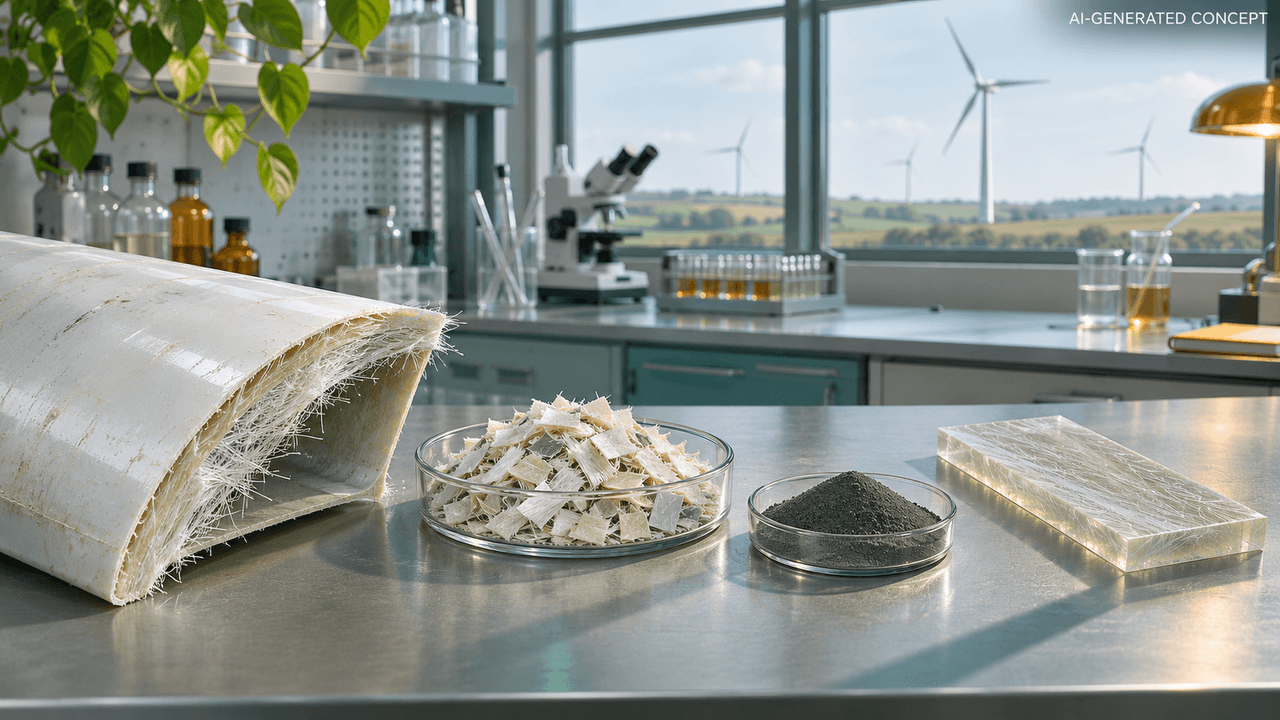
Researchers in China have turned ground-up wind turbine blades into an additive that improves fresh epoxy resin. Their laboratory result could give manufacturers a reason to buy one of wind power's most troublesome leftovers: the tough composite material in blades removed from service. [5]
When a wind turbine comes down, its steel and copper have established routes back into manufacturing. The blades leave a more awkward inheritance: enormous pieces of glass fiber and hardened plastic whose strength makes them difficult to take apart. Their next destination depends on the cost of cutting and transport, the recycling facilities nearby and whether someone wants the recovered material. [1]
The Tsinghua University team, led by Bing Deng and Hao Bi, used a brief burst of electrical heating to convert blade waste into silicon carbide and graphene. Their study, reported November 6 in Chem Circularity, tested small amounts of the resulting mixture in epoxy. [2, 3]
The researchers see a possible use in new blades. Their experiments covered resin samples, with full composite structures and their long-term durability still to be tested. [4]
Using the ingredients already inside the blade
A blade's glass fibers carry loads while the resin binds them into a lightweight structure. Epoxy is a thermoset: curing forms a tightly linked molecular network. Recycling then requires ways to break down that durable network or use the composite in another form. [4]
The technique is called flash Joule heating. After grinding the blade waste, the team adds carbon black to help conduct electricity. A short electrical pulse heats the resistive mixture to about 2,000 degrees Celsius. [4]
At those temperatures, carbon can react with the silica in glass to form silicon carbide, a hard, heat-resistant material. Carbon also rearranges into graphene. The resulting hybrid powder brings the two products into a single additive. [3]
Martín Muñoz Morales, a chemical engineering researcher at the University of Castilla-La Mancha, highlighted the attraction of recovering the components together, “avoiding additional separation stages.” In comments published by Science Media Centre Spain, he described the result as a multifunctional additive. [5]
What the resin tests showed
At an additive loading of 0.3 percent by weight, the resin's Young's modulus rose by 27 percent, according to Muñoz Morales's assessment of the study. That measures stiffness: how strongly a material resists stretching under an applied load. Tensile strength, which concerns how much pulling stress it can withstand before breaking, increased by 11 percent. [5]
The distinction matters when judging possible applications. A stiffer resin and a stronger resin address different engineering requirements. Performance in a blade will also depend on how the resin works with reinforcing fibers, how the full structure is manufactured and how it survives years of repeated loading.
A separate test, using 0.1 percent additive by weight, increased thermal diffusivity by 41 percent. That measures the rate at which heat spreads through the material. [3]
The small dose needed in resin puts commercial demand alongside reactor performance. A recycler would need to know how much usable powder each ton of blades yields and how many manufacturers can absorb it. Buyers would need consistent material and a reason to choose it over existing additives.
A developing route through the recycling problem
Electrical conversion of composite waste has a research history. In February 2024, a Rice University team reported using flash Joule heating to turn waste glass-fiber-reinforced plastics into silicon carbide. Bing Deng, the Tsinghua study's senior author, was a coauthor of that earlier paper. [6, 7]
The approach has also attracted industrial-development support. Among the winners of the U.S. Department of Energy's 2024 Wind Turbine Materials Recycling Prize was United Standard Materials Corporation, whose project uses an electrical pulse to convert blade composites into silicon carbide. Other winners pursued flooring panels and material for large-scale 3D printing. [8]
The November study extends this line of work by examining a combined silicon-carbide and graphene product as an epoxy additive. It sits alongside several possible destinations for retired blades. Existing approaches include grinding material for cement production and using thermal decomposition to recover glass fibers for new composites. Whole sections can also be repurposed into structures such as pedestrian bridges. [1]
For an operator removing blades, geography and demand matter as much as chemistry. A nearby processor with reliable buyers may offer a practical route even while a laboratory develops a higher-value product. The new additive will have to establish its place within that network.
Testing the business beyond the bench
Cell Press reports a projected profit of about $80 per ton of waste. The researchers' environmental model estimates greenhouse-gas emissions 83 percent below pyrolysis and 92 percent below chemical dissolution. These preliminary comparisons with particular recycling routes await confirmation with industrial operating data. [3]
Muñoz Morales calls for evaluation of energy use and economic viability under industrial conditions. In his assessment, the environmental and economic estimates “require validation on a larger scale.” [5]
Most experiments used 0.3 grams of feedstock, Deng and Bi told ConnectSci. They confirmed conversion at 10 grams and built a reactor intended for 200-gram batches. Scaling production and testing full composites remain ahead. [4]
“Real operating data are needed to determine how the process performs in practice,” Deng and lead author Hao Bi told ConnectSci. [4]
Those data will give recyclers and materials buyers something they can price: the amount of consistent, useful powder a plant can produce, the energy and handling each batch requires, and the performance customers gain by using it. A successful process would make an old blade a source of manufacturing material at the moment a wind farm needs somewhere to send it.