Researchers Report Metal Cooling Core Surviving 100 Million Cycles
Making a refrigerator that cools by squeezing metal presents a punishing engineering problem. The metal has to change shape repeatedly without falling apart. Researchers at the Hong Kong University of Science and Technology now report a cooling structure that survived more than 100 million compression cycles. [1, 2]
Published November 8, 2026Briefs / Frontier Tech / Experimental Systems
Making a refrigerator that cools by squeezing metal presents a punishing engineering problem. The metal has to change shape repeatedly without falling apart. Researchers at the Hong Kong University of Science and Technology now report a cooling structure that survived more than 100 million compression cycles. [1, 2]
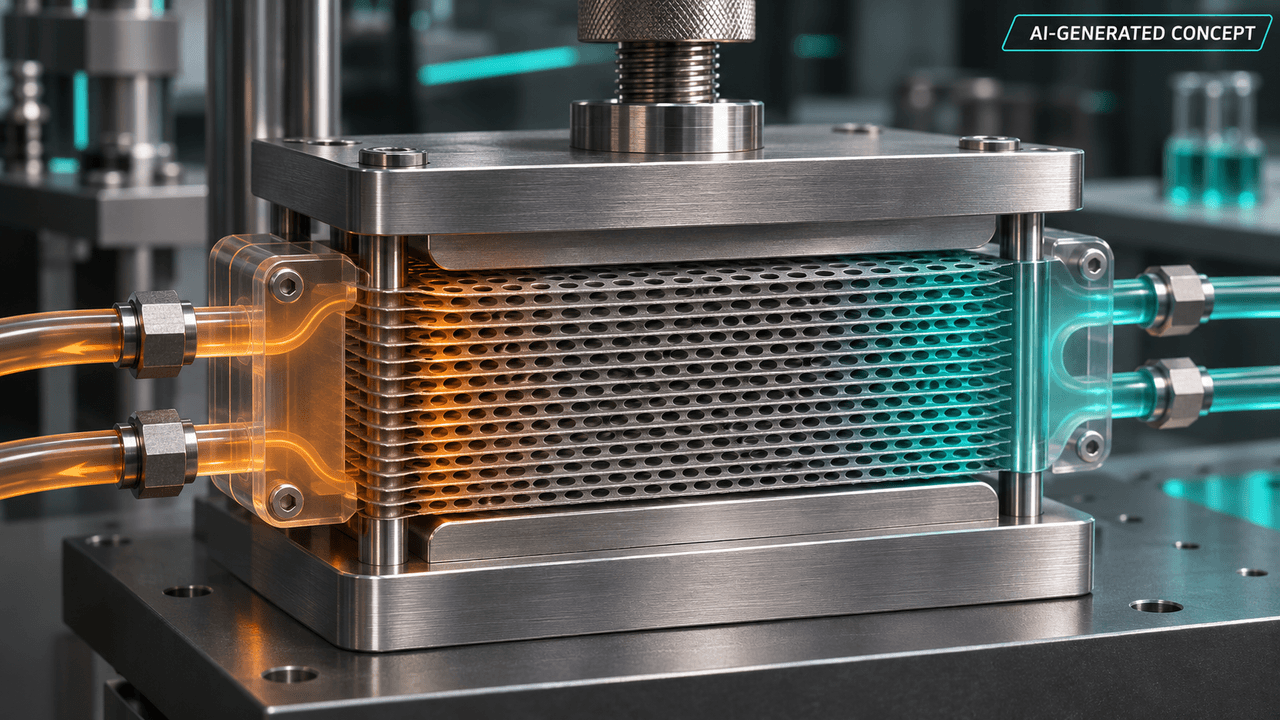
Their design starts with thin nickel-titanium sheets. A machine stamps holes into small pieces, which are then stacked into a compact cooling core. The openings let heat move between the metal and a fluid. HKUST says the interfaces between chips also help stop cracks from splitting the structure along its length. [2, 3]
HKUST says the reported stamping process can produce 100 pieces a minute, more than 100 times faster and 95 percent cheaper than the wire-cut electrical discharge machining used for comparison. Those savings concern fabrication of the refrigerant structure, rather than the price of a complete refrigerator or air conditioner. [2]
“Achieving all three has been a longstanding challenge for the field,” Qingping Sun, a corresponding author, said in HKUST’s announcement. He was referring to fast heat transfer, mechanical reliability and low manufacturing cost. The work appears in Science. [1, 2]
How metal moves heat
A conventional refrigerator circulates a fluid that absorbs heat inside the cabinet and releases it outside. Elastocaloric cooling uses a change within a solid material to perform the heat-pumping cycle. Nickel-titanium belongs to a family called shape-memory alloys, whose internal crystal arrangement can change reversibly under mechanical stress. [3, 4]
Squeezing the alloy makes it release heat. After that heat has been carried away, releasing the force makes the alloy cool, allowing it to absorb heat from its surroundings. Repeating the sequence moves heat from one place to another. The machine still needs a way to apply force and transfer heat; calling the refrigerant solid-state does not mean the entire appliance has no moving parts. [3, 4]
The appeal includes avoiding the high-global-warming-potential gases used in some conventional refrigeration systems. Electricity consumption remains a separate challenge. The International Energy Agency expects cooling demand to grow across its energy scenarios as incomes and temperatures rise, with appliance efficiency becoming increasingly important to the strain on power grids. [4, 5]
What the laboratory result shows
For the latest prototype, the researchers stacked 200 chips into a refrigerant unit just 30 millimeters long. HKUST reports a maximum temperature span of 11.7 kelvin and specific cooling power of 3.85 watts per gram. [2]
The latest figures are reported by HKUST. JetsonsAge could not review the Science full text or supplementary methods, so the test conditions, mass normalization and whether the headline performance figures occurred together remain unverified.
A span of 11.7 kelvin is a temperature difference of 11.7 degrees Celsius, about 21 degrees Fahrenheit. It does not tell readers the coldest absolute temperature reached. Specific cooling power is a mass-normalized measure of heat removal, not whole-machine power or electrical efficiency. It does not give the complete machine’s capacity or its electricity bill. A comparison with a household appliance would also need operating temperatures, cooling load and power consumption measured on the same basis.
HKUST estimates service life beyond ten years. That is an extrapolation from cycling, not a decade-long household trial. [2] The conversion depends on how frequently a device cycles and how many hours it runs. A refrigerator operating continuously and an air conditioner used seasonally would accumulate cycles at different rates.
Structural survival also needs to be distinguished from retaining the original cooling output. A metal component can remain intact while changes inside the alloy reduce the amount of heat it moves. That distinction is particularly relevant to this research program. [3, 4]
A longer test of an existing idea
In May 2026, Changfeng Su, Xueshi Li and Qingping Sun published an earlier study of porous nickel-titanium chips made by stamping and laser cutting. Their stacked samples survived 10,000 compression cycles without major structural failure, although small cracks appeared and the cooling response weakened. For the stamped sample, the measured temperature drop fell from 23.3 to 15.8 kelvin. Those were material temperature changes, rather than the hot-to-cold span of the new prototype. [3]
The November work therefore extends an established approach. The reported endurance is more than 10,000 times the cycle count in that earlier experiment. The reported cycle counts are not a like-for-like lifetime comparison: the detailed conditions of the new test have not been independently checked for this report. Its significance lies in the much longer reported structural endurance alongside a manufacturing route suited to repetition.
Related work by the HKUST team addressed cooling stability with a different alloy containing titanium, nickel, copper and cobalt. That study, published online in Joule in August, reported stable device performance over one million operating cycles. It is a separate result, with a different material and refrigerant design, and should not be folded into the new nickel-titanium stack’s specifications. [4]
The next useful comparison will be between complete machines delivering the same cooling service. It must include the energy required to squeeze the metal and circulate heat-transfer fluid, alongside long-term performance. Cheaper, durable cores would make that work easier to pursue. Whether they produce an affordable appliance depends on how well the rest of the machine works around them.
Primary sources
[1] Changfeng Su and colleagues. Stacked porous NiTi structure with low cost and ultrahigh fatigue life for elastocaloric cooling. Science, November 2026. Read source
[2] HKUST. University announcement of the Science study, November 6, 2026. Source of the fabrication comparison, cycle-life claim and prototype figures. Read source
[3] Changfeng Su, Xueshi Li and Qingping Sun. Porous NiTi Chips Fabricated by Laser Cutting and Stamping for Next-Generation Elastocaloric Cooling. Shape Memory and Superelasticity, May 19, 2026. Open-access research paper. Read source
[4] Yang Li and colleagues. A zero-degradation elastocaloric cooling device using fatigue-resistant refrigerant. Joule, published online August 17, 2026. DOI 10.1016/j.joule.2026.102627. Author institution’s abstract and bibliographic record. Read source
[5] International Energy Agency. World Energy Outlook 2025, executive summary. Context for cooling demand and appliance efficiency. Read source