Precision printing speeds up a tiny fusion research component
Lawrence Livermore National Laboratory has reduced production time for a tiny component used in fusion research from ten days to one.
Published November 8, 2026Briefs / Energy / Next-Gen Nuclear
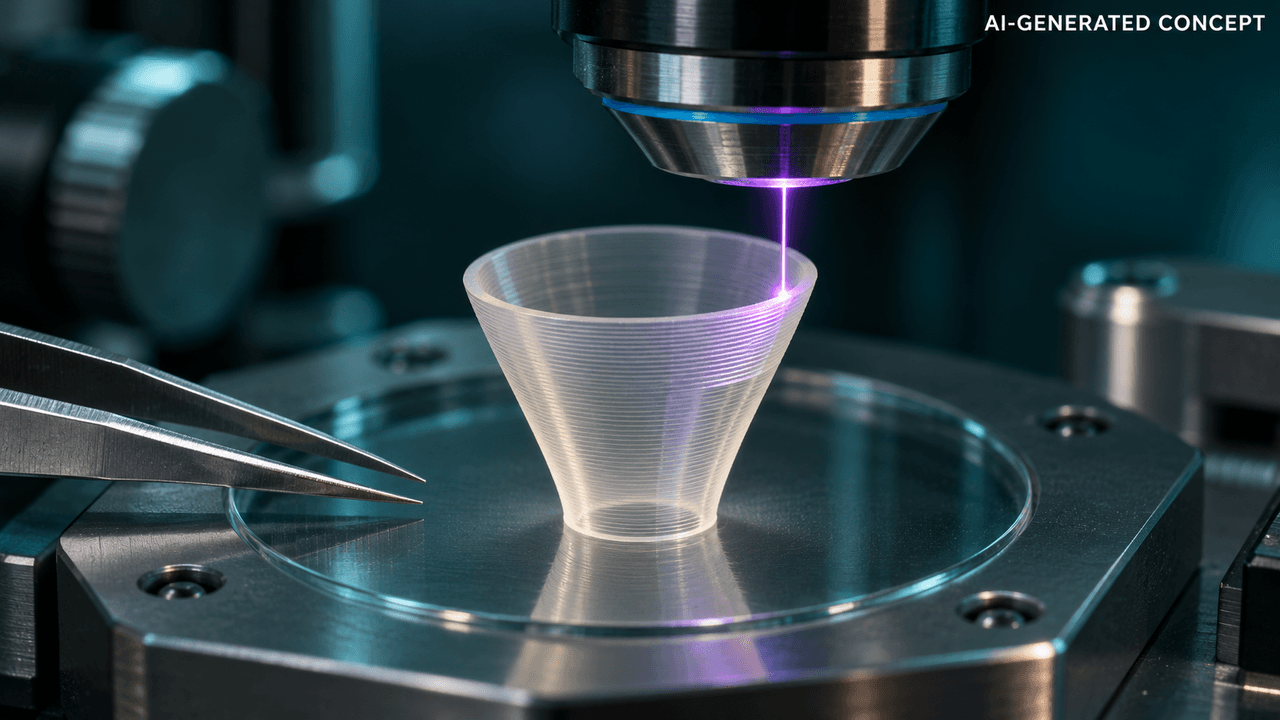
Lawrence Livermore National Laboratory has reduced production time for a tiny component used in fusion research from ten days to one. The advance concerns a compound parabolic concentrator, or CPC, rather than a complete fusion target. LLNL reported the result on November 5. [1]
The cone-shaped part helps concentrate laser energy. Earlier LLNL research showed how CPCs gather energy from the edges of a laser spot into a smaller interaction region. That makes them useful for experiments producing energetic particles and X-rays. At roughly a millimeter long, the concentrators fit into assemblies where a small change in shape can alter what researchers can measure. [2]
The manufacturing problem is familiar even at this unfamiliar scale: making a complicated object often requires several operations and careful assembly. LLNL’s new approach prints the CPC as one assembly without gold coating, replacing a process involving a machined copper form, coatings and removal of that form. [1]
Writing solid shapes with light
The method is called two-photon polymerization. A tightly focused laser solidifies selected regions of a light-sensitive resin, building a three-dimensional object from very small volumes of material. It is a way to print features much finer than those associated with an ordinary desktop 3D printer. [3]
Cornell’s NanoScale Science and Technology Facility describes a system using this technique that can produce features as small as 0.2 micrometers under specified conditions. Its equipment guide also illustrates an important tradeoff: greater resolution can mean slower printing. The useful question is therefore whether a process can make the required shape accurately and reduce the work needed to finish it. Those specifications describe Cornell’s equipment, not a measured feature size for the new LLNL component. [3]
For LLNL’s team, greater freedom to design the part also helped with assembly. A revised outer shape allowed the printed CPC to slide into guide rails inside a neighboring cone. “This component is just the beginning,” mechanical designer Scott Vonhof said in LLNL’s report. [1]
Why better components help experiments
The concentrator belongs to a larger effort to improve the tools used to study matter under extreme conditions. The National Ignition Facility’s Advanced Radiographic Capability, known as ARC, compresses laser pulses into intervals measured in picoseconds, or trillionths of a second. Researchers use that intense burst to generate high-energy X-rays that can reveal structures inside dense materials. [4]
A brighter source and a smaller emitting region can improve the detail in these images. LLNL’s March account of ARC research described experiments imaging internal features of lead balls, including tests with thick tungsten in the viewing path. Developing the source, positioning the sample and measuring the X-rays all contributed to the result. Precision components are part of that measurement system. [4]
The printed CPC has passed an initial practical test. In April 2026, it performed comparably to conventional components in an experiment used to calibrate diagnostics. A September experiment then used printed components in a campaign studying ions interacting with dense plasma. The team was still analyzing those data when the November report appeared. [1]
The larger manufacturing challenge
For future fusion power plants, manufacturing would have to meet a much more demanding production schedule. The Livermore Institute for Fusion Technology identifies a goal of roughly a million targets a day per plant, at less than 50 cents each. Its research roadmap also calls for targets that survive injection into a hot chamber and arrive where the lasers need them. These are development requirements, not capabilities demonstrated by the new CPC process. [5]
That distinction gives the latest result its proper scale. A quicker way to make one specialized research component can help engineers test designs and refine experiments. Whether it can contribute to economical mass production will depend on issues such as repeatability, inspection, materials and the demands of a complete target.
For now, the immediate value is in the laboratory: researchers have another way to turn a difficult shape into usable experimental hardware. The next campaign results will help show what that added design freedom makes possible.
Sources
[1] Patricia Brady, Target Fabrication Achieves a New Precision Through Additive Manufacturing. Lawrence Livermore National Laboratory, November 5, 2026.
[2] Benny Evangelista, Focusing Targets Give Over 10x Performance Boost to NIF’s ARC. Lawrence Livermore National Laboratory, February 12, 2020.
[3] Nanoscribe GT2. Cornell NanoScale Science and Technology Facility equipment guide. Accessed November 8, 2026.
[4] Patricia Brady, Advanced Radiographic Capability Achievements Featured in Physics of Plasmas. Lawrence Livermore National Laboratory, March 9, 2026.
[5] Target Fabrication. Livermore Institute for Fusion Technology research roadmap. Accessed November 8, 2026.