IOI and TNB plan a solar and battery project for Malaysian data centers
IOI and TNB are developing a 500 MWac solar project with a 1,000 MWh battery for grid-connected data-center supply in Malaysia.
Published November 8, 2026Briefs / Energy / Grid Technology
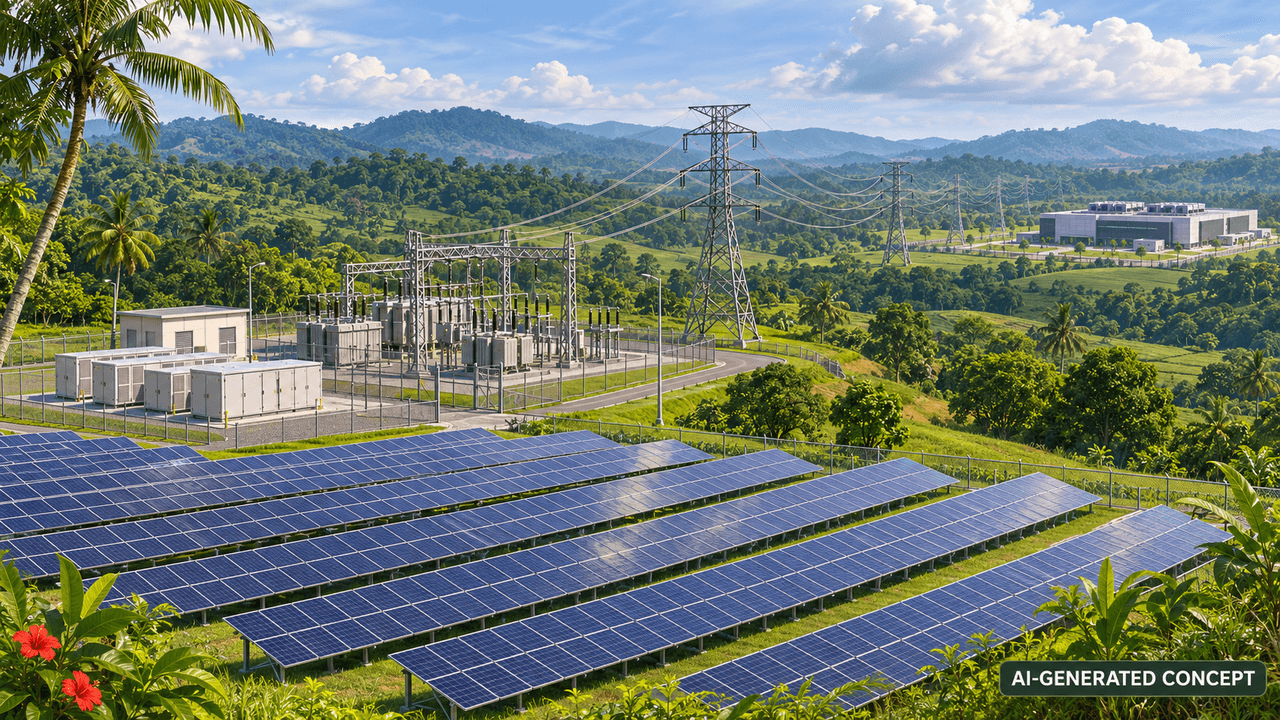
Malaysia’s expanding data center business is helping bring a large solar and storage project into development. IOI Corporation announced on November 3 that its subsidiary and partners had signed an agreement for a 500 MWac solar farm with a 250 MW battery capable of storing 1,000 MWh. The proposed complex would occupy about 1,300 acres in Bahau, Negeri Sembilan. [1]
TNB Renewables will own 70 percent of the project company, Bahau Energy Ventures. IOI says the project is supported by TNB’s long-term renewable electricity arrangement with DayOne Data Centres, which is expected to procure up to 500 MWac over 21 years for its Malaysian operations. The announcement establishes a development partnership; it does not report a plant already supplying electricity. [1]
What the battery adds
The battery’s two ratings describe different jobs. Megawatts measure how fast it can supply electricity. Megawatt-hours measure how much it can store. Dividing 1,000 MWh by 250 MW gives a nominal four-hour duration at its rated power. Actual delivery depends on usable capacity, losses and operating limits.
That storage can move some daytime solar production into later hours and make output easier to schedule. The 500 MWac solar figure describes generating capacity at the alternating-current side of the system. It cannot be treated as a continuous supply through the night. Solar output varies with sunlight, and the announced battery has its own discharge limit.
How electricity reaches the data centers
The project is being developed under Malaysia’s Corporate Renewable Energy Supply Scheme, or CRESS. This lets corporate customers buy renewable electricity through the existing electricity network. The Energy Commission’s posted guidelines require a grid connection and put generation and storage dispatch under the Grid System Operator. The utility remains the supplier of last resort for the customer’s contracted demand when the renewable developer cannot supply it. [2]
This is a grid-connected supply arrangement. The announcements provide no evidence of a self-contained data center campus operating independently of the grid. The amount of renewable electricity reaching DayOne over a year, and its availability at particular hours, will depend on actual production and the agreed supply arrangements.
The posted CRESS rules also explain why storage matters commercially. For plants unable to meet firm-output requirements, they specify a storage route sized at least at half the relevant plant capacity for four consecutive hours, with dispatch controlled by the grid operator, or a higher system access charge. The planned Bahau ratings follow that sizing pattern. Final compliance depends on the applicable requirements and approved project design. [2]
Long contracts help pay for new power plants
DayOne’s June 2025 announcement described a term sheet for up to 500 MW of renewable supply over 21 years. In June 2026, it announced further agreements with TNB subsidiaries covering approximately 1.5 GWp of solar and 2.2 GWh of storage across ground-mounted and hybrid hydro floating solar developments. Those figures cover a wider portfolio of developments than the Bahau proposal. [3, 4]
A committed customer helps developers estimate future revenue before committing money to construction. Grid charges also affect that calculation. On October 15, Malaysia’s Energy Commission said eligible projects under the CRESS Acceleration Package could receive a fixed system access charge of 14 sen, or Malaysian cents, per kWh for the first ten years of operation, provided they reach commercial operation by December 31, 2028 and meet the other conditions. Green consumers face a separate 4 sen per kWh CRESS charge under the prevailing tariff. The total electricity price also depends on the energy contract and other applicable charges. [5]
Questions still open
The IOI announcement leaves several details unanswered: the construction and commissioning schedule, annual electricity production, usable battery capacity, equipment suppliers and the project’s eligibility for the new CRESS package. It also does not establish what share of DayOne’s consumption this plant would cover in each hour. The regulator said supplementary CRESS amendments were expected by November, so the final technical and commercial requirements need checking as the project advances. [1, 5]
Bahau offers a concrete example of how data center demand can support new generation and storage. Its eventual value will be measured in electricity delivered, battery performance and dependable grid integration after construction is complete.
Primary sources
Sources checked on 8 November 2026. Company announcements describe planned projects and procurement. They are not operating-performance evidence.
1. IOI Corporation announcement
3 November 2026. Project capacities, site, shareholders and DayOne procurement link.
2. Energy Commission CRESS guidelines
Third version revised 29 December 2025 and listed by the regulator as issued 6 January 2026. Clauses 6.4, 6.7–6.10 and 8.14–8.17 cover grid connection, dispatch, utility backup and storage. Read alongside later amendments.
3. DayOne announcement of the CRESS term sheet
11 June 2025. Original 500 MW and 21-year procurement announcement.
4. DayOne announcement of additional TNB agreements
4 June 2026. Broader solar and storage portfolio context.
5. Energy Commission statement on the CRESS Acceleration Package
15 October 2026. Official statement and downloadable PDF explain eligible charges, commissioning deadline and planned guideline amendments.