Delft’s Quantum Expansion Plan Starts With the Wires
UniQ will bring semiconductor qubits and their supporting electronics closer together, tackling the connections and heat that complicate larger quantum computers.
Published November 15, 2026Briefs / Frontier Tech / Experimental Systems
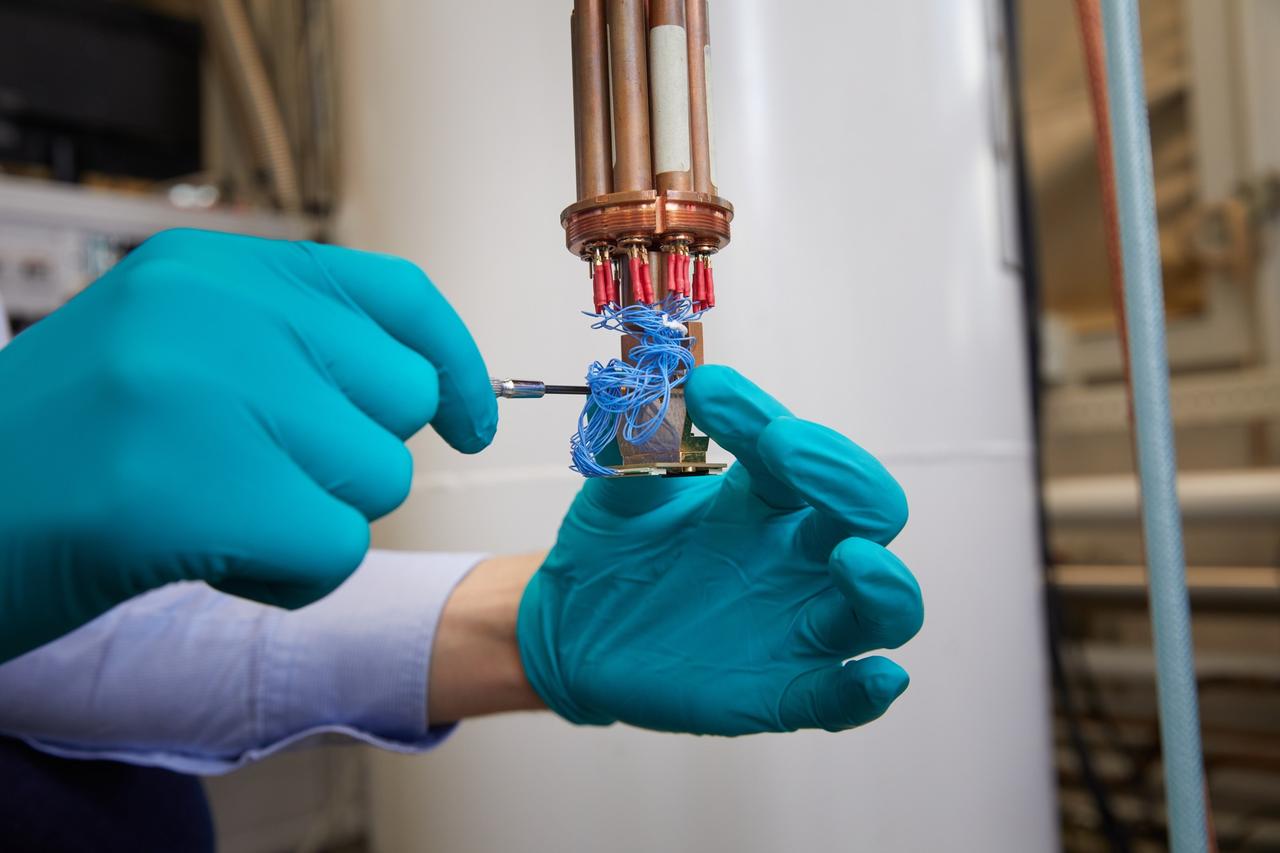
Inside a semiconductor quantum computer’s refrigerator, a tiny processor can depend on several electrical connections for each quantum bit. Adding more qubits means finding room for more controls and carrying their signals through an environment kept close to absolute zero. Nature
Four researchers at QuTech and Delft University of Technology in the Netherlands will tackle that problem through UniQ, a six-year project announced on November 12 with European Research Council funding. Their goal is a chip that combines a large array of spin qubits with selected control and measurement electronics. QuTech
Bringing those circuits closer could reduce the connections leading out of the refrigerator. It also places heat and electrical interference near delicate quantum information. The components have to be designed together: quieter, more consistent qubits can make the electronics simpler, and smaller circuits can leave room for more qubits.
The practical aim is reliable computation. Quantum error correction spreads information across several physical qubits, creating a protected unit called a logical qubit. That protection depends on precise, coordinated operations—and increases the work demanded of the controls.
Spin qubits use a quantum property related to magnetism to store information in electrons or in holes, the positively charged vacancies left by missing electrons. Electrical signals manipulate them inside tiny semiconductor regions called quantum dots. Their small size and compatibility with semiconductor manufacturing make them attractive candidates for larger processors. Semiconductor spin-qubit review
A separate experiment published in June 2025 offers evidence that control electronics can operate nearby. Researchers connected silicon qubits to a cold control chip containing about 100,000 transistors, with both chips mounted on one circuit board. They demonstrated single-qubit operations and interactions between two qubits. Other controls remained at room temperature, and the setup limited measurement of two-qubit gate accuracy. Nature study
UniQ will also investigate moving qubits through arrays, giving designers more freedom to connect them and accommodate circuitry. In a 2024 Delft-led experiment, researchers moved spin information through a small germanium quantum-dot array while preserving coherence: the relationships between quantum states that allow them to interfere during a calculation. The next engineering challenge is maintaining that behavior across larger networks. Nature Communications
Materials researcher Giordano Scappucci will work on germanium structures intended to make the qubits more uniform. “Every qubit that behaves differently asks something extra of the control system,” he said. QuTech
The team plans integration experiments from the outset. Those tests will reveal how much control circuitry the qubits can tolerate, how much heat it produces and how reliably the combined device preserves information.