BioBasicsBench Tests AI on Raw Lab Data
OpenAI and Ligo test AI agents on raw laboratory evidence, exposing mistakes that matter when scientists decide what to do next.
Published November 8, 2026Briefs / Artificial Intelligence / Generative Models
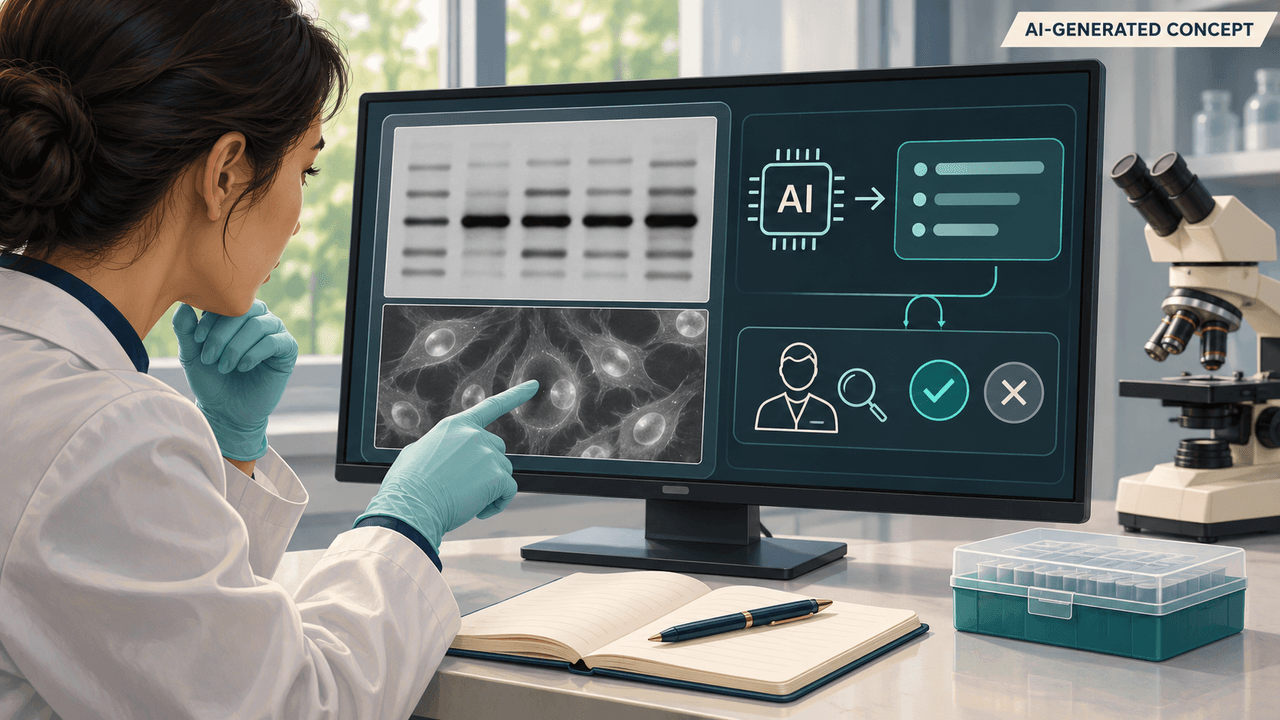
A laboratory assistant can read an image correctly and still recommend the wrong next experiment. In a new OpenAI evaluation, GPT-6 Astra distinguished two groups of DNA bands but reversed their meaning and selected the wrong bacterial colonies. 1
That failure appears in BioBasicsBench, a benchmark OpenAI introduced with enzyme-design company Ligo on November 6. Its 100 tasks ask AI agents to interpret raw experimental evidence, including microscopy and laboratory instrument data. 1
At the xhigh reasoning setting, which allows more reasoning per task, Astra averaged 66.7% of available rubric credit, versus 43.8% for GPT-5.6 Sol. The 22.9-percentage-point improvement measures answers that can receive partial credit. It is not the percentage of experiments successfully completed. Agents analyzed supplied evidence. They did not autonomously conduct physical experiments. 1
The evaluation covered seven OpenAI models, with five attempts per task at each tested setting. The announcement reports no human performance baseline. External scientists reviewed tasks, but that review does not establish independent replication of the model results. 1
A separate October preprint from Benchling and DNAForge illustrates another difficulty: combining individual decisions into complete cloning plans. Its BenchBench-Cloning evaluation uses a simulator for protocol tasks and separate checks for construct design. The authors report that even leading systems struggle to produce complete, valid plans. This is a different benchmark, not an independent validation of BioBasicsBench or a directly comparable score. 2
For a working lab, the useful question is whether an assistant reduces wasted effort after a scientist has checked its advice. A sensible follow-up would measure time saved and consequential mistakes on fresh data from other laboratories, while keeping the researcher responsible for deciding what to run.
That would show whether the gains make research easier without shifting too much of the work into checking AI-generated answers.
Sources
1. OpenAI. Measuring how AI agents handle everyday wet-lab science. November 6, 2026.
2. Sivakumar and colleagues. BenchBench-Cloning. October 23, 2026 preprint.