Blue Solutions brings lithium metal batteries closer to a quick charging stop
A French battery developer reports a short recharge in prototype cells. The next challenge is preserving that performance inside the equipment a vehicle must carry.
Published November 8, 2026Analysis / Energy / Advanced Battery Tech
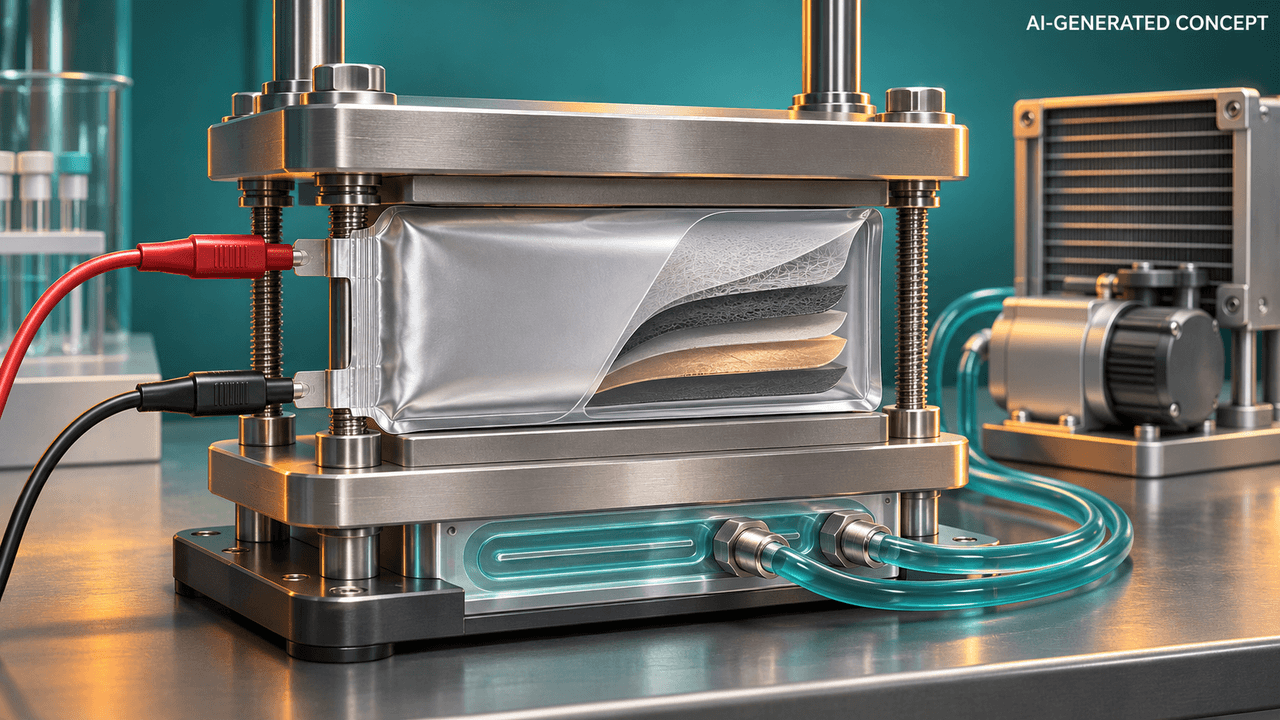
A charging stop lasting less than twelve minutes would change the rhythm of an electric journey. On November 2, Blue Solutions reported that its lithium-metal development cells recovered 70 percent of their capacity in under 11.5 minutes at 40°C. At 25°C, the reported time was 14 minutes. [1]
The cells were 10 amp-hour pouches tested under six bar of applied pressure. That detail brings the story into the workshop: a useful battery needs a way to hold its cells, control their temperature and protect the people nearby. Every part has weight. [1, 3]
For an electric aircraft, that weight travels on every flight. Short charging stops could help an operator fit more trips into a day, while lighter batteries could leave more capacity for passengers or extend a route. Engineers have to make those benefits work together with the bursts of power needed to take off and land. [3, 4]
Blue Solutions has supplied a promising measurement for that effort. Turning it into a practical vehicle battery now depends on the performance of the complete pack, including the hardware surrounding the cells. The November announcement gives engineers a reason to look closer. [1, 3]
What the charging numbers mean
The warmer test used a 3.6C charging rate; the 25°C result used 3.0C. A C-rate expresses current relative to cell capacity: for a 10 Ah cell, 3.6C corresponds to 36 amperes. Maintaining 4C recovered 65 percent at 40°C and 57 percent at 25°C. Those results describe the measured charging window, rather than a full recharge in fifteen minutes. [1]
An October 7 development update provides a second piece of the picture. Blue Solutions reported 404 watt-hours per kilogram in an NMC cell configuration, a measure of stored energy relative to mass. It also said it had manufactured 1,000 A-sample cells and was testing capacities up to 15 Ah. These are development-stage results, with specifications still evolving. [2]
Its durability result needs its own conditions attached. The company reported that 10 Ah cells approached 900 cycles while retaining more than 80 percent of their capacity, using C/4 charging, half-rate discharge, 40°C and six bar pressure. That charging current is much lower than the one used in November’s rapid-charge tests. A reader cannot combine the announcements into 900 demonstrated fast-charge cycles. [2]
Blue Solutions also attributes comparable smaller-cell durability results to independent testing at Fraunhofer ISE. Its October account identifies those cells as 1 Ah. The November rapid-charge announcement does not establish independent validation of the new 10 Ah fast-charge result. [1, 2]
The aircraft has to lift the whole battery
NASA researchers have explained why a cell’s headline energy density can overstate its usefulness in an aircraft. Structure and thermal management consume part of the weight budget, while the mission’s changing power demand affects how much energy can actually be used. A pack designed around a gentle discharge test may behave differently during a demanding flight. [3]
For Blue Solutions, the engineering question is how much equipment its operating conditions will require. The public updates do not establish the mass of a practical pressure system or a complete aviation pack. There is consequently no defensible aircraft-range improvement to calculate from the reported cell density alone. [1–3]
The connection between charging and flight has a longer research history. In 2021, a Penn State team reported lithium-ion designs that replenished enough energy for a modeled 80-kilometer eVTOL trip in five to ten minutes and sustained more than 2,000 fast-charge cycles. Their work used a different battery design and thermal strategy; it provides context rather than a like-for-like ranking. [4, 5]
“And they also need very high power during take-off and landing,” researcher Chao-Yang Wang said in Penn State’s account of that work. For any new chemistry, an aviation evaluation has to follow the battery through the flight and the charging stop that comes afterward. [4]
A closer view of the ions inside
Another recent battery story shows how researchers are improving the tools behind such development. An Argonne-authored explanation published by Tech Xplore on November 4 describes rotating a crystal in a neutron beam to see how ions move and interact inside it. The method, called four-dimensional quasielastic neutron scattering, gathers information across three spatial dimensions of momentum transfer and energy transfer. [6, 7]
The experiment used strontium chloride at high temperature. Its purpose was to examine a model material, with measurements revealing correlations between moving ions that simpler pictures can miss. The peer-reviewed paper appeared in PRX Energy on April 14, 2026, months before the November news coverage. It did not test Blue Solutions cells. [6, 7]
Together, the stories show the work happening at different scales: scientists examining motion inside materials, developers measuring prototype cells, and aircraft engineers evaluating a complete mission. Blue Solutions’ next useful milestone would connect more of those practical requirements in the same tested system. Fast charging becomes especially valuable when a battery can deliver it repeatedly, carry its supporting hardware efficiently and still supply the power the journey demands. [1–5]
Sources
1 Blue Solutions • GEN4 fast charging update • November 2 2026
2 Blue Solutions • GEN4 development update • October 7 2026
3 NASA • Battery Evaluation Profiles for X 57 and Future Urban Electric Aircraft • 2020
4 Penn State Engineering • Innovative batteries put flying cars on the horizon • June 8 2021
7 Argonne authored explanation on Tech Xplore • November 4 2026