Tesla Can Show You Its Next Turn. Will You Spot a Bad One Sooner?
A display can show a planned turn. Whether it helps the driver recognize a bad plan remains an open question.
Published November 22, 2026Intelligence / Robotics / Autonomous Systems
The speed on the touchscreen reads 52 mph. A white pickup sits to the left of the pictured Tesla. A blue ribbon runs ahead of the car, bending right, while bright chevrons point across the scene. In this frame from Tesla’s Reality View demonstration, the pickup and the arrows occupy the same convincing stretch of highway. They tell the driver two quite different things. The pickup is where the system depicts traffic. The arrows say where the car intends to go. Tesla demonstration · Tesla-credited frame
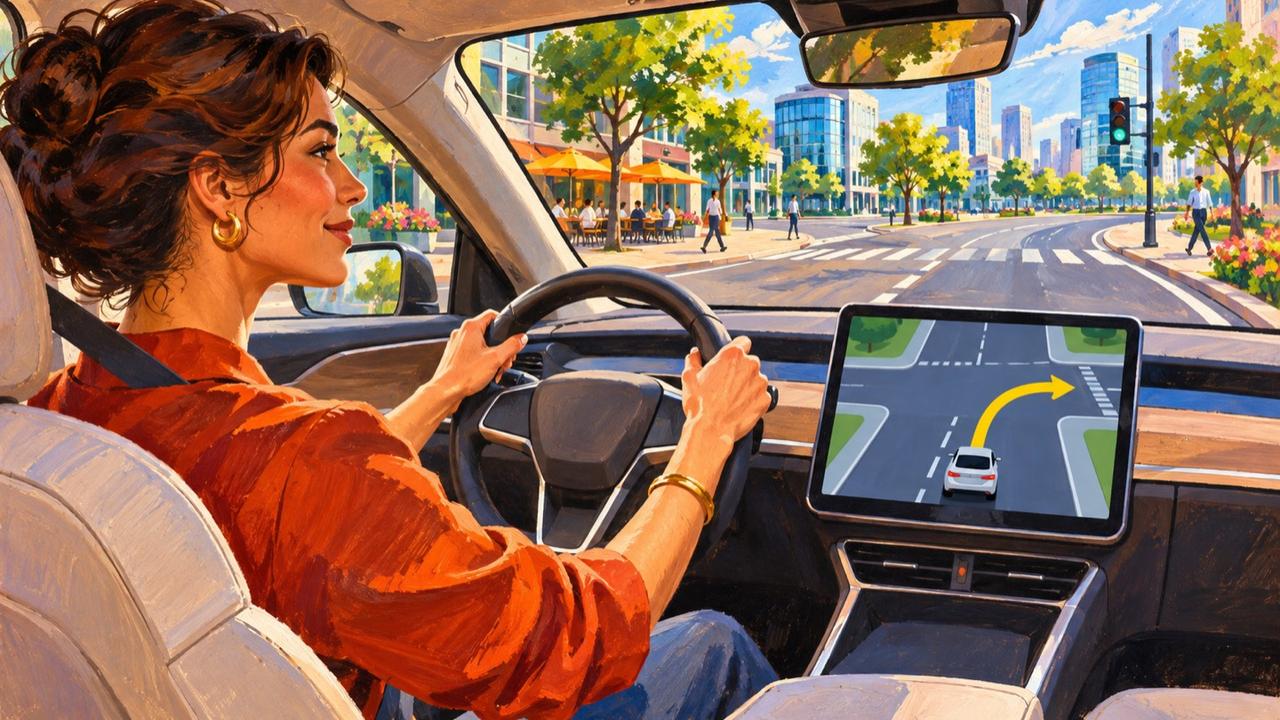
That second piece of information could buy a driver time. Someone expecting to continue straight could recognize the planned turn before the steering wheel moves. A perfectly legible arrow, though, leaves another question open. Has the car seen what the driver can see through the windshield?
Tesla introduced Reality View in the first rollout of Full Self-Driving (Supervised) v15. Ashok Elluswamy, who leads Tesla’s AI software work, says the same end-to-end model that drives also renders the view. He describes arrows for planned turns and pins for intended parking spots. The release notes describe a virtual camera above the car. A pin therefore announces a choice of space. It cannot establish that nobody is about to step into it. The driver remains responsible for supervising the maneuver. Elluswamy’s explanation · Feature notes · Tesla driver guidance
An overhead picture has long been possible without a camera on a pole. Nissan’s Around View Monitor combines feeds from four exterior cameras to help a driver judge, for example, where a wheel sits beside a curb. Tesla drivers already had a blue line marking a driving path. Reality View brings the surroundings and the planned movement into one rendered perspective. Tesla’s own manual cautions that its visualization can omit information the car uses. Seeing an object on the screen and knowing how the car will respond to it remain separate judgments. Nissan’s camera system · Tesla owner’s manual
Consider three questions a computer might answer about that white pickup. Where is it relative to the Tesla? That takes an estimate of the present scene. What would that scene look like from above and behind? That takes a rendering from a viewpoint where no physical camera sits. What would happen to the space between the vehicles if the Tesla braked now or changed lanes instead? That requires predictions under alternative actions. A launch frame can illustrate the first two. It reveals neither the alternatives the car evaluated nor how accurately it could predict their consequences. Tesla presented earlier work on estimating occupied space in 2022. That history does not identify the rendering architecture in v15. Tesla’s 2022 technical presentation · Reality View release description
A simulator experiment offers a reason to test what drivers do with the extra information. Researchers Dina Kanaan and Birsen Donmez randomly assigned 48 people to three displays. Everyone had an attention reminder. One group also saw when the automation intended to brake. Another saw that intention plus the expected location and severity of a hazard. In one scenario, a car closing on a slowing truck gave the driver an early clue that it might cut in. Drivers with the richest display first looked at environmental cues later than those with the reminder alone. The intent-only results were mixed. The study found no significant display effect on takeover likelihood or minimum gap time. Its cues were accurate throughout. It leaves open what happens when a convincing cue is wrong. Kanaan and Donmez study
Tesla already collects a measure that sounds close to the answer. Its European engineering vehicles recorded predicted gaze at tenth-of-a-second intervals in the five seconds before crossing a lane line. The dataset comprised 12,294 manual lane changes and 16,013 supervised ones. In the company's measure, a glance at the display can qualify alongside a glance at a mirror or window. A driver who spots a closing vehicle in the mirror and a driver who checks the screen can therefore both register awareness. Those 28,307 maneuvers tell us neither who recognized a danger nor who intervened in time. There was no comparison of Reality View switched on and off. Tesla’s separate internal claim of a 25-fold improvement on a critical-intervention measure for v15 likewise cannot isolate the display’s contribution or establish a change in road crash risk. Tesla dashboard, Study 3, Part 4 · Tesla v15 launch
A fair test would give drivers the same simulated traffic and the same driving software, varying only the display. Sometimes the planned turn would be correct. Sometimes the plan would change, or a hazard visible through the windshield would make it unsafe. Record when the driver correctly identifies the plan, when their eyes return to the road, whether they intervene in time and how often they interrupt a safe maneuver. If the blue ribbon buys a driver a second of useful warning, those measures should show where that second went.