Panasonic’s silicon deal goes from a purchase agreement to a factory test
Sila has opened its Washington plant. Panasonic’s cell targets now hinge on the material it can qualify in production.
Published November 20, 2026Intelligence / Materials / Advanced Composites
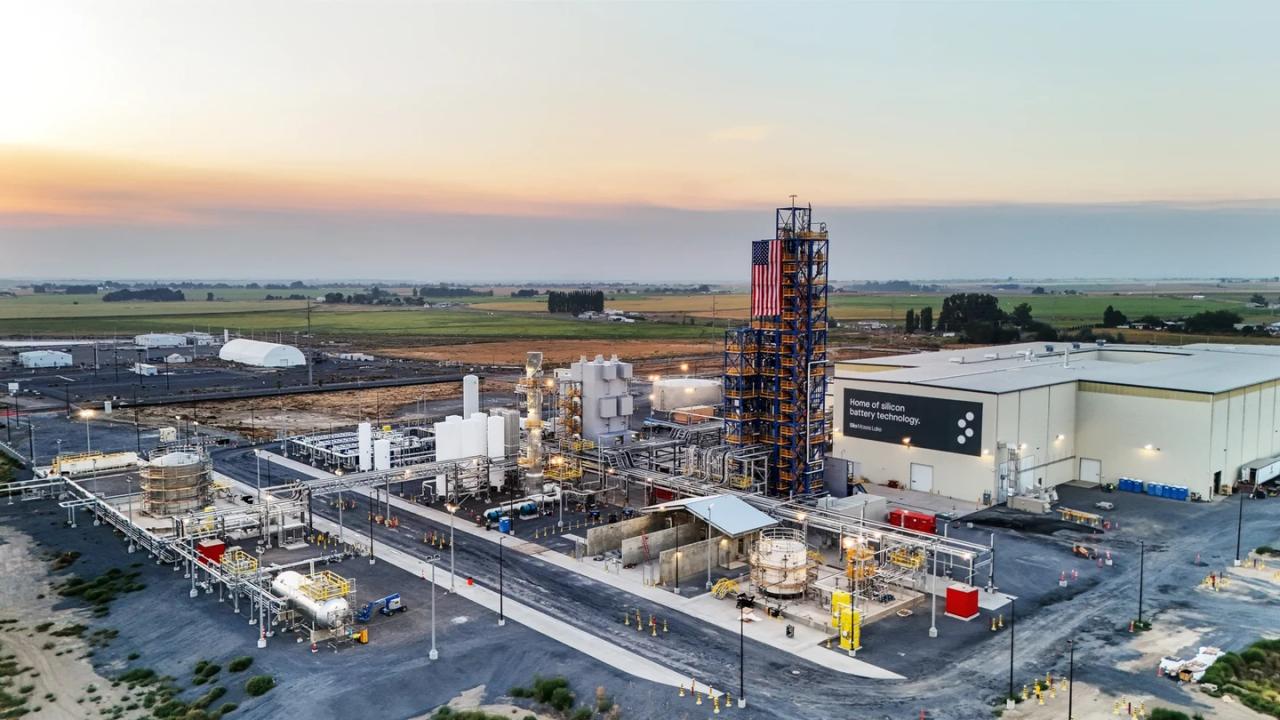
Three years separate Panasonic’s first public agreement to buy silicon anode material from Sila and the multiyear U.S. offtake Sila announced on November 18. In between, something tangible happened in Moses Lake, Washington: Sila opened the factory meant to supply the powder. The next step in the relationship is a less visible achievement. A production lot has to pass a cell maker’s tests, and the next production lot has to behave like the first.
Silicon attracts battery makers because it can store far more lithium per gram than graphite in the negative electrode. It also expands as lithium enters. Repeated expansion can damage particles and their electrical connections. Fresh surfaces can consume more lithium as a protective layer reforms. A cell has a finite inventory of lithium, so an electrode can look impressive in isolation and still cost the finished battery capacity over repeated charges. Sila’s Titan Silicon combines silicon and carbon to manage that expansion. The amount a cell designer can use depends in part on how much space and lithium the design must reserve to keep working.
Panasonic supplied a better benchmark for the intended gain in 2023. It targeted a rise in energy stored per liter of cell from 800 to 1,000 watt-hours by 2031, a 25 percent increase. At the same stored energy, those values would reduce cell volume by one fifth. The smaller denominator is easy to overlook. A carmaker would still have to fit cooling, structure and wiring around the cells, and Panasonic has yet to attribute that entire target to Sila’s material. Confirming a gain would take production cells tested at comparable charge rate, temperature and cycle life.
When Sila opened Moses Lake in September 2025, it described initial capacity in terms of the batteries its anode output could support: 2–5 gigawatt-hours. The facility makes material, so the cell capacity represented by a ton of product depends on the customer’s recipe. Factory nameplate, qualified tonnage and Panasonic purchases are three different quantities. The latest announcement calls the relationship potentially worth more than $1 billion over time. It gives no public minimum volume, unit price or date for a first production shipment, and the two announcements do not disclose how their contract terms relate.
What Panasonic stands to gain is more space in a cell designer’s budget. The designer could use it to store more energy in the same can, or keep the energy and try to shrink the cell. What Sila stands to gain is repeat demand from a demanding customer. The evidence for both will get better when a qualified production line discloses its cell performance and the supplier begins reporting recurring deliveries from Moses Lake.
Sources. Sila offtake disclosure · Panasonic procurement and volumetric target · Moses Lake opening and capacity basis · DOE battery development research · Independent silicon–graphite electrode study.
The industrial site pictured in Sila’s November offtake announcement. Courtesy of Sila