On a light-amplifying chip, twenty picoseconds changes the answer
A semiconductor waveguide amplified light at room temperature. The timing of a second pulse determined how much signal emerged.
Published November 20, 2026Intelligence / Frontier Tech / Experimental Systems
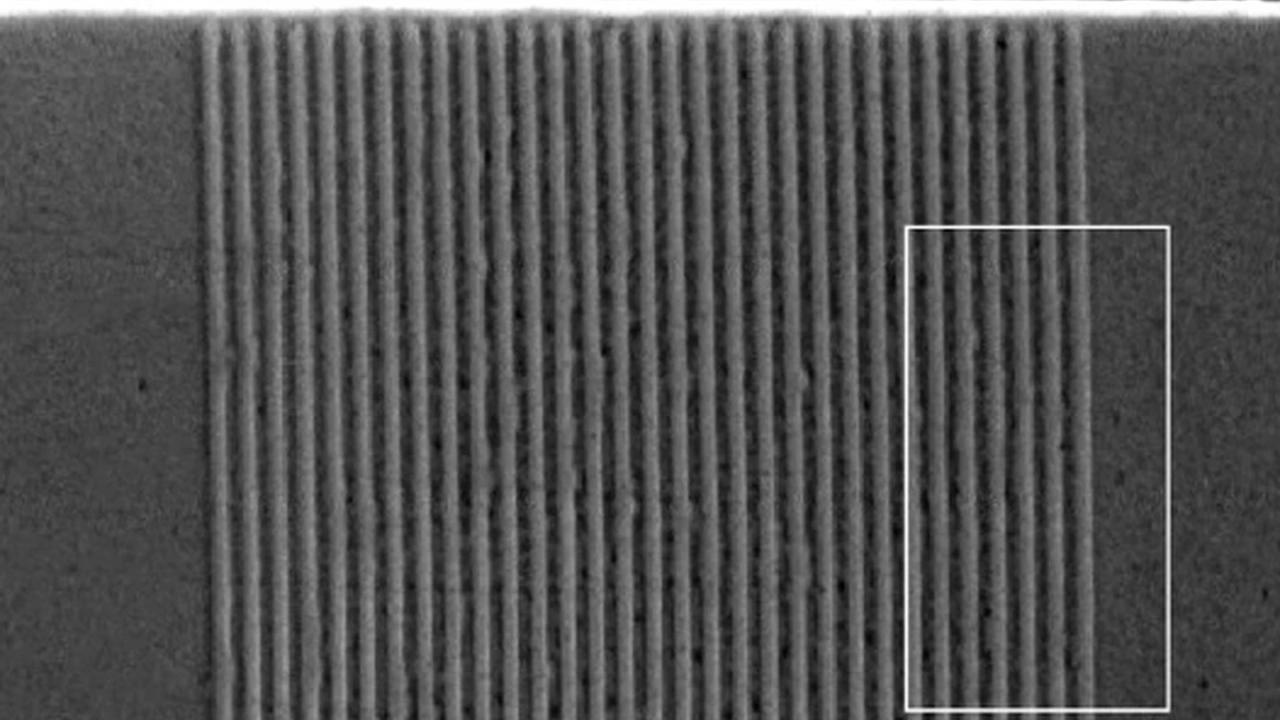
A light pulse crossed a 25-micrometer stretch of semiconductor and emerged with almost a hundred times the measured signal intensity under the best tested conditions. A second pulse, aimed at the middle of the route, supplied the energy. The telling part of the experiment came when Antonio Fieramosca and colleagues changed the timing. The extra light at the output faded as the signal arrived later. At room temperature, the opportunity to draw on the pump lasted on the order of twenty trillionths of a second.
In their November 18 Nature paper the researchers grew a cesium lead bromide waveguide and its fine grating couplers together. A grating lets a beam arriving from outside launch a wave along the chip and lets the wave out again at the far end. Inside this semiconductor, light couples strongly to an electronic excitation. The resulting traveling excitation, called an exciton–polariton, can interact with the material strongly enough for one optical input to control another. Building the couplers into the same growth step gives the team a way to make several active optical components with compatible geometry.
The gain experiment reads almost like a recipe for ruling out a misleading result. Measure the light leaving the end grating with the signal alone. Measure it with the pump alone. Turn both on, subtract the pump-only contribution, then divide by the signal-only reading. The result approached a factor of 100 near the highest signal energy at which propagation was still sustained. The pump created a reservoir of excitations partway down the guide. A signal arriving while the reservoir was populated could stimulate transfer into the traveling wave. Fits at two pump fluences gave an average decay time of 20.5 picoseconds. The pump’s energy bill is outside the optical gain ratio.
The same fabrication approach also supported lasing and, in a separate test, a phase adjustment of up to a full wave cycle. Phase controls how waves add or cancel when they meet, useful for a circuit that computes through interference. Other perovskite experiments have crossed different thresholds. Pushkarev and colleagues drove a polariton laser with direct current at roughly 65 microamperes at 8 kelvin. Liao and colleagues coupled perovskite emitters and detectors to silicon-nitride processing and demonstrated computational tasks in a hybrid system. Those results describe three tools available to a designer: electrical injection, system integration and room-temperature active control. Combining their best figures would describe a device that none of the teams built.
A convincing next circuit would send the output from one stage into the next, measure how much signal survives the coupling, then repeat the operation while accounting for pump energy and noise. High gain gives the designers room to absorb losses. The picosecond timing tells them how precisely the next stage must be ready to spend it.
Sources. Fieramosca et al., especially Fig. 3 and Methods · Pushkarev et al., electrical laser · Liao et al., hybrid photonic system.
Electron micrograph of a grating coupler replicated in cesium lead bromide. Detail of Figure 1d. Antonio Fieramosca and colleagues, Nature, CC BY 4.0. Cropped for display.