Most of the water went around the filter. Lakeland can learn from the storm that did it
Florida monitoring records show how bypass flows during large storms change the phosphorus a treatment project can intercept.
Published November 20, 2026Intelligence / Biourbanism / Sustainable Infrastructure
A filter can work precisely as designed during a Florida downpour while most of the stormwater takes another path. At Lake Pineloch in Orange County, instruments recorded nearly 104 million gallons passing through a stormwater installation across two monitoring periods. About 58 percent of that volume bypassed its off-line filter. Bypass occurred during heavy or prolonged rain. An overflow that opens only occasionally can account for most of the water that reaches a lake.
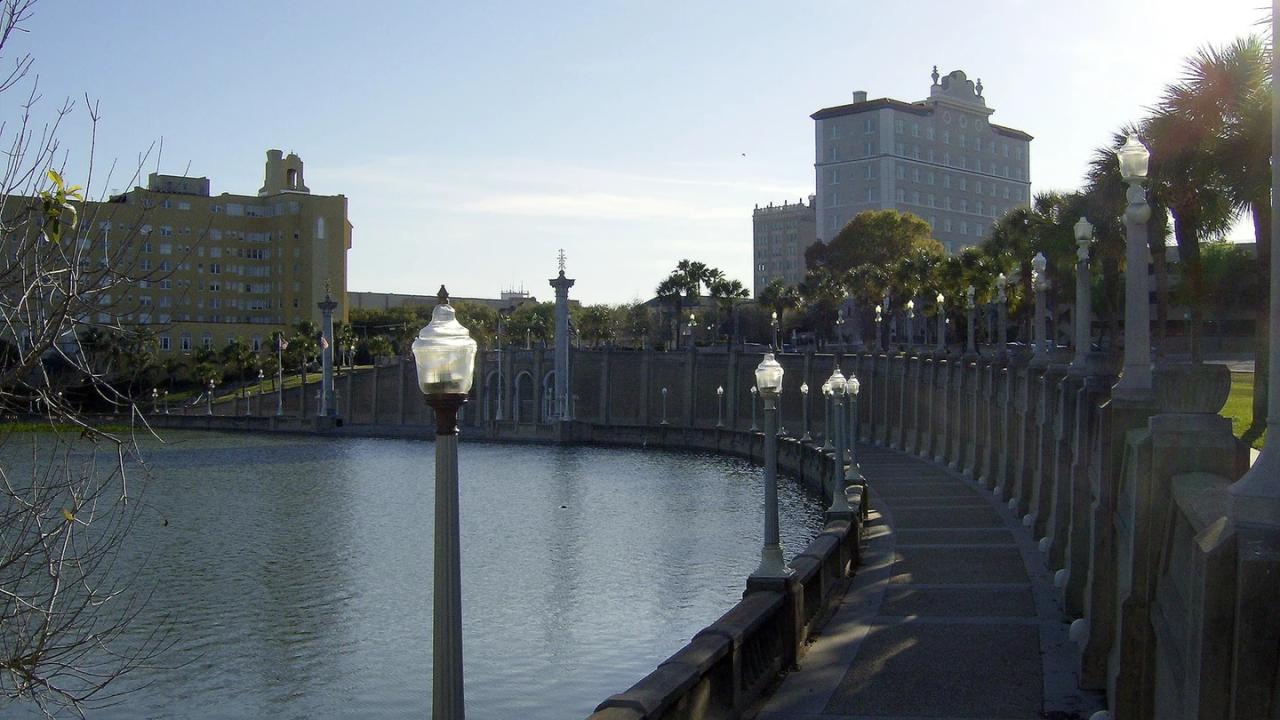
That record has a practical bearing on a different project in Lakeland. On November 18 the city announced the start of a retrofit to a dry detention pond on East Bay Street in the drainage system serving Lake Mirror and Lake Parker. A new underdrain and filter layer will draw water through material that can retain nutrients. The grant packet projects a 45 percent reduction in nutrient concentrations and puts the project at $715,000, including $550,000 in state construction funding. After the first hard rains, the lake will receive a mass of nutrients measured in pounds, however dilute each gallon may be.
At Pineloch, the water that missed the filter still passed through a baffle box where solids could settle. The study team measured the separate flows, sampled discharge and estimated inflow concentrations. A design model had predicted 49 percent removal of the incoming phosphorus load. The field-informed estimates, counting the bypass, were 31 percent in the first period and 16 percent in the second. Lawn maintenance damaged the sensor cables in 2023. The first period consequently missed much of the wet season and recorded 15.5 million gallons, of which 35 percent bypassed the filter. The second captured 88.4 million gallons, with 62 percent bypass. The wetter, better-observed period dominates the combined result. Those numbers cannot establish that the filter deteriorated by 15 percentage points. They do show how a monitoring program that misses big storms can give a different account of the installation it is supposed to evaluate.
East Bay Street has a different basin and drainage arrangement. Its own answer requires measuring how much water enters, leaves through the media or escapes another way, and sampling the phosphorus each flow carries. Sampling only the cleanest outlet would give credit for water the filter never treated. Recording a complete storm hydrograph would also show whether a short, dirty initial flush carries more phosphorus than a much larger volume later in the storm. Equal fractions of water need not carry equal fractions of the load.
Lakeland’s 2019 water-quality assessment identified lost wetland influence at Lake Parker and found that runoff was then a secondary contributor to excess phosphorus. Sediment already in a lake can release nutrients for years. A reduction measured at the pond outlet would justify a claim about pollution intercepted on East Bay Street even if the lake took longer to respond. Establishing what the city bought begins at that outlet, in the weather that sends the most water through it.
Sources. Lakeland construction notice · City and state grant packet · Orange County monitoring, Tables 4-1 and 5-2 and section 6 · Lake Parker assessment.
Lake Mirror in Lakeland, Florida, before the East Bay Street retrofit. Mike Russell, CC BY-SA 3.0. Cropped for display.