MIT rewrote one bit of cold memory while its neighbor held its value
A pair of superconducting cells let researchers test whether writing a bit disturbs its neighbor. The next question is how much wiring and heat a larger memory would need.
Published November 22, 2026Intelligence / Frontier Tech / Experimental Systems
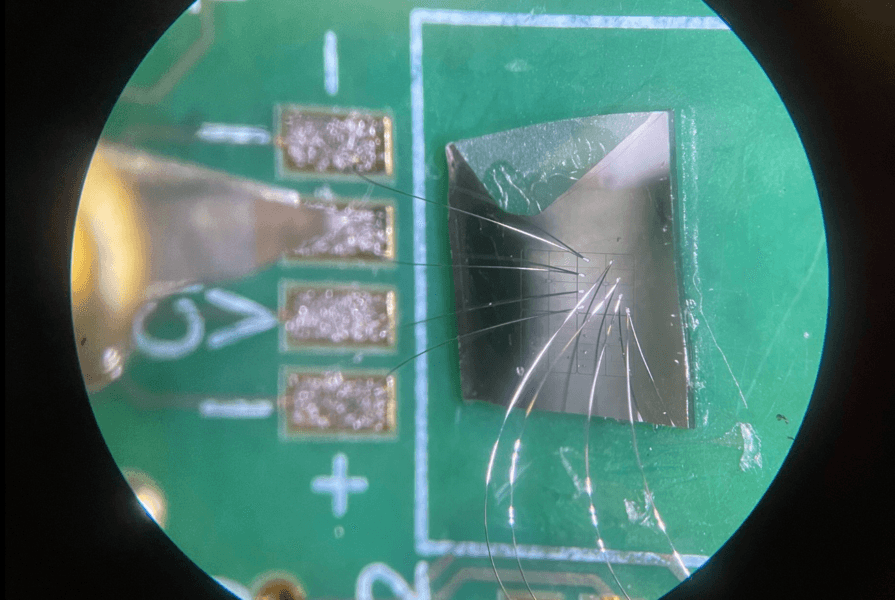
A memory cell that switches on command is only half a success. The cell beside it has to ignore the same command. At MIT, researchers briefly heated one of two neighboring superconducting cells while applying a small magnetic field. The selected bit changed; its neighbor kept its value. That modest-looking result gets at a stubborn problem for electronics that work inside refrigerators: how to keep information close to a cold processor and still change one piece of it at a time. MIT experimental account, November 20 · Physical Review Letters, October 5
The bit resides in the relative orientation of two magnetic layers, one on each side of an ultrathin superconducting film. At the memory’s operating temperature, opposing magnetizations let the film carry current without electrical resistance; aligned magnetizations leave it resistive. Reading the resistance distinguishes the two states. The writing pulse makes the selected magnet easier to switch in the applied field. Once set, the alignment persists after the pulse and field are removed. The refrigerator must still keep the device cold for superconducting operation. MIT’s description of writing and reading
There is already a working example of why it can pay to move an electronic task inside a refrigerator. In 2021, researchers demonstrated a silicon control chip at 3 kelvin that produced microwave bursts to operate spin qubits at 20 millikelvin, a still colder stage. It controlled actual qubits with fidelity comparable to commercial room-temperature instruments in their experiment. Preparing a control pulse on the cold side changes what has to be carried down a wire from room temperature. The experiment used conventional semiconductor control electronics. It provides a concrete place to ask what a separate cold memory might contribute. Cryogenic control experiment, Nature
For example, a controller that repeatedly needs the same setting could read a local bit after the setting is loaded. That could spare repeated transfers across a temperature boundary, provided the memory can be read at the controller’s operating stage and the wiring to address it is economical. Writing each bit introduces heat precisely where removing heat costs refrigeration power. Choosing a local memory means weighing how often a setting changes against how often it is reused. The MIT experiment measured neither the energy for that complete round trip nor its latency. Memory-device study · Control-system architecture
The same layered structure showed a second behavior at a lower temperature. The current at which superconductivity gives way to resistance differed by direction. With an appropriate pulse and magnetic setting, that asymmetry can favor passage in one direction, reverse the preference, or block a pulse in both directions. It suggests a way to steer signals in superconducting circuits. The researchers demonstrated a programmable device characteristic; they have yet to show a network routing traffic or a memory array serving a quantum processor. Physical Review Letters · MIT signal-control description
“Any useful memory must have the ability to change one bit without disturbing all the information around it,” first author Josep Ingla-Aynés told MIT News. A larger array would put that requirement under much greater pressure. How many nearby bits retain their state after repeated writes, how much heat accumulates and how much wiring is needed to select a cell will determine whether storing the bit locally saves work for the whole refrigerator. MIT News