At Hopi’s incident command center, the aim is power through the other half of the day
A federal review shows how a proposed solar microgrid could extend operating hours at the Hopi Tribe’s administrative campus.
Published November 21, 2026Intelligence / Energy / Grid Technology
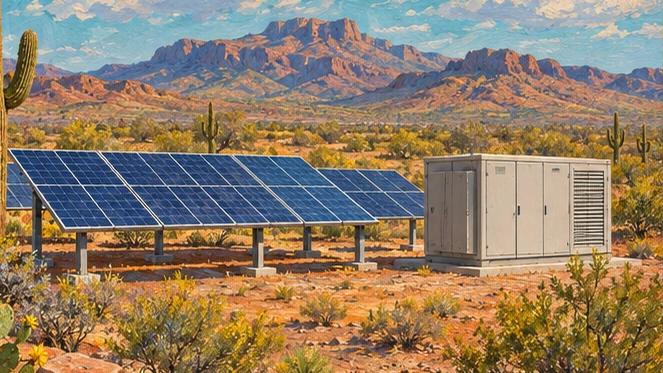
The incident command center at the Hopi Tribe’s Turquoise Trail Municipal Complex goes without power half of each day. The site in northeastern Arizona has seven diesel generators rated at 130 kilowatts apiece. Age has left only three operational at any given time, according to a federal environmental assessment. Across the campus, which has 21 modular administration buildings, the limits on electricity also restrict when staff can use their computer systems.
A proposed solar microgrid would give the Tribe another way to keep those services running. On November 18 the U.S. Department of Energy posted its final environmental assessment and a finding of no significant impact. The finding addresses the use of federal funding through Arizona State University for the project. The Hopi Tribal Council has approved the project and assigned land for it. The council retains authority to approve the actual construction plans.
For the people working there, the attraction is a reliable shift. In a 2025 account by Arizona State University, Hopi Chairman Timothy Nuvangyaoma described what steadier electricity would mean: “Having energy stability gives the program a stable worksite that essentially turns into better services for our community.” The university is working with Hopi Utilities Corporation and the microgrid developer BoxPower.
The plan in the assessment combines 1.25 megawatts of solar panels with a battery that can store four megawatt-hours and discharge at up to 0.9 megawatts. It retains 130 kilowatts of existing diesel generation as backup. A local controller would coordinate those sources. In daylight, the panels could supply buildings and charge the battery. Stored energy could carry selected loads after sunset or through a loss of solar output. Diesel gives operators another option when stored energy runs low.
How long that battery lasts depends on what the Tribe needs to keep running. Dividing its nominal four megawatt-hours by its maximum discharge rate gives about four hours and 27 minutes. A smaller critical load could run longer. An incompletely charged battery, conversion losses or a decision to hold energy in reserve would shorten the available time at any given load. The project team expects final design to account for present demand, growth and phased expansion. A night of measured command-center demand would say more about overnight coverage than the battery rating alone.
The assessment leaves open two electrical arrangements. In one, the microgrid is isolated from the wider utility grid and supplies backup power to the complex without exporting electricity. In the other, the complex is still the intended customer, but a connection could pass a small, intermittent surplus to the grid. The alternatives occupy the same footprint. The choice changes switching and controls. Neither configuration in the assessment establishes an operating export arrangement or service to surrounding homes.
The department estimated that three diesel generators running twelve hours a day, five days a week, could emit about 973 metric tons of carbon dioxide a year. That is a baseline for the existing service schedule. An emergency facility receiving more hours of electricity after construction would also be receiving a better service. A fair accounting would record the hours critical buildings had power alongside the amount of diesel burned. Those two records would show both what the Tribe gained and what fuel use it displaced. ### Sources
DOE final environmental assessment, §§1.2, 2.1–2.5 and 3.3.2 · DOE project docket · Finding of no significant impact · Arizona State University’s account with Hopi participants · DOE’s 2024 first-phase funding announcement
Sources · 5
- https://www.energy.gov/sites/default/files/2026-11/final-ea-2325-asu-hopi-nation-community-solar-project-20261028.pdf
- https://www.energy.gov/nepa/doeea-2325-hopi-tribe-turquoise-trail-site-hybrid-microgrid-project-navajo-county-arizona
- https://www.energy.gov/nepa/articles/doeea-2325-finding-no-significant-impact-november-2026
- https://news.asu.edu/20250814-environment-and-sustainability-building-blueprint-rural-energy-resilience
- https://www.energy.gov/cmei/oced/articles/award-wednesdays-october-2-2024