ARIDGE says its full-size aircraft made the handoff from rotor lift to wing lift
ARIDGE reported on November 22 that its full-size A868 prototype had tilted its rotors forward and flown on the lift from its wing.
Published November 23, 2026Intelligence / Transportation / Urban Air Mobility
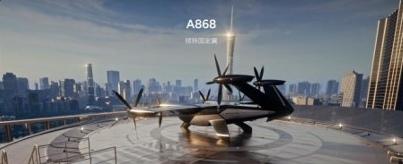
ARIDGE reported on November 22 that its full-size A868 prototype had tilted its rotors forward and flown on the lift from its wing. That is the part of the journey on which its proposed passenger service depends: the aircraft needs to leave the pad like a helicopter and cover distance on a wing. IT Home’s account citing the company’s official channel · Report identifying founder Zhao Deli’s announcement and video
In a hover, the rotors push air downward. The resulting upward thrust supports the aircraft. As they tilt forward, more thrust goes toward accelerating it and less remains to hold it up. Forward speed gives the wing the airflow it needs to take on more of the weight. The two changes have to overlap. A wing that will readily support the aircraft at cruise speed has far less lift to offer near the start of that maneuver.
ARIDGE chose a configuration in which all the lift rotors tilt. That lets the aircraft use those same rotors for forward propulsion instead of carrying a separate set used only for takeoff and landing. It also gives the flight-control system a demanding job during the handoff: manage rotor tilt and thrust while the share of lift carried by the wing changes. The reported test places those systems together on a full-size vehicle and takes them through that sequence. The announcement supplies no measured speed, height loss or power trace for it.
At the A868’s public debut, XPENG described a six-seat, hybrid-electric design and projected 500 kilometers of range. The transition report gives no basis for identifying the power source used on this flight or the payload carried. A full-size aircraft can test the handoff long before it has demonstrated the energy budget for six occupied seats, a destination landing and reserves. XPENG’s original design presentation
A particularly useful next disclosure would be airspeed and altitude through repeated transitions at a stated aircraft weight. That would show how much height the aircraft needs, or can hold, while the wing takes the load. A return from wingborne flight to a controlled hover would answer the corresponding question at the destination. Both would tell a prospective operator more than an isolated top-speed figure.
Sources
IT Home’s account citing the company’s official channel · Report identifying founder Zhao Deli’s announcement and video · XPENG’s original design presentation