A glider climbed to 17,200 feet on solid-state batteries. How much power was left?
A North Dakota flight demonstrated a new battery in the air. Charge remaining tells only part of the story of a cold pack at altitude.
Published November 20, 2026Intelligence / Frontier Tech / Experimental Systems
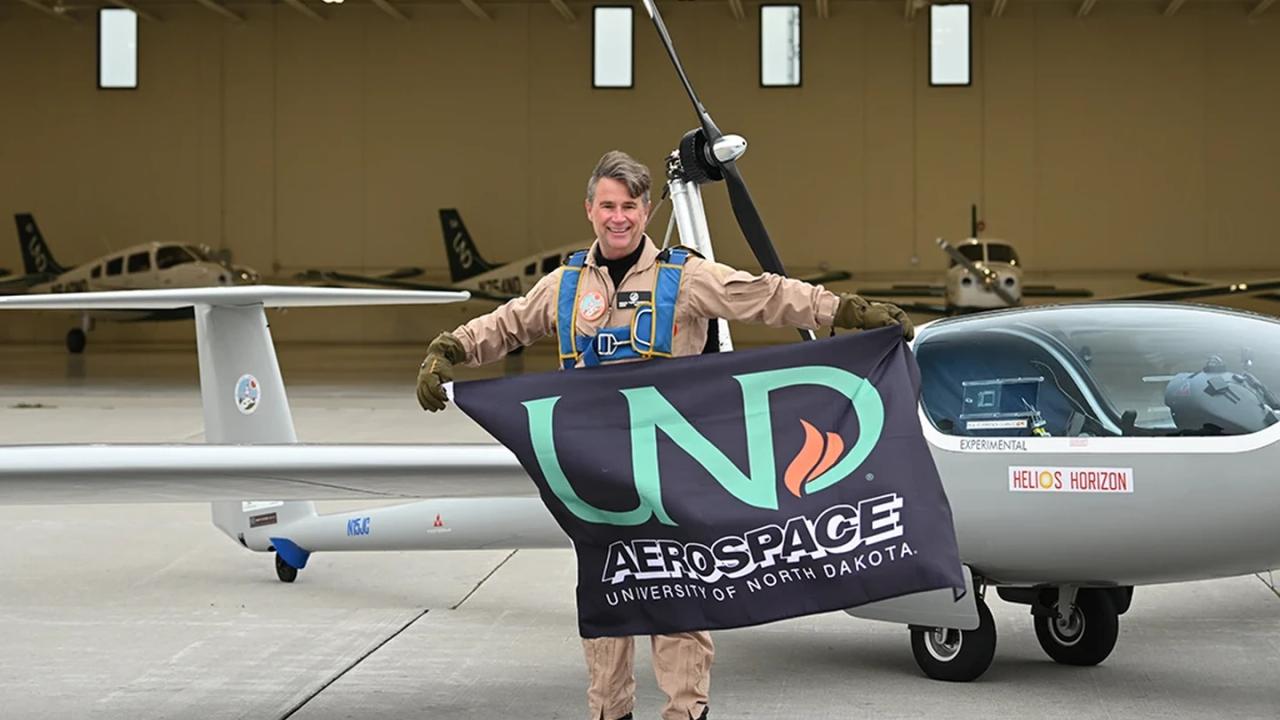
Over North Dakota, Miguel Iturmendi flew a modified Pipistrel Taurus on solid-state batteries to what the University of North Dakota reports was 17,200 feet. The flight used 36 percent of the battery’s charge, the university says. For a team working toward high-altitude atmospheric sampling, the achievement is sustained, piloted flight with this pack. For an engineer choosing a battery for another airplane, the most useful missing number is how many kilowatts the pack could still deliver near the end of the climb.
Charge remaining and power available can part company in cold air. A pack may contain energy yet reach its minimum allowable voltage under a heavy current draw. A winged glider accelerates on a runway and derives lift from its wings in forward flight. The same pack installed in an aircraft that has to hover would face a different load on departure and again on landing, when charge is lower. In one set of illustrative mission profiles presented by NASA researchers, vertical flight at takeoff and landing required roughly eight times the power of horizontal flight. That is an example of the change in demand, not a conversion factor for the Taurus.
The October flight also produced three claims submitted for international validation in the electric-aircraft class below 500 kilograms, according to UND, which supported the campaign. A National Aeronautic Association observer witnessed the attempt. The international federation’s accessible record table still lists Iturmendi’s ratified June 2023 altitude of 4,959 meters, about 16,270 feet. UND reports a climb above 3,000 meters in about 27 minutes as well as marks for maximum and level-flight altitude. A campaign announcement and an accepted record are different steps in the life of a flight. The federation’s final ruling and the precise submitted values warrant a check before any record headline.
Solid-state cells use a solid medium to conduct lithium ions between electrodes. Their appeal for aviation is the prospect of carrying more usable energy for a given mass. To compare complete airplanes, the enclosure, power electronics, wiring and thermal protection count against the mass allowance too. With pack mass, usable kilowatt-hours, current and temperature over the flight, an engineer could reconstruct the energy spent climbing and the power margin left for a diversion. The charge percentage alone cannot establish either. Dividing the altitude reached by 0.36 to project a battery-exhaustion altitude would ignore the changing atmosphere, reserve requirements and the altitude at takeoff.
There is already a scientific purpose for making the climb. The campaign carried a university atmospheric scientist’s experimental gas analyzer. And the pilot has used an altitude chamber to test life-support equipment as the team prepares for higher flights. Its proposed next step, toward 40,000 feet with higher-density cells, asks whether an entire aircraft and its occupant can keep working in colder, thinner air. For a research flight the most valuable return may be a sensor trace taken at an altitude the aircraft can reach reliably, with enough power in reserve to bring the instrument and pilot home.
Sources. UND campaign report · University follow-up · FAI ratified records, No. 19969 · NASA mission-profile examples, slides 2–3.
Test pilot Miguel Iturmendi with a UND Aerospace flag beside the Helios Horizon aircraft. James Darcy, courtesy of the University of North Dakota