A flying robot weighs barely a gram. Now it can tell when it drifts.
Onboard sensing lets a tiny robot estimate its own motion. Its flight trials show how much work remains before it can carry its power supply too.
Published November 21, 2026Intelligence / Robotics / Autonomous Systems
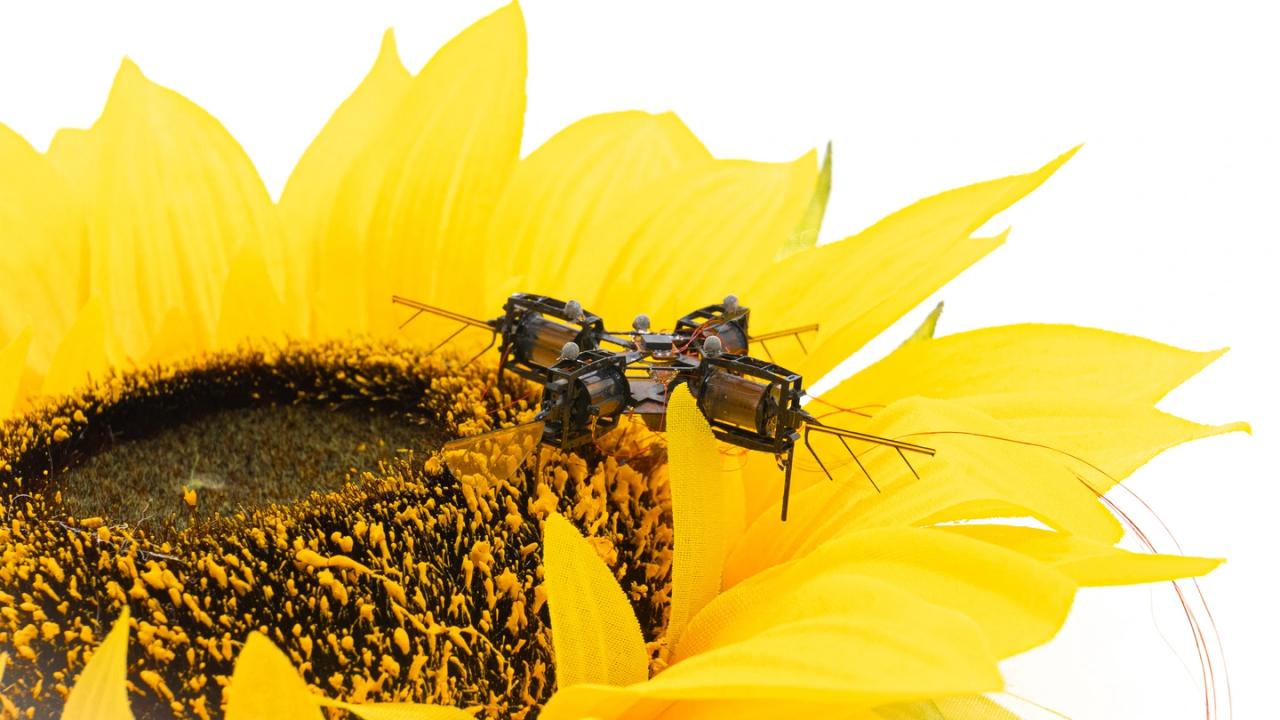
A tiny flapping robot landed on a sunflower outside the room whose cameras usually helped it fly. A person chose where it should go. The machine supplied something that earlier versions had to get from the room itself: a running sense of its own motion.
For an insect-sized aircraft, hovering is a considerable test of perception. A machine can tip or slide sideways between wingbeats. A laboratory camera can watch it from a distance and tell a computer where it went. A robot intended to work among plants would have to carry much of that capability with it, and every sensor it carries takes up weight that its wings must lift.
Researchers at the Massachusetts Institute of Technology and Cornell University reported their work November 18 in Science Robotics. Their complete flight electronics weighed 244 milligrams, just under a fifth of the equipped robot’s roughly 1.29 grams. In separate trials with sensing and computing both aboard, the machine hovered for ten seconds and followed a change of position over seven seconds. External cameras recorded those flights so the team could check the results afterward.
The sunflower flight tested a different part of the problem. According to the authors’ detailed preprint, the aircraft carried its sensors beyond the camera arena while a desktop computer processed their readings. An operator used a joystick to give the machine successive destinations. Over roughly 30 seconds it covered about 1.2 meters and settled onto the flower. The operator supplied the choice of landing place. The experiment measured the vehicle’s ability to get there from its own motion cues. Pollination would require a separate demonstration of pollen transfer.
An earlier machine from the same group could already maneuver quickly under laboratory tracking. To carry the new electronics, the team increased the lift available from the soft artificial muscles that drive its four wings. The sensors aboard the new version read tilt, height and the apparent motion of the ground beneath it. Ground sliding through the sensor’s view gives a clue to lateral speed. Accumulating those estimates gives the aircraft a position, although small errors accumulate as well. For keeping the vehicle steady, the researchers found that a fresh estimate could be more useful than a finer one delivered late.
The next burden is power. In the authors’ accounting, even at their highest tested sensing and computing load, the electronics drew about 0.12 watts. The artificial muscles alone drew about 2.04 watts in hover. That makes the electronics draw roughly 6% of the muscles’ draw, or about 5.6% of the two together. The tether supplied electricity throughout. Moving the computer aboard has answered one question about flight among plants. Carrying the energy to keep those wings beating for a useful length of time is a heavier proposition.
Sources
Authors’ full preprint, especially figures 5 and 6 · November journal article · MIT’s account of the result · Previous camera-tracked aircraft, December 2025