Who is turning AI into operating capacity faster, China or the United States?
A sprayer in Arkansas and a hospital ward in China reveal how much can change between installing AI and measuring the work it does.
Published November 21, 2026Analysis / Artificial Intelligence / Predictive Analytics
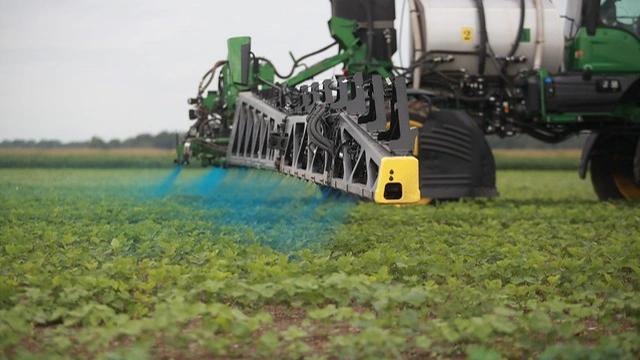
In a soybean field near Keiser, Arkansas, a tractor could pass a patch of small pigweed without opening a spray nozzle. The cameras were working. The operator had set the machine to spray only weeds large enough to clear its detection threshold. The saving showed up immediately in the tank. The cost took another growing season to see.
University of Arkansas researchers compared targeted spraying with spraying the whole field in a three-year trial that began in 2022. They reported a 43–59% reduction in herbicide use. At low sensitivity, some Palmer amaranth survived both the first pass and the follow-up treatment. “These escapes produced seed, resulting in an increase in the soil seed bank,” said Jason Norsworthy, the University of Arkansas weed scientist who evaluated the sprayer. His team reported a 280% annual increase in the pigweed population under that setting. A farmer looking only at the chemical bill and a farmer looking at next year’s field could reach opposite conclusions about the same machine. Arkansas Agricultural Experiment Station
The Arkansas trial points to the hardest part of comparing the United States and China on AI: a machine can do exactly what its operator asks while leaving more work for next year. China is adding industrial robots faster. The United States has better survey evidence that AI use is spreading among employers large and small. Which country is getting more useful work from AI faster remains open. Answering it means following the harvest, the factory shift or the hospital ward long enough to see what happened to output, labor and quality. Industrial robot installations · U.S. employer estimates
Half a world away in Hebei, researchers asked a question that comes one step earlier. Could a sprayer find a weed among young corn plants and put droplets where its camera said the weed was? On June 13, 2025, they tested the equipment in five strips of maize at three times of day. They measured an average targeting deviation of 1.45 centimeters. Their reported 93.7% application accuracy concerned the coloring of test cards. A card can tell an engineer whether a nozzle hit its mark. It takes a harvest, and sometimes another spring, to learn what that hit was worth. Hebei Agricultural University and Beijing Academy of Agriculture and Forestry Sciences, field methods and results
How a field trial becomes a farm purchase
The American grower has a decision the Hebei engineers’ test was never designed to settle. A single-tank machine can need a separate pass to broadcast a residual herbicide over the ground while targeting emerged weeds selectively. A dual-tank setup can separate the jobs on one pass. At high sensitivity the Arkansas team estimated a $25,000 upgrade could pay for itself after treating 819 acres under its price, machine-efficiency and application assumptions. A grower with fewer acres might obtain the same service from a contractor who spreads the equipment cost across several farms. That last possibility is a business proposition. The trial did not count contractors or establish a national break-even acreage. Arkansas trial and economic assumptions
In Hebei, the group gathered training images at different times of day because a weed in shadow can look unlike one in midday light. The field machine had to turn that recognition into a valve command while moving. A next-season buyer would want to know how often it misses the weeds that do the most damage, how its speed compares with a conventional pass, and whether technicians can keep it calibrated. For a small farm, the important adoption statistic may be acres treated by a contractor rather than machines owned. Neither country’s example counts that population. Chinese field report, §§1 and 2.7
The factory has to keep moving
A roll of battery separator or aluminum foil gives a camera a more orderly view than a cornfield. It also gives the operator less time to act. In June 2026 a Wuxi machine-vision supplier described inspecting continuous materials for tiny surface flaws. The local government’s published interview reports that the missed-defect rate fell from 27.5% to 0.1%. A marketing representative for the supplier explained the advantage of inspecting film, foil and other materials for different customers: “Serving several fields can spread risk and also build up a large collection of defect data,” the representative said, in translation from Chinese. The company uses those examples to refine its inspection algorithms. The report gives no common inspection sample, independent audit, false-reject rate or hours lost to line stops. A customer would need those figures before translating fewer missed flaws into more saleable rolls per shift. Wuxi supplier interview, June 17
In Spartanburg, South Carolina, BMW uses cameras and acoustic sensors during production to send immediate quality feedback to employees on smart devices. It describes its inspection system as a company standard and says it is assessing whether suppliers could use it. Wuxi’s specialist sells inspection to several manufacturers; BMW’s route starts with the automaker’s own lines. Neither publishes matched defect and rework records for the two systems. At the same South Carolina plant BMW also tested a Figure humanoid robot feeding sheet-metal parts into the welding process. Over ten months it supported production of more than 30,000 X3 vehicles, according to BMW. An American shift therefore provides evidence of repeated physical work by a robot in an actual production sequence, even though the automaker is German. The relevant alternative is whatever BMW would otherwise use to place the same parts, including conventional automation. BMW’s vehicle count establishes exposure to production conditions. It gives neither a labor saving per vehicle nor the comparative cost when a feeder breaks down. BMW’s Spartanburg production account
China’s industrial scale matters here because a specialist supplier can reach many plants without each plant assembling its own AI team. It cuts both ways. A factory with rare defects may have too few examples to train a system on its own, yet a model trained on a neighboring industry may reject good material on its line. The test of a supplier network would be shorter commissioning times and sustained yield improvements at the second and tenth customer. Robot purchases establish a market for equipment. They cannot supply that follow-up evidence.
The last few yards of a delivery
A street address gets a driver to an apartment complex. It may leave the driver circling for an entrance or carrying a parcel to the wrong building. In U.S. testing that began in October 2024, Amazon’s Wellspring system combined information from earlier deliveries, images and maps to place more than 2.8 million apartment addresses in their corresponding buildings across more than 14,000 complexes. Once a driver’s map contains the entrance, the next driver can use the answer without opening a separate AI application. The company counted mapped addresses. A customer would also want to know how many failed deliveries the mapping prevented. Amazon’s Wellspring account
Meituan describes a different decision on the same last mile in China. Its food-delivery system estimates travel and handoff time using conditions including weather, restaurant preparation and local supply and demand. The model supplies one candidate deadline. The platform computes three protective time allowances and takes the longest of the four results. That rule deliberately permits more time than the model alone would sometimes grant. An evaluation that rewarded only shorter predicted trips could penalize a decision the operator took to protect the rider. Failed deliveries, lateness, rider hours and injuries per completed trip would make a more revealing comparison. Those matched results are absent from the two operators’ accounts. Meituan’s original explanation of delivery deadlines
The two systems spread through a dispatcher’s software. A driver or small restaurant can benefit without licensing a model or reporting an AI purchase. The operator can also change how an entire network works by changing one default. Amazon’s address coverage does not measure minutes saved on a route; Meituan’s allowance does not establish fewer injuries. Compare similar neighborhoods before and after rollout, controlling for delivery density, weather and order mix, then count successful handoffs per paid hour alongside rider safety. Faster deliveries bought by transferring extra waiting time to restaurant staff would show up very differently on those two ledgers.
What three minutes buys a hospital
At Fuwai Hospital in China, doctors on four coronary wards took part in a trial of a locally developed medical-record assistant. Two wards received the tool. Two continued with conventional documentation. Discharge records took an average of 5.73 minutes to write in the intervention group and 8.69 in the comparison group. The difference, just under three minutes per record, came with an improvement on the hospital’s own quality assessment. A hospital that matched this result over 100 discharges would free nearly five physician-hours for other work. Whether that time becomes shorter waits, fewer late shifts or another round of paperwork is a question for hospital management. The study measured the records. Fuwai study, methods and results
In California, researchers randomized 238 outpatient physicians across 14 specialties to usual care or access to one of two commercial AI scribes. The scribes listen to the visit and draft a note for the physician to check. One, Nabla, reduced time spent writing notes by 9.5% relative to control. The other, DAX, produced an estimated 1.7% reduction, with enough uncertainty to include no change. Physicians used each tool in only about a third of visits in its assigned group. Only one product showed a statistically detectable improvement against usual care. That alone does not establish a statistically significant difference between the two products. UCLA randomized trial in NEJM AI
Some of the notes omitted clinical information or used the wrong pronoun. “This technology requires active physician oversight, not passive acceptance,” said Dr. John N. Mafi, a UCLA Health internist and the trial’s senior author. For the doctor signing the chart, reviewing the draft is part of the job whose time the hospital hopes to save. UCLA Health’s account of the trial
Fuwai’s doctors wrote inpatient discharge records. UCLA’s doctors documented outpatient visits. Fuwai randomized only four wards, even though the researchers collected 8,785 records. The Chinese paper does not isolate the contribution of machine learning from the rest of the writing system. Both countries have moved beyond demonstrations to measuring physician time against usual practice. In both, what a hospital buys, which notes it asks the system to prepare, and how often a clinician chooses to use it stand between procurement and a return. Neither experiment measured nationwide adoption or patient throughput. Fuwai trial · UCLA trial
The same question about who does the work runs through schools. In an American tutoring trial, giving human tutors live suggestions improved students’ probability of mastering a math topic by four percentage points. In rural China, an experiment with 8,647 students in 315 primary classes compared personalized computer instruction with ordinary computer instruction and other educational activities. The researchers found no significant achievement gain from the personalized program. The U.S. endpoint was mastery during tutoring; the Chinese trial measured academic achievement. The American result makes a case for supporting a particular worker at a particular moment. The Chinese result gives a school district reason to demand evidence of learning before buying personalization for every classroom. Tutor CoPilot trial · Rural China randomized trial
Where the national evidence changes the picture
The latest comparable U.S. employer collections, ending November 30, 2025 and November 15, 2026, put reported use of AI in any business function at 17.3% and 25.0%. Among employers with one to four workers the share rose from 17.0% to 23.4%. Among those with at least 250 it rose from 30.5% to 44.0%. Small employers gained access while the large-employer advantage widened by 7.1 percentage points. Capital costs on a farm and systems integration at a hospital suggest reasons why purchase and sustained use can diverge. The survey itself cannot establish the cause. Its broader question began in late 2025; the older goods-or-services question is a different series. Census national estimates · Size estimates · Question change
China’s Ministry of Industry and Information Technology reports AI use at more than 30% of manufacturing enterprises above designated size. Entry into that population requires at least 20 million yuan in annual revenue from the main business. On the American side, the latest Census period put manufacturing at 22.4%, up from 12.7% in the comparable collection last November. Excluding the smallest Chinese manufacturers while including small American employers could itself change which country appears ahead. We also lack a matched starting value and a common question about where the technology was used. Purchasing-office AI can put a U.S. manufacturer in the numerator. Chinese ministry briefing · Chinese statistical threshold, note 3 · U.S. sector estimates
Physical scale gives China an advantage that software usage surveys struggle to see. Chinese factories added about 354,000 industrial robots in 2025, up 20% in a year. U.S. factories added nearly 38,500, up 12%. Yet the United States had more operating robots relative to manufacturing employment, 323 per 10,000 workers against China’s 193. China’s 2020–25 density rose 147% on the federation’s revised employment basis. A buyer seeking an enormous market for industrial vision equipment and a worker asking how automated the typical workplace is could reasonably take different lessons from those figures. IFR installations · IFR November density release
Those national numbers also miss work done inside an adopting firm. In the winter Census supplement, 18% of employer firms used AI, rising to 32% when firms were weighted by employment. The second figure counts jobs at adopters. An employee maintaining a boiler enters that count even if only the purchasing office uses AI. Among adopting firms, 57% reported use in at most three business functions. Likewise, a consumer can open a model every day without ever entrusting it with a job. Microsoft’s selected-product tracker put individual reach among working-age people at 33.0% in the U.S. and 17.5% in China in Q2 2026, and identified omissions of popular Chinese products. Adding them could raise the Chinese estimate even if nobody changed behavior. Census research supplement · Microsoft methodology, p. 10
Retail offers a warning about even the cleanest throughput metric. In a randomized Taobao experiment, automating eligible service chats with human escalation shortened them by 16.8% but reduced customer ratings by 0.412 points on a five-point scale. Nor can a study of support for U.S. small-business customers establish a domestic U.S. labor advantage: 89% of the agents in the widely cited QJE study worked abroad, mainly in the Philippines. The productivity belongs where the work took place. Taobao experiment · QJE rollout study
Mining, utilities, finance and public administration make a national verdict harder still. Komatsu identifies an autonomous haul truck operating at Nevada Gold Mines. In Inner Mongolia, the operator of the South Open-Pit Mine reported putting a driverless electric truck into service in July 2026. The operator calculated a 65% drop in energy cost per unit of output against a diesel truck of comparable tonnage. The comparison changes propulsion and automation together. A diesel-to-electric saving cannot all be credited to the software steering the truck. Komatsu’s Nevada account · Chinese mine operator’s July commissioning account
A grid operator can improve its wind forecast through new sensors and better weather physics as well as machine learning. A bank can count interactions while leaving resolution rates undisclosed. Public agencies can inventory projects long before a resident gets a decision any sooner. Each calls for a different test: tonnes moved per staffed hour at a comparable mine, balancing cost at the same forecast horizon, correctly resolved cases and elapsed time to an appealable decision. Nevada Gold Mines announcement · NCAR’s utility forecast account · U.S. government inventory audit
On the industrial buildout, the evidence favors China. On documented diffusion across employer sizes and business functions, the United States has the stronger time series. The Arkansas field trial and the Spartanburg line challenge the idea that America’s strength stops at professional work. The Fuwai wards and Meituan’s dispatch rules challenge the idea that China’s strength stops at installing machines. Neither lead establishes a faster national rise in output attributable to AI.
A decisive comparison would follow matched workplaces for more than one budget cycle, including the farms and small factories that decline to buy. Record which systems remain in use, what fraction of the work they do, the labor spent checking them and the quality of the output. In Keiser, the operator could read the chemical saving from the tank that afternoon. The field had to be counted again the following year.
In a demonstration of targeted spraying, a See & Spray machine sprays water dyed blue. Photo by University of Arkansas System Division of Agriculture.