How Hesai’s Kosmo Turns Real Spaces Into Training Environments for Robots
LiDAR, cameras and motion sensing capture the surroundings. Turning that data into reliable robot practice requires several more steps.
Published October 18, 2026Analysis / Robotics / Autonomous Systems
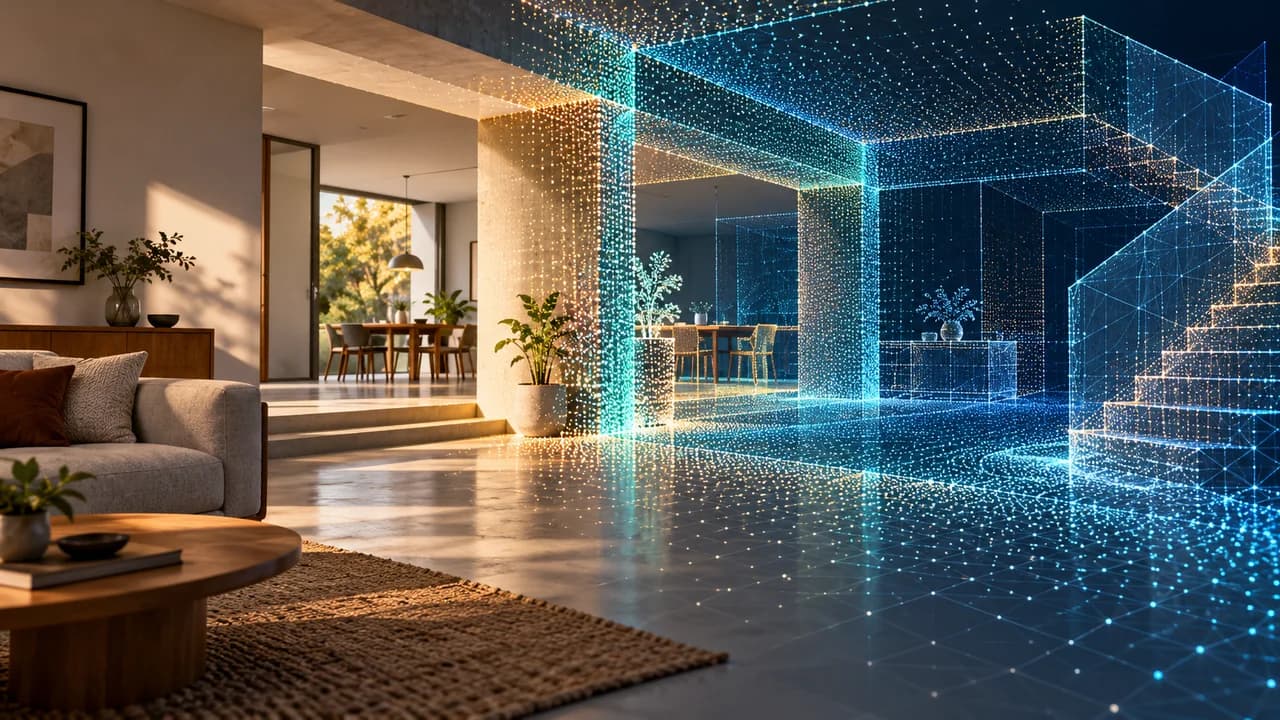
A robot learning to work in a store needs more than a recognizable picture of the room. It needs usable information about where surfaces are, what objects look like and what happens when it moves through or touches them. Hesai’s Kosmo is aimed at the first part of that problem: capturing real places and making them reusable as digital environments.
Hesai launched Kosmo on October 14, 2026, combining its Kosmo One capture device with the Kosmo World platform. The company is based in Shanghai, with a U.S. office in Palo Alto, California, and a European office in Böblingen, near Stuttgart. Its listed U.S. address is 3500 W Bayshore Road, Palo Alto. Hesai’s launch · Company locations
Measuring the space from several directions
Kosmo combines LiDAR, camera imaging and an inertial measurement unit, or IMU. LiDAR provides distance measurements; images supply visual detail; inertial measurements help track movement during capture. Kosmo’s product site also lists access to images, point clouds, IMU readings and sensor-calibration parameters. Kosmo product information
A point cloud is a collection of measured locations in three dimensions. Calibration describes how the sensors behave and how their coordinate systems fit together. Without that alignment, a wall measured by the laser and the same wall photographed by the camera would not necessarily line up.
Combining these inputs is an established engineering approach. Research systems such as FAST-LIVO2 demonstrate LiDAR–visual–inertial mapping. That provides context for the technique; it does not establish that Kosmo uses that particular algorithm. The commercial opportunity is making capture, calibration and reconstruction work together with less specialist preparation. FAST-LIVO2 research implementation
One capture, different digital products
Hesai describes outputs including Gaussian splats, meshes and depth data. These serve different jobs. A Gaussian-splat scene uses many overlapping elements to reproduce the appearance of a place. A mesh describes surfaces. Depth data records distances from a viewpoint. Hesai’s launch
There is a concrete example beyond the announcement. In an October 5 Pixar tutorial, Dylan Sisson documents a Kosmo capture of the studio’s plaza moving through USD scene data into Houdini Solaris and RenderMan 28 beta. The example contains roughly 1.26 million splats that can be moved, scaled and edited. Captured lighting and shadows remain in that example; it does not demonstrate relighting. Pixar acknowledges the supplied capture hardware. This establishes a usable creative workflow, rather than a benchmark of robot performance. Pixar’s tutorial and demonstration
Processing is not described solely as a cloud service. Kosmo’s current support page lists Windows-based Kosmo Studio reconstruction, scene fusion and editing, plus PLY/SOG splat exports and OBJ mesh exports. It specifies licensing and NVIDIA GPU requirements for reconstruction. Those release notes are undated, so these are current documented capabilities rather than features assigned here to the October 14 launch. Kosmo support documentation
From recognizable scenes to robot practice
Hesai describes semantic segmentation, which identifies objects in a scene, and generative completion of uncaptured areas. Developers need to distinguish measured surfaces from estimated additions. A plausible-looking surface behind a cabinet is not automatically a reliable measurement. Hesai’s launch
In principle, a reconstructed shop could help a mobile robot rehearse navigation, or provide camera views for training a perception system. A robot arm practicing a grasp needs more: collision geometry, object mass, friction and other physical properties. These are additional simulation requirements. NVIDIA’s Isaac Sim workflow includes importing assets, enabling physics and configuring robots and sensors. A file that renders beautifully is therefore only part of a working robotics environment. NVIDIA Isaac Sim
Hesai names Isaac Sim and Isaac Lab as destinations for its data. The public material reviewed for this story did not establish a turnkey, independently validated Kosmo-to-robotics physics workflow. That remains a practical question for developers evaluating the system.
Where Kosmo fits among competing approaches
XGRIDS offers the closest comparison: its Lixel scanners and Lixel CyberColor software also turn captured spaces into Gaussian-splat scenes. LCC Studio documents exports of splats, triangle meshes and NVIDIA-compatible USD, with Isaac Sim 5.0 or later explicitly supported. That is a documented import route, although visual compatibility alone does not establish complete physical properties for every object. XGRIDS export documentation
NavVis approaches the market from measured-building capture. Its VLX 3 combines two LiDAR sensors with four panoramic cameras; IVION supports downloads including E57 and PLY point clouds and panorama images. Those are useful foundations for geometry and visualization, but they still require preparation before becoming interactive robot-training environments. NavVis VLX 3 · IVION exports
World Labs' Marble tackles an adjacent task: generating worlds. It offers Gaussian splats, detailed meshes and lower-detail collider meshes for coarse physics. Such environments can provide variation for experimentation, but generated geometry should not automatically be treated as a measurement of an actual workplace. World Labs Marble
These products overlap without being interchangeable. XGRIDS competes closely in capture and reconstruction; NavVis supplies measured-space assets; Marble supplies generated environments. NVIDIA Isaac Sim is chiefly a downstream complement that can supply simulation machinery. Kosmo's case therefore rests on how efficiently its integrated workflow delivers usable data and validated robot-task improvements, rather than simply whether it can produce an attractive 3D scene.
What has been shown in robotics?
Reuters reported on October 14 that a Sharpa robot was serving ice cream at a Dairy Queen outlet in Shanghai. The report attributes a 99% task-success figure, and the claimed contribution of Kosmo mapping, to Hesai. It also notes that Sharpa was founded by Hesai’s co-founders and operates independently. This is a concrete reported application, but it should not be mistaken for an unrelated customer’s controlled comparison establishing how much Kosmo improved performance. Reuters reporting
The opportunity is substantial if capture reduces the effort needed to create useful practice environments. The tests that matter are repeatable geometry, dependable exports, clearly identified generated content and measurable improvements when trained robots return to the physical world. Kosmo supplies a route from real places to reusable data; the quality of the resulting robot learning still needs to be demonstrated task by task.
Sources · 12
- https://www.hesaitech.com/9974-2/
- https://www.hesaitech.com/about-us/
- https://www.kosmoai.com/
- https://github.com/hku-mars/FAST-LIVO2
- https://renderman.pixar.com/gaussian-splatting-the-pixar-campus
- https://www.kosmoai.com/support/
- https://developer.nvidia.com/isaac/sim
- https://docs.xgrids.com/en-us/06-lixel-cybercolor/01-lcc-studio/v2.4.0/11-my-models.html
- https://www.navvis.com/hubfs/Content%20Library/Content%20Library%20Files/NavVis%20VLX%203%20product%20info/NavVis-VLX-3-product-info-Digital_EN.pdf?hsLang=en
- https://knowledge.navvis.com/docs/downloading-processed-data
- https://www.worldlabs.ai/blog/marble-world-model
- https://www.ksl.com/article/51636197/chinas-hesai-launches-spatial-camera-to-boost-ai-powered-robotics-adoption