Xanadu and HyperLight Cut Optical Switch Loss as Photonic Quantum Hardware Scales
A reported 7 millidecibel switch preserves more light through repeated routing while speed, control and manufacturing remain part of the larger engineering challenge.
Published November 11, 2026Intelligence / Frontier Tech / Experimental Systems
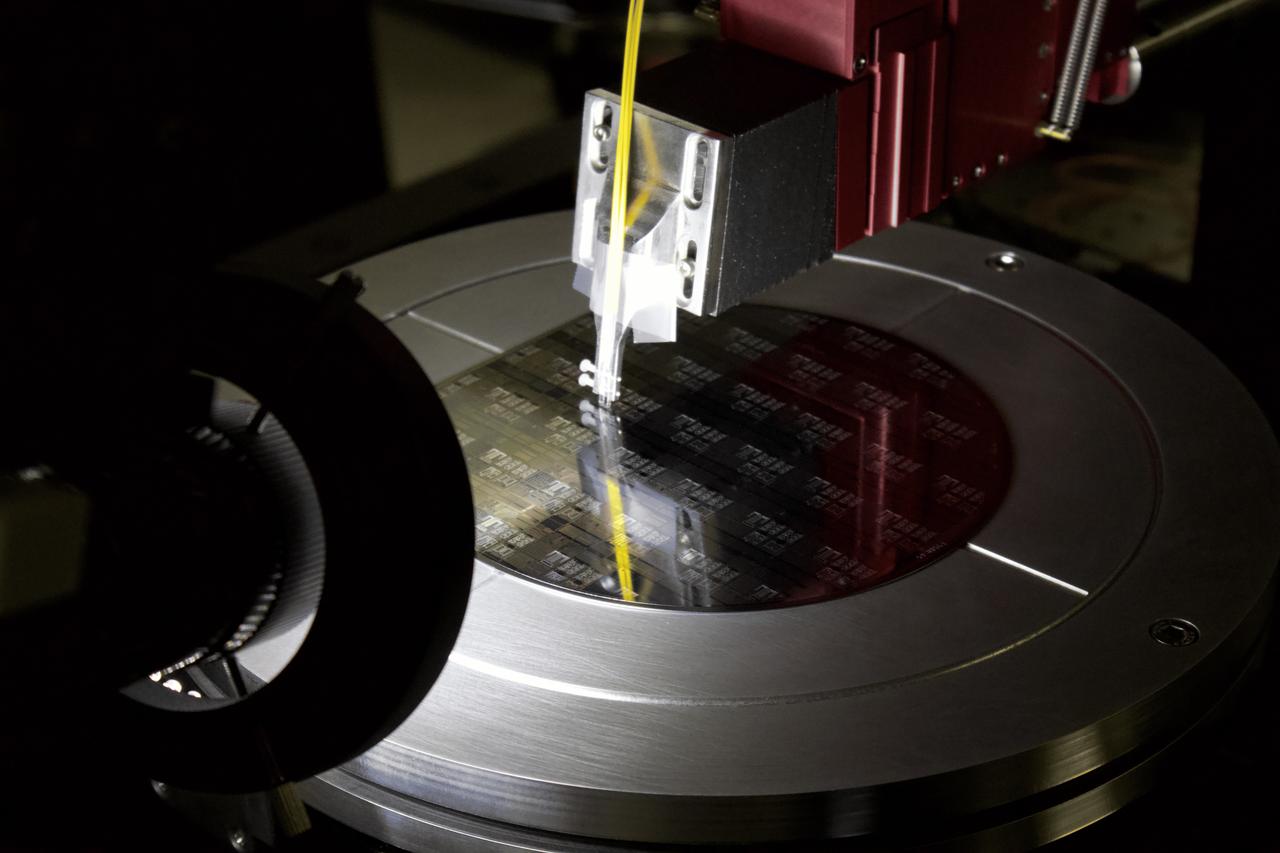
Xanadu and HyperLight say they have reduced optical switch insertion loss to 7 millidecibels, down from approximately 20 millidecibels in July 2025. The November 10 announcement addresses a persistent obstacle in quantum computers that use light: photons must pass through many components before they produce a useful result, and every routing step can lose some of them. 1,2
The companies reported the result on HyperLight's thin-film lithium niobate platform using a high-volume wafer manufacturing line. They described good yield and repeatability, while leaving device counts, numerical yield and the full measurement conditions undisclosed. The milestone is a company-reported component measurement, with performance in a packaged, operating network still to be established. 1
There is a specific reason to watch this small number. In the 2025 Nature paper describing Xanadu's Aurora system, H. Aghaee Rad and colleagues called optical loss the “dominant and most challenging hurdle” to fault-tolerant operation. One contemplated optical path passed through as many as 15 switches; its analysis allowed roughly 7 millidecibels per switch even when other losses were set aside. Reaching that component figure addresses a demanding target within a broader architecture. 3
The nearly threefold reduction does not mean a computer runs three times faster. Insertion loss measures how much light a component removes from the transmitted signal. Seven millidecibels is 0.007 decibel. Speed, routing accuracy and the probability of completing a useful computation have their own measurements, and a machine needs acceptable performance across all of them.
The cumulative effect is easier to see through an illustrative calculation. For 15 identical switches, 0.007 decibel each adds to 0.105 decibel, leaving approximately 97.6 percent of the entering light. Fifteen switches at the earlier 0.020-decibel figure add to 0.300 decibel, leaving about 93.3 percent. This uses the standard transmission calculation, ten raised to minus the loss in decibels divided by ten. It isolates switch loss and assumes each traversal has the stated value.
The difference is about 4.3 percentage points of transmission across that example path. Sources, connections, delays and detectors consume additional parts of the optical budget. For an actual quantum state, the consequences also depend on how information is encoded and how the error-correction scheme handles missing photons. The calculation illustrates accumulated attenuation; a whole-machine success rate or cost forecast needs additional system data.
Routing is an active part of computation. Some photonic processes succeed probabilistically, and a detection event can tell the controller which available state to send onward. A network can combine many attempts and select useful outcomes, improving the supply of states for later operations. That requires a measurement result to travel through electronics and reach the switch while the light is still available. PsiQuantum's architecture research identifies fast switching as a requirement for this adaptive use of its sources and entangling operations. 4
The choice of switch affects how that schedule works. A Mach–Zehnder interferometer splits light between two arms, changes their relative phase and recombines them so interference directs the output. Lithium niobate responds to an applied electric field, making it useful for fast phase control. Longer active sections can obtain a given phase change with less drive voltage, while more waveguide length adds opportunities for loss. The Aurora paper discusses that voltage and length tradeoff as component performance improves. 3
Fabrication quality enters through the tiny structures that guide the light. Roughness and other imperfections can scatter it out of the desired path. In July 2025, Xanadu and HyperLight reported waveguide losses below two decibels per meter and corresponding switch loss near 20 millidecibels after dedicated fabrication development. Their latest announcement gives the switch result, leaving the new waveguide propagation figure and full device geometry for further disclosure. 1,2
Loss is also separate from fidelity, the agreement between an intended quantum operation or state and the measured result. Light can survive but emerge with the wrong phase or in the wrong output. Crosstalk describes unwanted coupling or leakage between channels; electrical and thermal interactions can also disturb nearby controls. A useful specification therefore connects insertion loss to switching state, wavelength, polarization, drive conditions and the quality of the quantum operation. Those measurements would show whether a low-loss device remains accurate throughout its intended use.
Barium titanate offers a competing electric-field-driven material. In its 2025 Nature paper, the PsiQuantum team described two-millimeter phase shifters with about 100 millidecibels of insertion loss and a loss-voltage product of 0.33 ± 0.02 decibel-volts. The latter combines attenuation with the voltage needed for a phase change. It is a different quantity from insertion loss alone. The study developed barium titanate on full 300-millimeter wafers, illustrating an industrial route that integrates an active material with a larger silicon-photonics platform. 4
Direct rankings need matched boundaries. A phase-shifter measurement can exclude parts of an assembled switch, and an on-chip switch figure can exclude fiber coupling and packaging. Drive voltage, optical wavelength and the measurement method also affect a comparison. Xanadu links a competitor preprint in its announcement, but its broad competitive claim would be stronger with a common measurement protocol and distributions across devices. 1
Thermal control remains useful for slower configuration tasks, although heating many elements creates power and temperature-management demands. A 2025 silicon-switch study by Peng Bao and colleagues demonstrated crosstalk below minus 40 decibels at the central wavelength for thermally and electrically driven eight-by-eight switch networks. Its thermal design switched in 500 microseconds, with reported on-chip loss below five decibels; the electrically driven design switched in under 100 nanoseconds with loss as low as 8.5 decibels. These were data-network devices with a different circuit scope. Their figures illustrate the joint design problem rather than a direct benchmark against the new quantum switch. 5
Other approaches try to reduce the energy consumed while a circuit holds its setting. A June 2026 Nature Photonics study by Cristina Catalá-Lahoz and colleagues demonstrated a barium-titanate programmable mesh with 58 unit cells and 116 actuators. The paper distinguishes an approximately 80-nanosecond electro-optic response from the longer pulse sequences used to establish persistent settings. The mesh experiments used volatile control; persistent settings were demonstrated at unit-cell level. Its prototype's 1.48-decibel loss per programmable unit also includes integration transitions. Fast response, persistent memory and low attenuation remain separate achievements, even within one material platform. 6
At larger scale, control and assembly become as consequential as an individual device. Many channels need synchronized drive signals, calibration and stable optical connections. A lower-loss switch gives designers more room in the optical budget, but the network must preserve that gain after connections, packaging and repeated operation. Both the Aurora research and PsiQuantum's platform study describe substantial remaining work in components and integration on the route to fault tolerance. 3,4
Manufacturing evidence should show how many devices meet the full operating specification across wafers and production runs. A best device, a median result and a production yield answer different questions. Measurements with uncertainties, controls active, and representative packaging would let system designers assess the 7-millidecibel result against their complete routing budget. For customers seeking useful quantum calculations, that evidence would connect a promising chip measurement to the hardware resources and repeated operations their application actually requires.
Sources
1. Xanadu and HyperLight switch loss announcement November 10 2026
2. Xanadu and HyperLight earlier waveguide and switch result July 29 2025
5. Bao and colleagues Ultra low crosstalk silicon switches driven thermally and electrically April 2025
Sources · 6
- https://www.xanadu.ai/press/xanadu-and-hyperlight-achieve-breakthrough-reduction-in-optical-switch-loss
- https://www.xanadu.ai/press/xanadu-and-hyperlight-unveil-groundbreaking-advancements-in-photonic-chips-setting-new-benchmarks-for-quantum-computing-performance
- https://www.nature.com/articles/s41586-024-08406-9
- https://pmc.ncbi.nlm.nih.gov/articles/PMC12095036/
- https://www.nature.com/articles/s41378-025-00911-9
- https://www.nature.com/articles/s41566-026-01934-y