A 3D-Printed Boom Unfolds a Solar Array in Orbit
Orbital Matter’s small flight demonstration combines manufacturing and deployment, pointing toward a different way to build spacecraft power systems.
Published November 12, 2026Intelligence / Space Development / Base Development
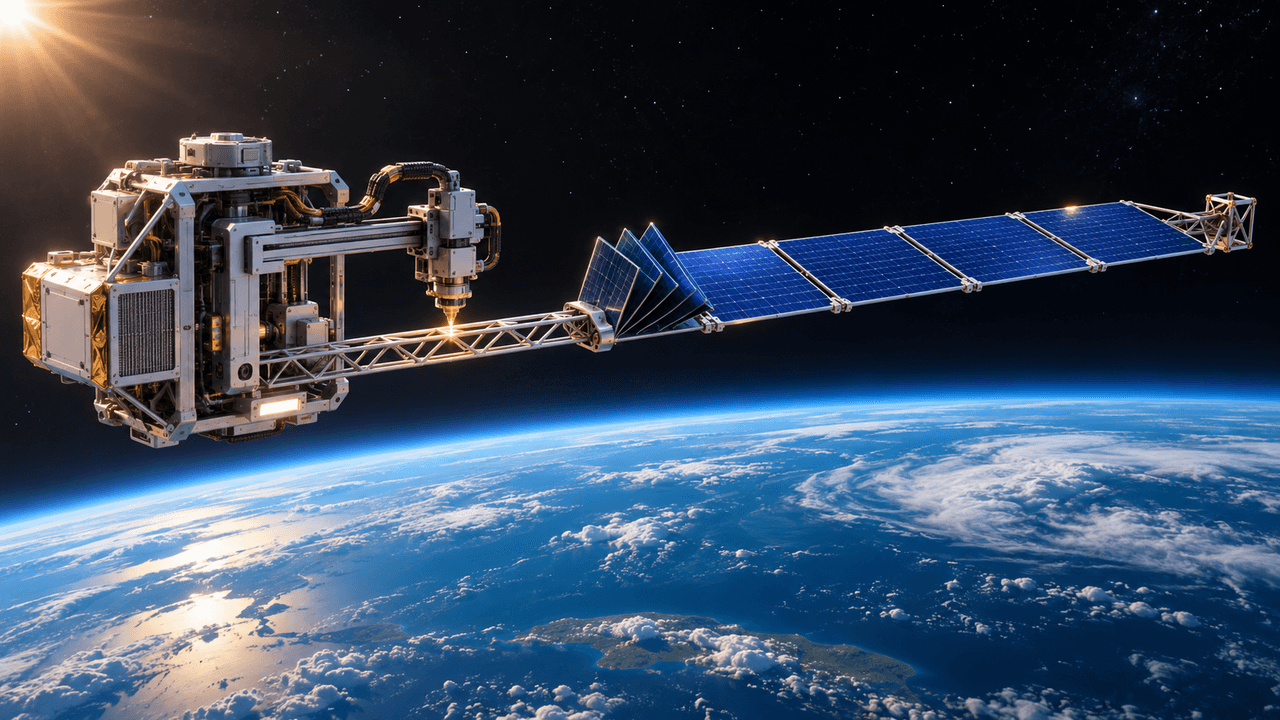
A small printer aboard Orbital Matter’s Replicator 2 satellite has turned liquid resin into a rigid boom and used the growing structure to unfold a solar array. The process took about 30 minutes, according to a European Space Agency (ESA) account published November 11. The Polish company’s experiment gives the printed support a useful mechanical job as it takes shape in orbit. [1]
The boom provides a backbone for a thin solar array. Making that backbone grow outward also supplies the movement needed to open the folded array, giving the printer a second job as a deployment mechanism. “We printed a rigid structure directly in space that helped deploy a stowed solar array,” chief technology officer Robert Ihnatisin said in ESA’s report. [1]
Orbital Matter says the boom was printed on October 21 and described the result in a November 3 update. An earlier run on August 12 established that its printer could extrude resin and harden it in the exposed orbital environment. The later run followed two months of adjustments to printing parameters and firmware; the company reports that it produced a continuous boom with well-bonded layers. [2, 3]
The next planned demonstration would use two printers to open a thin solar blanket for a 5-kilowatt array. Orbital Matter says that mission is planned for 2028 with satellite manufacturer EnduroSat. For spacecraft designers, the attraction is the possibility of forming a support after launch while deploying the surface it carries. The present result establishes that sequence at a small scale; the planned array would test it as a larger power system. [1, 2]
The process starts with liquid photopolymer, a resin that solidifies under light. An extrusion head lays down the material and an ultraviolet source hardens it, using light to form the structure. ESA gives the boom’s dimensions as 32.5 centimeters long and 3.8 centimeters across; the company describes about 30 centimeters extending outside the satellite. A printer slightly larger than a Rubik’s cube built the hollow structure in a continuous spiral. The printer worked in daylight and darkness, exposed to the vacuum and changing temperatures of orbit. Earlier polymer printing on the International Space Station in 2014 and orbital metal printing in 2024 took place under controlled conditions. [1–3]
Each of Replicator 2’s four printers has an inspection camera. The company says the feeds also support an image-recognition system that monitors the material during printing. Such inspection becomes more consequential as structures grow: engineers need to establish their shape, material quality and performance over time. ESA’s Out of Earth Manufacturing white paper identifies monitoring and part verification as central requirements for manufacturing after launch. The broader goal is to ease the packaging and launch-load constraints that shape today’s large antennas, telescope structures and power arrays. [1, 3, 5]
A separate Caltech experiment demonstrates how orbital construction can also start with finished components. Its Autonomous In-Space Tensioned Reflector Assembly (ASTRA) robot deployed two prebuilt truss bays and assembled a third in orbit. The reflector design uses netlike perforated film. Orbital Matter’s printer produces a structural member from feedstock; ASTRA joins structural members carried into orbit. Each method addresses a different step in building larger structures after launch, and each needs reliable materials, geometry and connections as it scales. [6]
Orbital Matter also has a European Union-funded project to develop and test an engineering model of a complete deployable solar-array system. The European Commission’s record lists about €500,000 in support, a July 2026 to June 2027 schedule and tests in relevant environmental conditions. That program extends the work toward an integrated system. The next flight’s practical test will be whether printing can repeatedly open and support a much larger power-producing surface, while longer observations establish how the printed structures endure in orbit. [1, 4]
Sources
[1] European Space Agency, First structure 3D-printed in the extremes of open space. November 11, 2026.
[2] Orbital Matter, second-print mission update. November 3, 2026, reporting the October 21 test.
[3] Orbital Matter, first-print mission update. August 12, 2026.
[4] European Commission CORDIS, Printer Assisted Deployable Solar Array project, grant 101310748.
[5] European Space Agency, Out of Earth Manufacturing white paper. September 19, 2025.
[6] Caltech, Caltech Robotic Space Demo Successfully Builds in Space. November 5, 2026.
Sources · 6
- https://www.esa.int/articles/about-us/directorates/technology-engineering-and-quality/first-structure-3d-printed-in-the-extremes-of-open-space
- https://www.orbitalmatter.com/newsroom-second-print
- https://www.orbitalmatter.com/newsroom-first-print
- https://cordis.europa.eu/project/id/101310748
- https://esamultimedia.esa.int/docs/technology/White_Paper_OoEM_Final_4_Signed_For_Publication.pdf
- https://www.caltech.edu/about/news/caltech-robotic-space-demo-successfully-builds-in-space