NVIDIA Robot Model Learns New Tasks From Five Demonstrations
Company tests show rapid adaptation on a selected set of manipulation tasks, with the evaluation design shaping the reported 95 percent average.
Published November 11, 2026Intelligence / Robotics / Humanoid Robotics
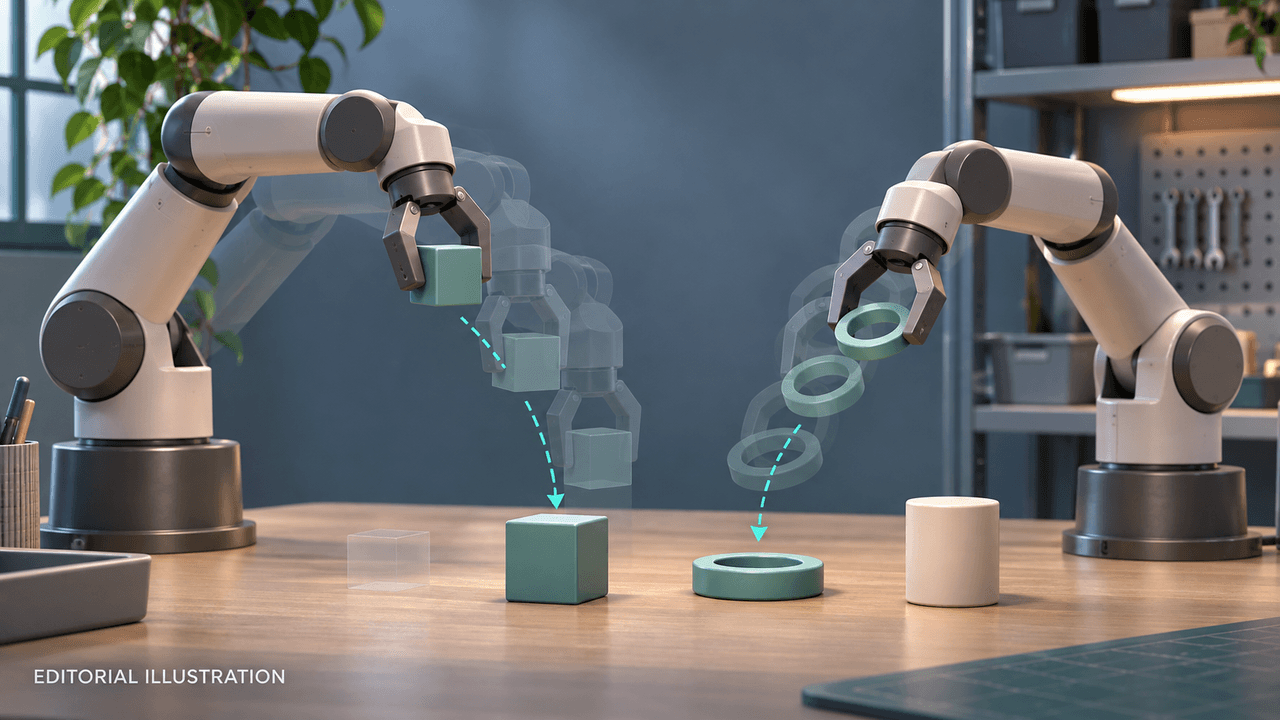
NVIDIA introduced GR00T 2 at the Conference on Robot Learning in Austin on November 9, reporting that a robot could improve substantially after seeing just a few demonstrations of a task. Across 50 selected tasks, average success rose from 40 percent with the pretrained model to 95 percent after five demonstrations per task and additional training. The result concerns adapting a research system to particular jobs. 1,2
The selection of those jobs helps explain the figure. NVIDIA chose tasks on which the model could reach at least 80 percent success after five demonstrations. The paper describes the resulting five-demonstration rate as “high partly by construction.” The tasks were new to the target robot, a machine with two arms and dexterous hands, but appeared in human video, another robot's data, or both. The experiment measures transfer and adaptation within that defined set. 2
GR00T 2 learns to predict future camera images together with the actions that could produce them. It takes recent video, an instruction and the robot's current state, generates a short sequence of movements, and repeats the process as the scene changes. Training combines people performing tasks, recordings from handheld grippers and remotely operated robots. A shared model can therefore draw on experience gathered through several kinds of body and recording setup. 1,3
Unfolding a tripod illustrates the practical challenge. The pretrained robot may attempt a sensible sequence and still struggle to manipulate a particular joint or grip. Demonstrations on its own hardware provide examples of the movements that work. For a laboratory trying to automate a changing set of procedures, reducing that adaptation effort could make it economical to attempt more jobs. The relevant saving would include the time spent recording examples, adjusting the system and supervising its early runs. 1,2
NVIDIA says the five demonstrations amounted to under three minutes of robot data per task. Each adaptation then took about 30 minutes on a single RTX 5090 graphics card. The researchers adjusted a small set of added model parameters while keeping the pretrained system's main weights fixed. Those short adaptation runs sit on top of the much larger data collection and training effort that created the starting model, as well as the cost of the robot and recording equipment. 1,2
The announcement also describes industrial evaluations. Foxconn is applying GR00T 2 to server-manufacturing automation, while Siemens is assessing industrial uses, according to NVIDIA. The project's page lists code availability for December. That creates a further checkpoint for outside laboratories: reproducing the published tasks and trying the method on equipment, objects and procedures of their own. The partner work establishes interest and testing activity; the research scores describe the company's evaluations. 1,3
A short sequence of successful trials answers a narrower question than a working shift. A robot may need to recover a dropped object, recognize that an insertion is incomplete or ask for help when the scene changes. NVIDIA's paper separately explores agents that monitor progress and invoke recovery actions. For an operator, the cost of those interruptions belongs alongside the headline success rate. Independent repetitions and longer runs would establish how reliably the reported gains carry into other settings. 2
The practical opportunity is a reusable starting point that can be adapted with a manageable amount of local teaching. A laboratory evaluating the release could compare the full time needed to establish a dependable task with its existing programming method, then track completed work and human interventions over repeated runs. That would turn a promising adaptation result into evidence about the work a customer actually receives.
Sources
3. NVIDIA Conference on Robot Learning announcement and industrial evaluation context, November 9, 2026