LingBot Touch Gives Different Robot Hands a Shared Way to Read Contact
Robbyant reports stronger task scores across two robot hands and four action models.
Published November 12, 2026Intelligence / Robotics / Autonomous Systems
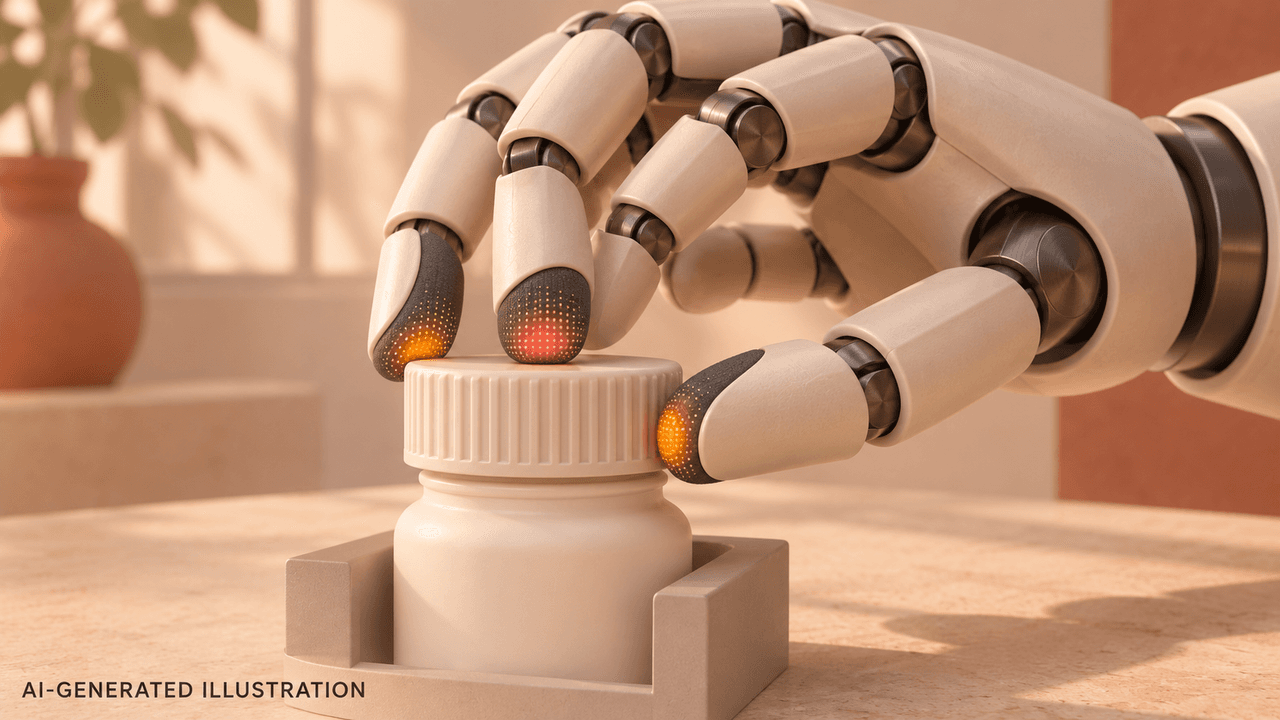
A robot twisting a bottle cap needs to sense how the cap moves against its fingers as well as see where the bottle sits. Robbyant’s LingBot-Touch model gives robot-control software a reusable way to interpret that contact, drawing on recordings from human gloves and robot fingertips. The Ant Group robotics company announced the release on November 10, following a research preprint posted November 9. [1, 2]
Across 26 tasks on two robot hands, four action models gained roughly 14 to 25 percentage points in average task scores when supplied with LingBot-Touch features. The scores measure progress through operations such as turning pages and opening caps, awarding credit for intermediate stages as well as completed tasks. They offer evidence that the shared touch model helps controllers use contact information in the tested settings. [1]
The team also reused the touch encoder on XHand1, whose magnetic sensor model was absent from pretraining. The encoder—the software that turns sensor readings into useful numerical features—kept its learned settings while the researchers taught the hand’s controller with demonstrations. Its six-task results improved. For developers, that suggests some knowledge gathered with one set of tactile devices can remain useful when the hardware changes. [1, 3]
The bottle-cap test shows how to read the results. T-Rex’s score rose from 56.25 percent with its original inputs to 62.5 percent with raw touch data and 90 percent with LingBot-Touch. The task awards increasing credit for approaching the cap, grasping and rotating it, fully unscrewing it, and lifting it clear. The 90 percent figure summarizes stage points earned over 20 trials; a count of fully completed openings would answer a separate question about end-to-end reliability. [1]
The model has to reconcile sensors that record contact in different ways. Magnetic devices detect changes in a magnetic field as their surface deforms; piezoresistive sensors register changes in electrical resistance under pressure; visuotactile sensors use internal imaging to observe deformation. LingBot-Touch maps sensing points into a common fingertip coordinate system, processes each sensing type through its own input path, then uses a shared Transformer model to learn relationships across positions and time. The resulting tactile tokens are compact numerical features that an action model can combine with camera images and information about its joints. [1, 3]
Training uses a joint-embedding predictive architecture (JEPA): the system hides parts of a touch recording and predicts their internal representations from the visible context. This directs learning toward patterns of contact in data where many sensing points are inactive much of the time. The corpus contains 4,983 hours of recordings. “Human operators wearing tactile gloves generate the bulk of the corpus,” Bing Han and colleagues write; those gloves supplied magnetic and piezoresistive data, while teleoperated Sharpa Wave hands supplied visuotactile data. The main robot comparison used the Tiny encoder pretrained on 4,000 hours. [1]
Each action model was tested with its original inputs, with added raw tactile readings, and with added LingBot-Touch features. Training demonstrations were held constant: 200 per task, or 500 for tasks requiring both hands, followed by 20 evaluation trials per task. Average scores across the 26 tasks rose from 21.6 to 35.6 percent for Diffusion Policy, 48.1 to 69.9 percent for π0.5, 48.3 to 73.1 percent for the LingBot vision-language-action model (LingBot-VLA), and 45.4 to 68.6 percent for T-Rex. The encoded version scored below the original controller in five of the 104 model–task combinations, so the overall gains came with variation across tasks. [1]
The public repository provides the frozen encoder, sample recordings and feature-extraction tools, with Tiny and Small model files hosted separately. The release documentation specifies an account with permission to access those files. Integration also requires aligned sensor coordinates, normalized signal values and a trained controller. The reported transfer across hands gives other laboratories a starting point for replication. More hand designs, additional sensor types and richer sensing across palms and fingers would test how far the approach extends beyond its present emphasis on fingertips. [1, 3]
Sources
[2] Robbyant company announcement, November 10, 2026.
[3] Robbyant, LingBot-Touch repository and release documentation.
The research paper is available under Creative Commons Attribution 4.0. This summary adapts its findings and organization. License: https://creativecommons.org/licenses/by/4.0/