
Intelligence
China's Low-Altitude Blueprint: How Regulatory Clarity Propels EHang Years Ahead in the UAM Race
Published March 2, 2026Intelligence / Transportation / Urban Air Mobility
With EHang's EH216-S securing a full suite of certifications, China's strategic cultivation of a "low-altitude economy" is transitioning from theory to commercial reality. A clear regulatory framework, massive state investment, and impending national standards for unmanned aircraft position China to dominate the nascent Urban Air Mobility market, setting a global precedent for integrating eVTOL technology into the urban fabric.
The Trillion-RMB Airspace
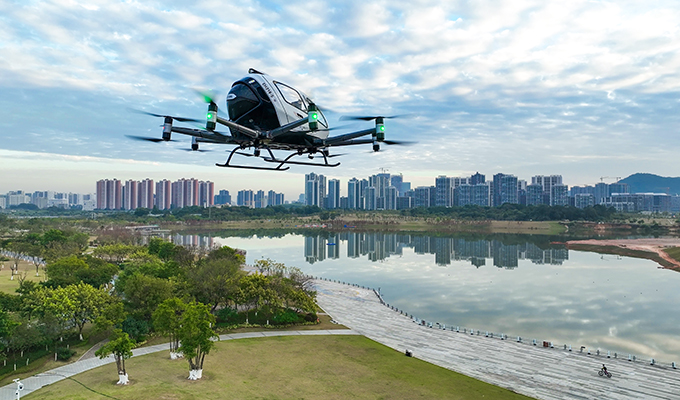
China is systematically building a new economic frontier in the airspace below 3,000 meters, a sector officially termed the "low-altitude economy." Projections indicate this market will surge from RMB 506 billion in 2023 to over RMB 1.06 trillion by 2026, a staggering growth trajectory. At the heart of this expansion is the commercialization of electric vertical takeoff and landing (eVTOL) aircraft for Urban Air Mobility (UAM). EHang Holdings Limited has emerged as the undisputed frontrunner, becoming the first company globally to secure the complete set of regulatory approvals—Type Certificate (TC), Production Certificate (PC), and Airworthiness Certificate (AC)—for its EH216-S pilotless passenger eVTOL, effectively unlocking the door to large-scale operations.
Regulatory Certainty as a Competitive Moat
The key to EHang's multi-year lead over Western competitors like Joby Aviation is not just technology, but regulatory velocity. The Civil Aviation Administration of China (CAAC) has established a clear, albeit rigorous, pathway to commercialization. Securing the TC validated the EH216-S's design, the PC authorized its mass production, and the AC confirmed individual aircraft are safe to fly. The final piece, the Air Operator Certificate (OC) granted in March 2025, serves as the ultimate green light, permitting EHang's partners to sell tickets and conduct commercial sightseeing flights. This comprehensive certification suite provides a level of operational certainty that remains years away for competitors navigating the Federal Aviation Administration (FAA) or European Union Aviation Safety Agency (EASA) frameworks.
Technology Designed for the Mission
The EH216-S is a multirotor eVTOL, a design choice that prioritizes simplicity, stability, and control over the high speeds and long ranges offered by more complex lift-and-cruise or vectored-thrust designs. With a maximum speed of 130 km/h and a range of 35 km, it is purpose-built for short-hop urban tourism and air taxi routes. While competitors focus on inter-city travel, EHang's strategy targets the immediate, commercially viable applications within dense urban cores. The CAAC's creation of "Special Conditions" for this novel aircraft, covering everything from data link redundancy to flight envelope protection, further legitimized its pilotless design on the global stage, with the standards being presented to the International Civil Aviation Organization (ICAO).
Building a Digital Sky
To manage an airspace potentially filled with tens of thousands of simultaneous Unmanned Aerial Systems (UAS), the CAAC is implementing a foundational digital infrastructure. Effective May 1, 2026, two mandatory national standards will come into force, requiring all civil unmanned aircraft to have real-name registration and to actively transmit identification information. This framework is not a barrier but an enabler of scale, creating a monitored and orderly environment where UAM services can safely coexist with other air traffic. This preemptive move to establish a robust digital backbone for the low-altitude economy is a critical strategic step that other nations are only beginning to contemplate.
The Civilian Spillover: From Blueprint to Urban Reality
The commercial rollout is being actively fostered through strategic city-level partnerships. Hefei and Guangzhou have become pioneering demonstration zones, translating policy into tangible infrastructure. In Hefei's Luogang Central Park, a dedicated UAM Hub has been constructed, capable of supporting up to 20 EH216-S aircraft with facilities for ticketing, maintenance, and operations. This physical infrastructure is backed by formidable financial support; Guangzhou’s Huangpu district offers up to RMB 30 million for eligible low-altitude projects, complemented by a RMB 10 billion venture capital fund dedicated to seeding the entire industry ecosystem. This fusion of infrastructure and capital is accelerating the transition from test flights to routine public services.
Quantifying the Urban Air Market
The addressable market for these new services is immense. Internal scenario analysis reveals a significant latent demand within China. Capturing just a 5% penetration rate in the aerial tourism market would require an estimated 6,288 eVTOL units. The air taxi market is even larger; achieving a modest 2% penetration rate for urban commuting would necessitate a fleet of over 91,800 aircraft. These figures underscore the economic imperative behind China's push, transforming UAM from a niche concept into a potential pillar of urban transportation infrastructure and a high-value manufacturing sector.
Forecasting the Flight Path to Profitability
With its regulatory hurdles cleared and a significant order backlog, EHang is positioned for exponential growth. Financial forecasts predict shipment growth of 100% year-over-year in 2025, followed by another 50% in 2026. This surge in production is expected to drive economies of scale, pushing gross margins above 60% and enabling the company to achieve net profitability by 2026. While global aerospace giants and automotive players continue to invest heavily in their own eVTOL programs, EHang’s certified, commercially operating platform in a protected and supportive home market gives it a formidable advantage that will be difficult for international rivals to overcome in the near term.
Ultimately, China’s strategy represents a holistic, state-guided approach to creating an entirely new industrial sector. By aligning national regulation, municipal investment, and a domestic technology champion, the country is not merely participating in the UAM race—it is actively defining the track. The successful commercialization of the EH216-S is the first major step, but the broader implication is the creation of a scalable blueprint for the low-altitude economy that could become the global standard for integrating the skies into the fabric of daily urban life.