AlphaGenome 2 Traces DNA Changes to the Cells Where They May Matter
DeepMind's new model gives geneticists a more precise way to investigate how a DNA variant changes gene activity. An immune-cell benchmark shows a substantial gain in candidate recovery, with experimental confirmation still central to the work ahead.
Published November 12, 2026Analysis / Artificial Intelligence / Predictive Analytics
Google DeepMind has released an artificial intelligence model that could help researchers follow a disease-linked change in DNA to the cell types where it may alter gene activity. AlphaGenome 2, announced November 11, predicts how a DNA sequence behaves in a specified cell type or biological state, giving scientists a way to narrow the search from a stretch of genetic code to a testable biological explanation. [1]
A statistical association directs attention to a genomic region. Turning that lead into a drug-discovery program usually requires a more specific account of the genes, cells and processes involved. A stronger prediction could help a laboratory decide which mechanism to test first.
The problem begins with how cells use DNA. Gene expression is the process through which genetic information produces ribonucleic acid (RNA), a molecule that carries instructions and performs other cellular jobs, and often proteins. Different cells regulate that production differently, and their activity changes with their circumstances. A DNA change can therefore have sharply different consequences depending on where and when it is read. [2]
AlphaGenome 2 makes that context an explicit part of the question. A researcher supplies DNA together with a selected tissue, cell type or cell state. The model predicts molecular activity under that condition. DeepMind says its training incorporated more than 100 million individual cell profiles across 68 tissues. [1]
Following the biological instructions
The first AlphaGenome, introduced in 2025, brought together predictions of several processes involved in gene regulation. It could examine about a million DNA letters at once, compare a reference sequence with an altered version, and estimate changes in measurements such as RNA production and the accessibility of DNA to cellular machinery. That long view helps encompass regulatory elements located far from the genes they influence. [3]
AlphaGenome 2 changes how researchers specify the biological setting. Its documentation describes a sequence of choices: select a condition, identify a genomic region and variant, then inspect predicted activity or variant scores. Each call concerns one condition; comparisons across cells come from running or batching those conditions together. The user can also provide gene-activity measurements from their own cells, enabling the model to work with a newly observed state. [4]
This creates a practical experiment-planning tool. A laboratory investigating an immune response could compare a candidate DNA change across relevant cell types, examine which gene shows the strongest predicted effect, then choose a focused experiment. The value would come from making those choices more productive. Establishing that value will require studies that follow predictions through laboratory validation.
Sarah Teichmann, a co-founder of the Human Cell Atlas and a professor at the University of Cambridge, highlighted the model's ability to adapt “directly to new single-cell data without retraining” in DeepMind's announcement. [1]
What the benchmark measures
In the team's research preprint, AlphaGenome 2 recovered 30% of the benchmark's putatively causal variant–gene–cell-type associations in the TenK10K immune-cell test at 90% precision, compared with 16% for a single-cell-tuned version of AlphaGenome 1. The evaluation pooled 28 cell types and paired 6,346 positive examples with 6,346 matched controls. [5]
Recall measures how many positives a method finds. Precision measures how many of its positive calls are correct against the benchmark labels. The result means a larger set of promising candidates at the same high-precision operating point in this matched test. The percentages describe recovery of labeled variant–gene–cell associations in a research benchmark. Diagnostic performance and the share of patients receiving a causal explanation would each require a separate clinical study.
Fine-mapping estimates which variants are likely causal from genetic evidence. AlphaGenome 2’s larger yield at the same precision threshold gives researchers more candidates to investigate. The benchmark supports using the model to prioritize research, while validation determines which predictions hold up biologically.
An example from bowel disease research
Genome-wide association studies compare genetic variation across large groups of people to find links with diseases or traits. These studies establish statistical associations. Following them toward a causal explanation requires additional work on the implicated variants and their biological effects. [6]
DeepMind's worked example concerns an inflammatory-bowel-disease association on chromosome 21. Seven nearby DNA variants were plausible candidates after statistical fine-mapping. The strongest statistical candidate differed from the variant that experimental researchers had previously implicated. AlphaGenome 2's tutorial scores the candidates across seven intestinal immune-cell conditions. [7]
The model favors the experimentally implicated variant, rs2836882, and links it to ETS2, a gene roughly 289,000 DNA letters away. It predicts the clearest effects in macrophages and monocytes, two related kinds of immune cell. That combination recovers the central relationship established in earlier laboratory research: a regulatory change, a distant target gene and a particular immune lineage. [7]
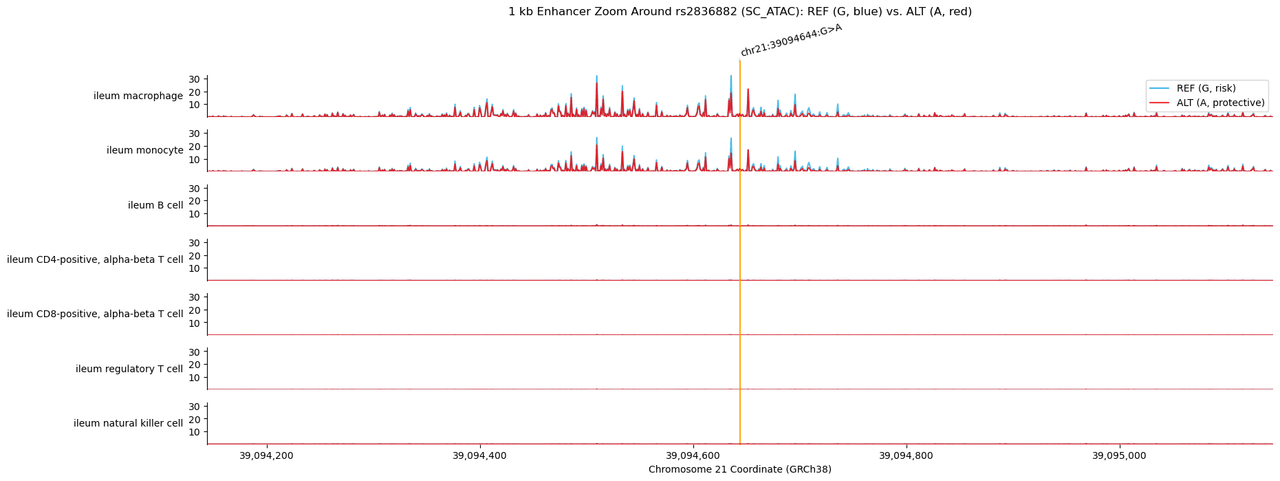
AlphaGenome 2’s published tutorial compares predicted chromatin accessibility for two versions of rs2836882 across ileum immune-cell conditions. These are model predictions. Credit: Google LLC / Google DeepMind, AlphaGenome documentation, “Fine-mapping the ETS2 locus”; CC BY 4.0. Reproduced without alteration.
The example connects a DNA variant with a gene some distance away and with the immune cells where its effect is strongest. For a laboratory, a useful result joins the candidate variant to a mechanism and a place to test it. Recovering an established explanation is a valuable check; prospective experiments on newly nominated mechanisms would provide stronger evidence of discovery value.
From predictions to experiments
DeepMind describes AlphaGenome 2 as available for non-commercial research through its application programming interface (API), with commercial research in private preview. The release is accompanied by a preprint and tutorials. The original AlphaGenome's Nature publication belongs to the earlier model. [1,3,8]
The documentation also distinguishes the evidence behind different outputs. Some predicted measurements correspond to data used during training. Others fill in a measurement using information from another assay. A further category is explicitly exploratory. Researchers need to preserve those labels when interpreting or communicating a result. The published usage terms limit direct API outputs to research use. [9]
The authors identify several priorities for further research. At high precision, the model currently recovers a minority of relevant variants. Training data represent transient, stimulated and disease states sparsely, and the model has difficulty distinguishing some closely related cell populations. Its cell-state representations come from observational profiles; the ability to predict responses to deliberate gene perturbations remains an open research question. [5]
For drug discovery, the next meaningful milestone is whether cell-specific predictions consistently help laboratories choose better experiments and uncover reproducible mechanisms. Evidence would include successful validation across independent datasets, tissues and disease settings, followed by a clear account of how often predicted targets prove useful.
AlphaGenome 2 gives researchers a more detailed starting point for that work. Its promise rests on more precise comparisons of a variant's predicted effects across cells, helping researchers choose where to investigate next.
Sources
Google DeepMind, November 11, 2026: AlphaGenome 2 announcement.
National Human Genome Research Institute: Gene expression.
Google DeepMind: AlphaGenome's original release and January 2026 publication update.
AlphaGenome documentation: Getting started.
Gayoso and colleagues, November 2026 preprint: AlphaGenome 2 predicts regulatory activity and variant effects across cell states, especially Figure 2, Discussion and single-cell QTL methods.
National Human Genome Research Institute: Genome-wide association studies.
AlphaGenome documentation: Fine-mapping the ETS2 locus.
AlphaGenome official community announcement, November 11, 2026: Release and preprint status.
AlphaGenome documentation: FAQs, output categories and research-use terms.
Sources · 9
- https://deepmind.google/blog/alphagenome-2-deciphering-how-cells-read-dna-to-better-understand-disease/
- https://www.genome.gov/genetics-glossary/Gene-Expression
- https://deepmind.google/blog/alphagenome-ai-for-better-understanding-the-genome/
- https://www.alphagenomedocs.com/getting_started.html
- https://storage.googleapis.com/deepmind-media/DeepMind.com/Blog/alphagenome-2-deciphering-how-cells-read-dna-to-better-understand-disease/alphagenome-2.pdf
- https://www.genome.gov/genetics-glossary/Genome-Wide-Association-Studies-GWAS
- https://www.alphagenomedocs.com/colabs/v2/finemapping_ets2.html
- https://www.alphagenomecommunity.com/t/alphagenome-2-predicting-regulatory-activity-and-variant-effects-across-cell-states/1008
- https://www.alphagenomedocs.com/faqs.html